
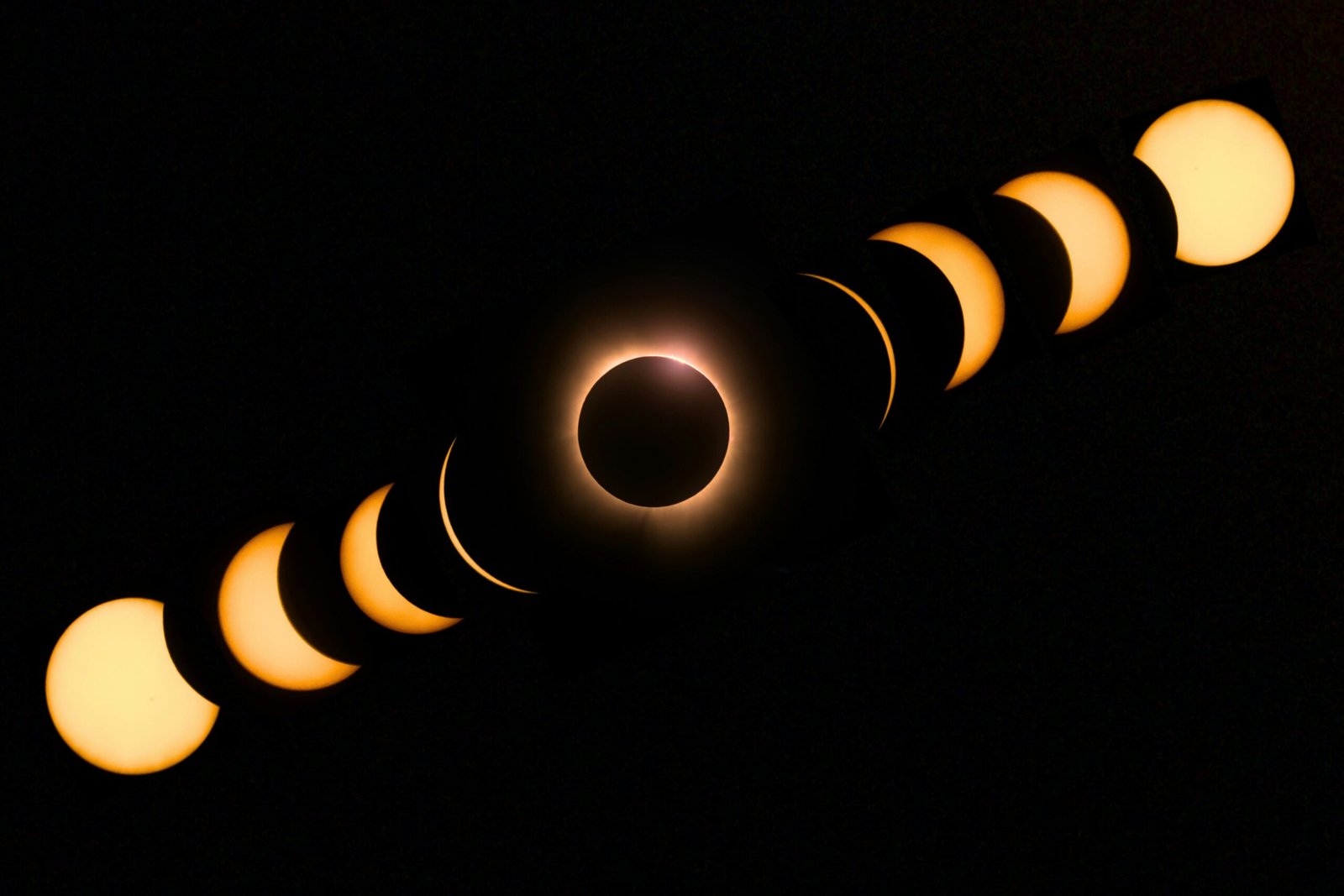
The first eclipse of 2026 is scheduled for February 17 (Tuesday). Known as “Ring of Fire”, the phenomenon receives its nickname because it forms a pattern in the sky when the Moon covers most of the Sunleaving only a luminous ring around it visible.
An annular solar eclipse occurs when the Moon is positioned between the Sun and the Earth while it is at its apogee – the point at which the natural satellite is furthest from the planet. In this configuration, a ‘circle of fire’ forms in the sky.
The eclipse will begin with the partial phase at 9:56 am (Brasília time). The annular phase begins at 11:42 am, with the maximum of the phenomenon predicted for 12:12 pm. The event ends at 2:27 pm, when the partial phase of the eclipse ends.
It is worth noting that the phenomenon should not be observed with the naked eye, and the use of protective equipment is essential for safe observation. This is because solar radiation can cause permanent eye damage when looked at directly.
Will the first eclipse of 2026 be visible in Brazil?
No, the eclipse scheduled for February 17th will not be visible from Brazil. The phenomenon can be effectively contemplated in Antarctica and partially in regions of Africa and the extreme south of South America.
However, this year the “Blood Moon” will take place, a phenomenon that can be observed from Brazil. According to NASA’s official website, in this type of eclipse “the Moon moves into the inner part of the Earth’s shadow, or umbra. Some of the sunlight that passes through the Earth’s atmosphere reaches the Moon’s surface, illuminating it dimly. Colors with shorter wavelengths — such as blue and violet — disperse more easily than colors with longer wavelengths, such as red and orange. Because these longer wavelengths are able to pass through the Earth’s atmosphere, and the The shorter wavelengths disperse, the Moon takes on an orange or reddish hue during a lunar eclipse. The more dust or clouds there are in the Earth’s atmosphere during the eclipse, the redder the Moon will appear.
Therefore, If you want to observe an eclipse from Brazil, it’s worth paying attention to March 3, 2026. At the beginning of March, the “Blood Moon” will light up the Brazilian sky.
Calendar of all eclipses that will happen in 2026
- February 17th: partial solar eclipse (not visible in Brazil);
- March 3: total lunar eclipse (visible in some states in Brazil);
- August 12: total solar eclipse (not visible in Brazil);
- August 27-28: partial lunar eclipse (visible throughout the country).
