
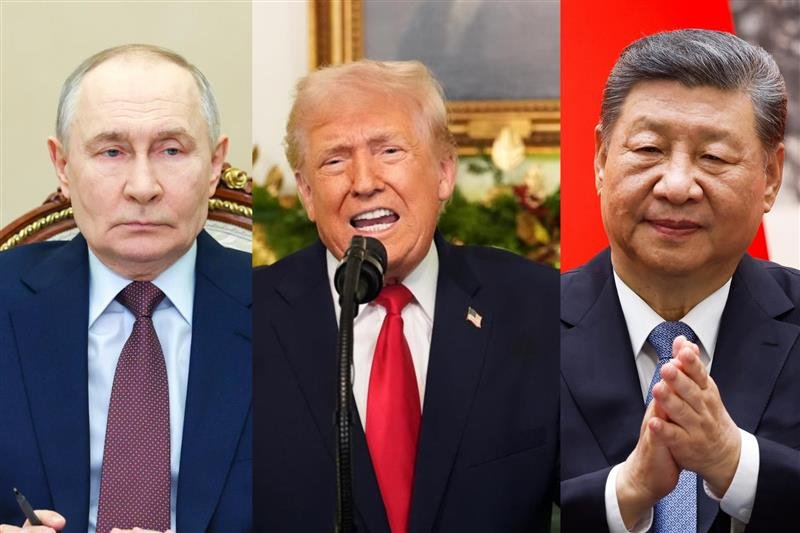
The last nuclear disarmament treaty in force between the USA and Russia, Start III or New Start (Strategic Nuclear Weapons Reduction Treaty, in Portuguese), expired this Thursday (5), with no confirmation of progress on a new agreement between American President, Donald Trump, and Russian dictator, Vladimir Putin.
With this, the world enters a new period of uncertainty, marked by the growing fear of countries and international organizations of seeing a new arms race emerge, not between two, but between the three main military powers in the world: USA, Russia and China.
In force since 2010, the treaty aimed to limit the nuclear arsenal of Moscow and Washington, especially in relation to the number of strategic nuclear weapons that could be deployed and maintained in readiness by both (a maximum of 1,550 nuclear warheads and 700 ballistic missile systems for each of the two powers, whether launched by land, sea or air). In February 2021, New Start was renewed for another five years.
Moscow even presented an offer to extend the agreement for a year, but Trump ignored the appeal on the grounds that China should participate in any ongoing nuclear negotiations, something that Beijing rejects because it claims it does not have an arsenal comparable to the other two powers.
The USA and Russia hold 87% of the world’s nuclear weapons, while China, the United Kingdom, France, India, Pakistan, North Korea and Israel complete the list of countries with nuclear arsenals. But China, in particular, has become a concern for the American government due to the rapid expansion of its nuclear arsenal and the prediction that, within a decade, it could have 1,500 nuclear warheads.
Despite Donald Trump’s pressure for Xi to also sign a containment treaty, there is still speculation about a renewal of New Start. This Thursday, three sources familiar with the matter told the portal Axios that American and Russian delegations would be negotiating an extension of the treaty.
Could the end of nuclear arms control trigger a new arms race?
According to the American think tank Center for Strategic and International Studies (CSIS), the expiration of the bilateral treaty does not immediately mean that countries will begin a new arms race as occurred in the Cold War.
This will directly depend on the actions adopted: if a power takes the initiative to increase its arsenal, then a cycle of action and reaction will begin and the other party will also feel obliged to expand its power. But this cycle may be limited by national budget constraints and other priorities on the powers’ geopolitical agenda.
A compilation of data from the Strategic Risks Council (Council on Strategic Risksin English) exposed an asymmetry between the expansion of American, Russian and Chinese nuclear arsenals over the last 13 years.
According to the survey, Moscow expanded its number of nuclear-capable systems by 22% on average, including a 20% increase in the number of nuclear-armed submarines and submarine-launched ballistic missiles (SLBMs). The increase in the arsenal is related to non-strategic nuclear weapons.
Beijing, for its part, has shown even faster growth, increasing the number of intermediate-range ballistic missiles by 635% and adding new types of strategic and non-strategic launch vehicles.
Washington has already reduced its arsenal of submarine-launched ballistic missiles (SLBMs) by 17%. While the Chinese Army recorded an 88% increase in its intercontinental ballistic missile (ICBM) force, the US decreased by 11% over the duration of New Start.
The data shows that Russia is already investing heavily in its strategic arsenals, well before the expiration of the bilateral agreement with the Americans. China, which is not party to the treaty, has also drastically expanded its military resources.
Russia has violated or abandoned several arms control agreements
Since 2010, when the nuclear treaty was signed, Russia has violated, suspended or abandoned several important arms control agreements. Two of them are recent: in 2022, Moscow suspended inspection activities under New Start, one of the strategic benefits of transparency and predictability in relation to adversaries’ arsenals; in 2023, it suspended participation in New Start and withdrew ratification of the Comprehensive Nuclear-Test-Ban Treaty.
Last year, Putin made a narrower proposal to the U.S.: The country would continue to observe New START’s key quantitative restrictions for a year after its expiration, as long as the U.S. refrained from measures that could undermine the “existing balance of deterrence,” an apparent reference to Trump’s proposed Golden Dome missile defense system.
Dictator Putin’s offer to extend the agreement did not include the return of inspections or other transparency measures associated with the treaty, which calls into question his alleged intention to maintain the limits on the non-proliferation of nuclear weapons.
In the CSIS analysis, these actions by Russia and China signal a growing dependence on nuclear weapons by US adversaries, particularly for regional ambitions to intimidate American allies and partners and try to create a rift between them and Washington.
New security priorities and budget deficits change the powers’ agenda
The International Institute for Strategic Studies (IISS), a British research think tank, highlights that the US and Russia currently have parity in numbers and systems.
The broader geopolitical security picture and efforts to facilitate an end to the war in Ukraine could contribute to maintaining the status quo in relation to an arms race. In short, Putin may continue to seek to maintain good relations with Trump in order to recover economically.
The financial situation of the countries also signals that the powers would not be willing to invest heavily in nuclear weapons. Russia, for example, ended 2025 with a budget deficit of 2.6% of GDP and drastically reduced oil and gas revenues due to its war against Ukraine and international sanctions.
The US, on the other hand, appears to be much more interested in building defenses against nuclear missiles than in deploying more of them. This was evident with the executive order signed by Trump in early 2025 advocating the construction of the Golden Dome, which could cost trillions of dollars in the coming years.
Neither party to the latest nuclear treaty appears prepared or interested in making massive investments to significantly expand their nuclear arsenals.
China and the three scorpions theory
China, in turn, is increasingly arousing international concern due to little-publicized military activities. An investigation by the non-profit organizations Open Nuclear Network (ONN) and Verification Research, Training and Information Center (Vertic) last year revealed through satellite images how the Asian giant is secretly advancing its production of nuclear warheads.
According to The Washington Post, Beijing is rapidly revamping a network of facilities used to manufacture nuclear components. Due to the alarming situation, the US seeks to include China in the international dialogue on the issue.
Nuclear strategy experts warn that China’s entry as the third major atomic power breaks the logic that sustained stability during the Cold War. At the time, the balance was likened to two scorpions trapped in a bottle — each capable of killing the other, but held back by the risk of mutual destruction.
With three relevant nuclear powers, this model may no longer work. Political analyst Andrew F. Krepinevich Jr explained, in an article for Foreing Affairs published in 2022, that the so-called “three scorpions theory” describes a more chaotic system, in which each country needs to protect itself simultaneously from two adversaries, increasing the risk of miscalculation and escalations in times of crisis.
“In a world with a three-pole nuclear system there will be both an increased risk of a nuclear arms race and increased incentives for countries to resort to nuclear weapons during a crisis,” Krepinevich wrote.
