
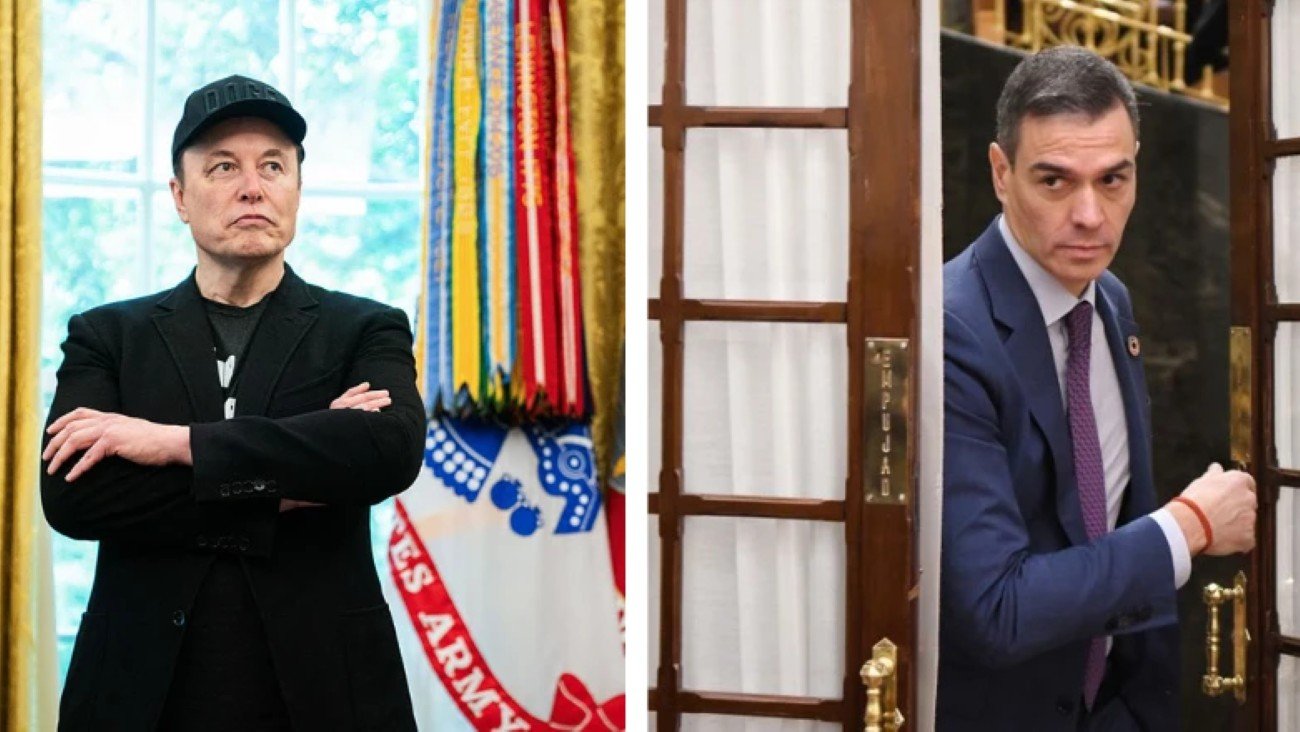
Musk attacked Sánchez after the announcement that Spain will ban networks for under-16s Getty Images via BBC American businessman Elon Musk entered Spanish politics this week with an unexpected series of attacks on Spanish Prime Minister, socialist Pedro Sánchez. Musk classified Sánchez as a “tyrant”, “traitor of the Spanish people” and “fascist” in several messages published on his social network, X. He also referred to the Spanish Prime Minister as “sucio Sánchez” (“dirty Sánchez”, in free translation) and placed the feces emoji next to the politician’s name. The attacks occurred after Sánchez’s announcement that Spain will prohibit access to social networks by minors under 16 and will promote changes in the law so that executives of companies that own these platforms are criminally liable for illegal content published on them. READ MORE: Spanish Prime Minister responds after Musk calls him a tyrant and traitor See what countries are doing to regulate children’s access to networks See the videos that are trending on g1 Musk was not the only businessman in the sector to make public criticisms. This Wednesday (4/2), Pvel Durov, founder of the messaging app Telegram, accused Sánchez of promoting “dangerous regulations” capable of leading to the creation of a “surveillance state” in Spain. The accusations were published on Telegram. Sánchez responded to this last comment on What Pedro Sánchez announced At an international event held this week in Dubai, the Spanish Prime Minister announced that Spain will ban access to social networks for children under 16, who will now be required to implement effective systems to verify the age of users. Sánchez said that “social networks have become a failed state, in which laws are ignored and crimes are tolerated”, and promised that his government will protect minors in the “digital Wild West”. The Spanish Prime Minister also stated that, among other measures, legal reforms will be promoted so that platform executives are legally responsible for violations committed on them. “This means that tech platform CEOs will face criminal liability if they fail to remove hateful or illegal content.” “Social networks, their companies, are richer and more powerful than many countries, including mine. But their power and influence should not frighten us, because our determination is greater,” declared Sánchez. The publication of the video of Sánchez’s speech in Dubai led to a reaction from Musk, who published and shared several messages on The Spanish government was the most recent to announce measures to protect minors from the risks of social media Getty Images via BBC Europe against the networks The clash between Sánchez and Musk comes at a time when a growing number of European countries are beginning to adopt measures to contain abuse on social media and protect minors from excessive or harmful exposure. Based on the example of Australia, a pioneer in prohibiting access to social networks for children under 16, France, the United Kingdom and others are discussing laws in the same direction. On the same day that Musk criticized Sánchez on X, the French police carried out searches at the headquarters of the social network OX was forced to disable a function of its Grok tool, which allowed users to obtain nude images generated by artificial intelligence from photographs of real people, after days of international controversy and Musk’s initial refusal to do so. The Digital Services Law approved by the European Union also expanded the requirements and requirements imposed on companies that own social networks, especially those controlled by US technology giants, such as X and Meta. The government of American President Donald Trump criticized the measures adopted in Europe as an attack on freedom of expression, a criticism that Musk also repeated and which contributed to the growing distance between the US and its European allies. Musk publicly supported European radical right-wing parties, which compete for space with forces such as Pedro Sánchez’s Spanish Socialist Workers’ Party (PSOE) and the left-wing formations that make up his government coalition. Sánchez has been one of the most critical European leaders of social media and its billionaire owners, whom he often refers to as “the technocaste.” “Europe must confront and rebel against this threat to democracy,” Sánchez said in January last year. The controversy over the regularization of immigrants A few days earlier, Musk and Sánchez had already exchanged messages on social media due to the decision recently adopted by the Spanish government to regularize hundreds of thousands of immigrants in an irregular situation in the country. The Spanish Minister of Inclusion, Social Security and Migrations, Elma Saiz, defended the extraordinary regularization of immigrants as “necessary to respond to the reality that exists on our streets” and stated that the measure seeks to “recognize, dignify and offer guarantees, opportunities and rights to people who are already in our country”. The open-door immigration policy promoted by the Sánchez government has attracted attention on the international scene, at a time when the US and several European countries are adopting increasingly restrictive measures. Musk, who was born in South Africa, who obtained Canadian citizenship through his Canadian mother and became a naturalized American in the early 2000s (according to his biographies), was also one of the critics of the regularization of immigrants announced by the Sánchez government. Musk shared with his 233 million followers on X a video by Malaysian political commentator Ian Miles Cheong, in which Sánchez is accused of approving regularization to “defeat the radical right.” “The logic is simple: legalize half a million people, accelerate their access to citizenship,” said Cheong’s video, shared by Musk with the comment: “Wow.” Sánchez responded to this last message from Musk with another, in which he stated: “Mars can wait. Humanity cannot.” The Spanish Prime Minister makes references to Musk’s plans to colonize Mars. The main Spanish opposition parties have taken a stand against the most recent regularization of immigrants promoted by the Sánchez government, described by the radical right of Vox as “the murder of Spain” and an “invasion”. The measure was also criticized because the government approved it without going through Parliament, where it did not have the necessary support. Sánchez’s government and the social organizations that support the initiative maintain that it will serve to guarantee rights to people who already contribute to the good economic moment experienced by the country and will allow for the expansion of formal employment and, as a consequence, tax collection. There are several factors involved in the Spanish decision, such as economic perspectives, cultural ties (between Spain and Latin America) and the political composition of the Spanish government. According to experts interviewed by BBC News Mundo (BBC Spanish service), the regularization of immigrants in Spain will favor, for example, the formalization of employment and public revenue in the short term by reducing the informal economy, while, in the medium term, it should guarantee greater sustainability to the pension system, which is increasingly pressured by demographic aging. Additional reporting by Atahualpa Amerise
Source link
‘Tyrant’ and ‘traitor of the people’: what’s behind Elon Musk’s attacks on the Prime Minister of Spain
57

previous post