
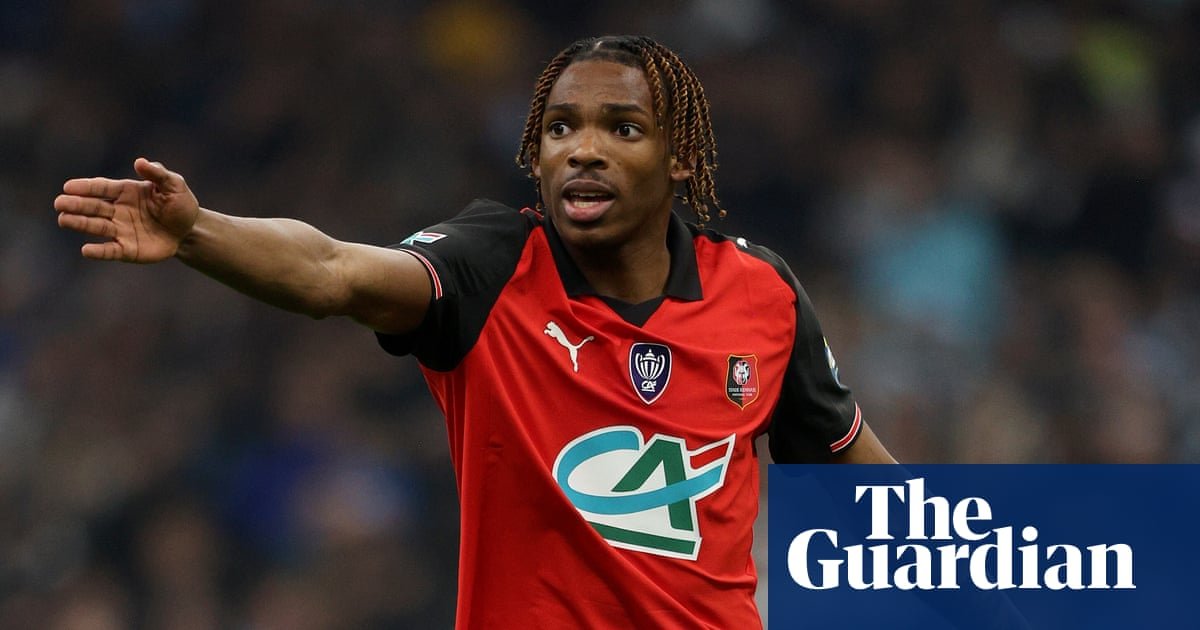
When you miss 18 months of football, there is a natural eagerness to make up for lost time. Jérémy Jacquet has certainly done that. This time last year Rennes recalled him from a loan spell at Ligue 2 side Clermont Foot and now he has been signed by Liverpool for £60m.
The conditions were always ripe for Jacquet to succeed at Rennes, a club known for developing talent. But even by their standards, the 2005 generation is something special. Désiré Doué, Mathys Tel, Jeanuël Belocian, Lesley Ugochukwu and, come the summer, Jacquet will have all left Rennes, but not before pushing each other to greater heights during their formative years.
However, Jacquet’s growth was stunted in his teenage years, albeit not literally. The defender grew by 10cm in a year, which was not without its complication. For 18 months, Jacquet hardly played and required surgery to remove the end of a cartilage. “For Jérém, it was growth injuries, Osgood-Schlatter, things like that. You know you’re going to lose time,” recalls Laurent Viaud, his manager at under-19s level.
As it transpires, those injuries gave Jacquet fresh momentum. “When he came back, he wanted to eat everything up,” says Viaud. “It was bordering on us having to slow him down because we had to manage him because otherwise, at some point, he was going to explode. The day young players come back from injury they have a desire to grow because they know what it’s like to be off the pitch, out of training. Suddenly, they forge a mentality that may be better than that of those who were permanently on the pitch.”
Rennes were also relieved to see Jacquet had not lost any of his technical gifts. “Their bodies change, they may become less coordinated – that’s where you have a doubt,” says Viaud. But that was not the case for Jacquet, who was already considered a “complete” defender – bestowed with “speed, aggression, a strong heading game, and above all, technical quality”. He honed his technique while playing in midfield at a young age. When he first arrived at the club, he was profiled as a defensive midfielder and took inspiration from Paul Pogba. “I always wanted to play like him,” Jacquet told The Team. The influence is evident in Jacquet’s expansive and ambitious – sometimes overly ambitious – passing game.
Jacquet was initially opposed to playing deeper but he gave in to his coaches. “They knew football better than me at that point,” admitted Jacquet, who has developed as a defender while maintaining the football IQ of a midfielder. “Where he has really advanced is in his reading of the situation and reading of the trajectory of the ball,” says Viaud. He has improved with experience, with his loan spell at Clermont Foot – where Jacquet says his career “started” – crucial.
“It’s off the pitch where we saw the difference,” says Viaud, noting the difference between the Jacquet who left Rennes and the one who returned. “Here in Rennes, our boys are in a cocoon. He saw what Ligue 2 was, what a training centre was in Ligue 2. And yet at Clermont, they don’t have a bad training centre, but he saw the training conditions you can have. In Rennes, we are extraordinarily lucky.”
His performances in Ligue 2 impressed to the extent that, last February, Rennes paid nearly €1m to bring back the defender early. The fee made Jacquet the 17th-most expensive departure in Clermont’s history but the club’s manager, Laurent Batlles, was desperate to keep the young defender.
It was clear that Jacquet would play a role in the second part of the season at Rennes, but what wasn’t foreseeable was how important he would become in Habib Beye’s side. Despite Anthony Rouault and Lilian Brassier both arriving for a combined cost of €25m that month, Jacquet became indispensable, starting 11 of Rennes’ 14 remaining league games and instigating a rise up the table.
That has continued this season, with Jacquet playing every game but for two he missed due to suspension. Abdelhamid Aït Boudlal, an exciting Moroccan 19-year-old, has joined him in the team at centre-back, giving Jacquet a more senior role. “I have to be more of a presence in the dressing room and on the pitch,” he says. Charged with greater responsibility, his level has remained high, even if there are still weaknesses. While he is impressive on the ball, he admits that he can be “nonchalant” at times. But at his age, it is better to play with confidence than with fear of losing the ball, and his ambition will serve him as he makes the step up to the Premier League next season.
And he will have leaders around him, not least in the form of Virgil van Dijk, one of the great defenders of the 21st century. Jacquet named the Netherlands international, as well as his centre-back partner Ibrahima Konaté, as an inspiration, and Viaud sees the Frenchman as the Dutchman’s natural “heir” – and he has an eye, given he worked as a scout for Liverpool during the Rafael Benítez era.
“I think the recruiters have seen in Jérém the heir to Van Dijk because in a lot of areas Jérém looks like him,” says Viaud. “I would almost say he is faster than Van Dijk. He has to learn from players like Van Dijk, but there is a lot of similarity between the two.” Viaud adds that any scout who failed to recognise Jacquet’s huge potential would be guilty of “professional misconduct”.
“I was from the generation of Marcel Desailly – I was at school with him. Jérém is Desailly on the defensive side and Laurent Blanc on the attacking side; he’s a mix of the two. When you see the careers the two of them had, honestly, I can’t imagine how far Jérém can go. He can really define his generation of defenders.” They are big shoes to fill, but Jacquet has already grown a lot – both physically and metaphorically. As Rennes’ record sale – above Ousmane Dembélé and Doué – he looks capable of filling them.
This is an article by Get French Football News
