
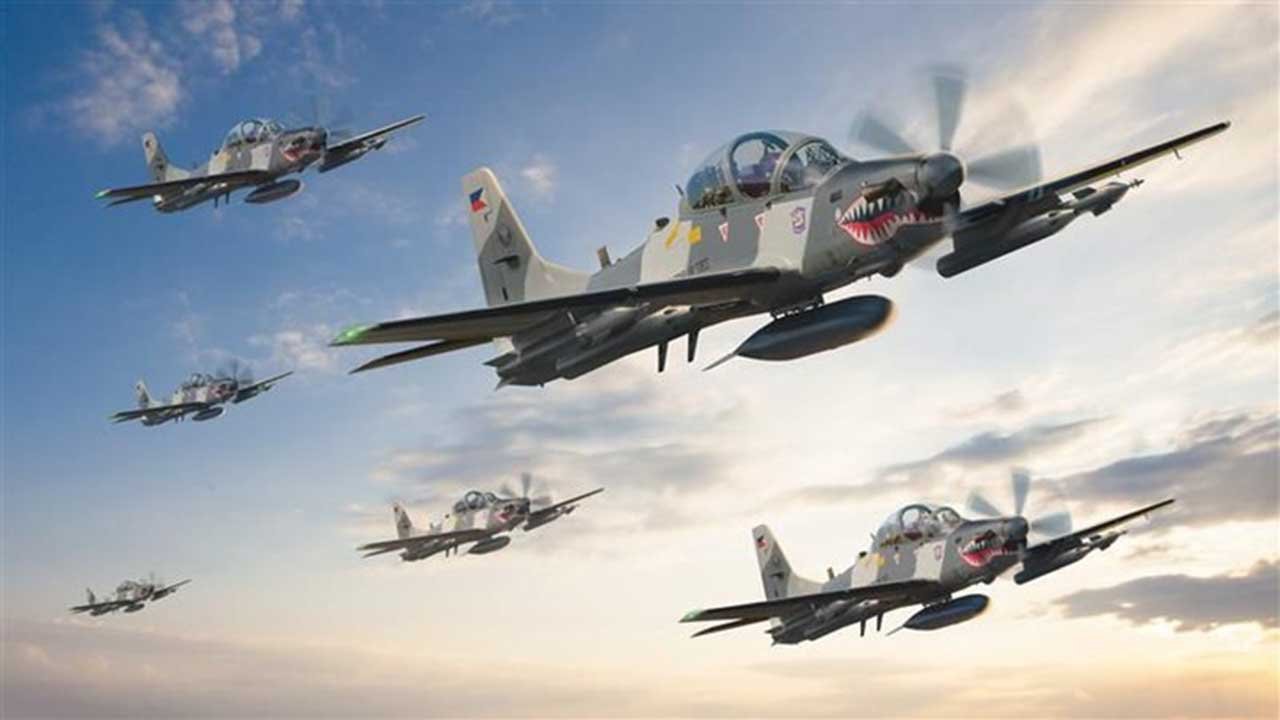
The Philippine Air Force has been confirmed as the customer behind a previously undisclosed order for six A-29 Super Tucano aircraft, as Embraer announced on February 3 at the Singapore Airshow.
With the new contract, the Philippine A-29 Super Tucano fleet will consist of 12 aircraft, taking into account the previous purchase of six aircraft. According to Embraer, the additional order is intended to expand the Air Force’s operational capabilities in missions such as close air support, light attack, surveillance, air interception and counterinsurgency operations.
The Brazilian manufacturer emphasized that the A-29 has been selected to meet continuous operational requirements in complex homeland security environments, where factors such as long-term presence, low operational costs and precise weapon deployment are considered essential. The contract value and delivery schedule were not disclosed.
Of A-29 Super Tucano is a turboprop aircraft for light attack and advanced training, widely deployed by air forces seeking a relatively cost-effective platform for irregular warfare, border security and homeland security. The model features a reinforced structure, armored protection and an integrated avionics system designed for operations in contested environments. Depending on the mission profile, it can deploy machine guns, missiles and precision-guided munitions.
In the case of the Philippines, the new aircraft are expected to strengthen existing units responsible for homeland security and maritime surveillance missions. The Philippine Air Force uses the Super Tucano as one of its primary counterinsurgency platforms, especially in remote areas with limited infrastructure, where jet aircraft are less suitable. The turboprop design allows operations from short or unpaved runways while maintaining a long dwell time over the operating area.
Embraer also indicated that the fleet expansion will contribute to better aircraft availability and operational tempo, while maintaining standardization in training, logistics and maintenance. This commonality reduces life cycle costs and simplifies support, a factor that has driven global adoption of the A-29.
The Philippines is part of a growing group of countries in the Asia-Pacific region deploying the Super Tucano, indicating a regional demand for light attack aircraft that can carry out kinetic missions as well as intelligence, surveillance and reconnaissance tasks.
Outside the region, the A-29 is also in service with countries in Latin America, Africa, the Middle East and other parts of Asia, with Embraer presenting the aircraft as a mature platform with a proven operational track record and international training and logistics support.
Source and images: Embraer. This content was created using AI and reviewed by the editorial team.
