
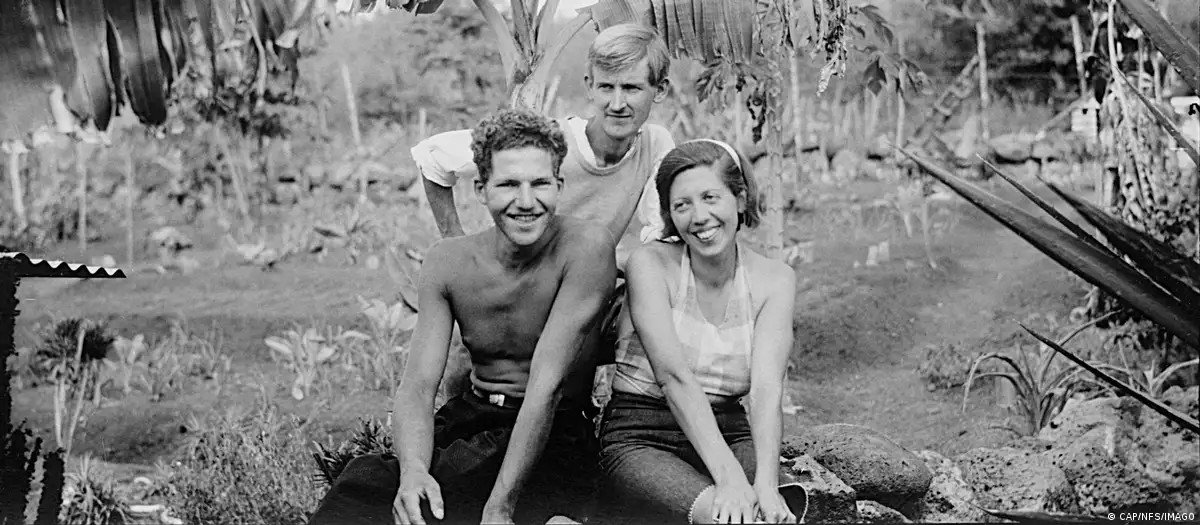
VIDEO: 14303262 The paradisiacal setting of the Galápagos Islands, off the coast of Ecuador, became the scene of true hell in the 1930s. At the time, a German doctor wanted to transform one of the islands in the archipelago into a utopian society. But the story ended in violence, unexplained deaths and mysterious disappearances. ✅ Follow the g1 international news channel on WhatsApp It all started with a forbidden love. Doctor Friedrich Ritter had fallen in love with one of his patients, Dore Strauch. The two were married, but they made the decision to flee Germany together. The context was one of global crisis, with the Germans still recovering from the First World War. The couple’s idea was to go to Floreana to apply ideas from the philosopher Friedrich Nietzsche and create an alternative way of life. According to American writer Abbott Kahler, who researched the story and wrote the book “Eden Undone: A True Story of Sex, Murder, and Utopia at the Dawn of World War II”, Ritter wanted to embody Nietzsche’s vision of the “Übermensch”, or “superman”. Nietzsche’s superman is someone capable of transcending conventional customs, behaviors, and thought patterns to create a superior system of values. According to Kahler, when planning to leave Germany, Ritter sought to escape civilization in a place that lived up to his dark Nietzschean dream. Dore, on the other hand, wanted to get rid of her husband, who was older and more conservative. “Floreana, a small island in the southern Galapagos, seemed like the perfect choice. Unlike many of the islands in the archipelago, it had at least one freshwater source. Ritter was eager to try growing a vegetable garden and living off the land,” he says. “Just as importantly, the island was not inhabited by humans. Several groups had tried to settle there before him, but they all failed.” The couple left Germany in 1929 to head to South America. According to Kahler, before the trip, Ritter and Dore removed their own teeth to avoid dental problems in their new home. Instead, they started wearing steel dentures. Friedrich Ritter and Dore Strauch, in Floreana, in the 1930s Allan Hancock Foundation Collection/USC Library Upon arriving in Floreana, the couple began working on building their own space. Soon, the story hit the press and spread around the world, with Ritter and Dore being nicknamed “Adam and Eve.” At the time, contact with the outside world occurred through ships that stopped at the island and carried letters from the couple. The curiosity aroused by the case, however, ended up undermining the utopian project, paving the way for the arrival of new residents, as well as conflicts and power struggles. In the following years, the sequence of events would end in the deaths of the German doctor and another man, in addition to the disappearances of a “baroness” and one of her lovers. The island of Floreana, in the Galápagos Thalita Ferraz/g1 Arrival of neighbors and ‘trisal’ In 1932, another German couple fascinated by the story of Floreana decided to follow in the footsteps of Ritter and Dore. Heinz and Margret Wittmer embarked on the adventure mainly out of concern for their family. According to Kahler, Heinz’s teenage son, from a previous marriage, had been in fragile health since birth. He believed that the tropical climate would be good for the boy. Margret dreamed of having children and, when she arrived at Floreana, she was four months pregnant. Reports from families indicate that the arrival of the new couple brought direct clashes on the island. The American writer states that there was resentment from the beginning of their coexistence. “Dore thought Margret was a fool for choosing to have a baby on a remote island, and Margret thought Dore was pretentious for quoting Nietzsche on a remote island,” he says. The Wittmer family on Floreana in the 1930s Allan Hancock Foundation Collection/USC Library But the problems really began when the self-proclaimed Austrian baroness Eloise von Wagner Bosquet — also known as “Crazy Panties” — decided to move to the island with two lovers. The arrival of the trisal shook up coexistence in Floreana once and for all. Kahler explains that the baroness was driven by fame and wealth. As soon as she arrived on the island, Eloise announced her intention to transform Floreana “into the next Miami” and attract American millionaires with the construction of a luxury hotel. The idea bothered the residents, as it was contrary to the utopian ideal of the doctor Friedrich Ritter. Furthermore, according to the writer, the baroness began to provoke the island’s inhabitants: she pitted her two lovers against each other, staging physical fights; stole objects from other families, including milk from the Wittmers’ newborn baby; made sexual advances to Dore and Margret’s companions. Also according to the BBC, the baroness also abused resources such as water and food administered by families and interfered in letters sent to the German press, always appearing at the center of the story. “She spread rumors about everyone and convinced tourists not to visit the other houses on the island. There was even a near-fatal episode involving a visitor who did not respond to the baroness’s advances”, says Kahler. “Even Ritter and Heinz, who couldn’t stand each other, put their differences aside and came together to try to stop the baroness. Of course, they weren’t as successful as they had hoped.” Baroness Eloise Wehrborn’s trisal CAP/NFS/IMAGO via DW Deaths and mysteries The mysteries in Floreana began on March 27, 1934, when the baroness and Robert Philippson, one of her lovers, disappeared. Kahler explains that to this day it is not known what happened to the baroness and her lover. Accounts recorded in books written by Dore and Margret about life on the island differ. Margret claimed that the baroness left Floreana on a ship bound for Tahiti. However, according to the BBC, investigations indicate that there are no records of vessels that could have made the trip during that period. Dore said he heard a scream the night before the baroness disappeared. She also stated that she did not see any ships pass by the island. “At some point, all the characters in the book lie — or at least omit truths. It was a lot of fun trying to figure out who was lying, when and why,” says the writer. After the baroness’ disappearance, her second lover, Rudolf Lorenz, left Floreana for the island of São Cristóvão. Months later, his body was found mummified in Marchena, also in the Galápagos. The island is in the opposite direction to where Lorenz said he would go. Still in 1934, Friedrich Ritter suddenly fell ill. A central figure at the beginning of Floreana’s story, the doctor would have eaten a contaminated chicken. An article in The New York Times reports that Ritter became “eating unwell and died within a few days.” In 2024, a report by the German agency Deutsche Welle pointed out that Ritter was supposedly a vegetarian and that there were signs of abuse against Dore, who was the one who served the chicken that allegedly caused the doctor’s death. Dore Strauch and Friedrich Ritter in Floreana, in 1932 The Galapagos Affair/Golden Globes/Reproduction After Ritter’s death, Dore returned to Germany and released the book “Satan Came to Eden”. A New York Times report, published in 1936, contained excerpts from the work. In the text, she states that she noticed that every trace of Friedrich’s tenderness towards her disappeared the moment they left the house. However, Dore says he has no regrets about the experience. “I believe that these islands are, in fact, one of those places on Earth where human beings are not tolerated,” he said, according to the NYT. Heinz and Margret Wittmer remained on the island and opened a family hotel. The establishment still operates today. Margret also released the book “Agência de Correios de Floreana: an extraordinary life of a woman at the end of the world”. “In the end, it all comes down to one simple truth: Every person on that island had a different definition of ‘utopia.’ And because of human failings, any kind of utopia is impossible,” says Kahler. VIDEOS: most watched on g1
Source link
‘Satan went to Eden’: how an island planned to be paradise was swallowed by mysteries and unexplained deaths
47
