
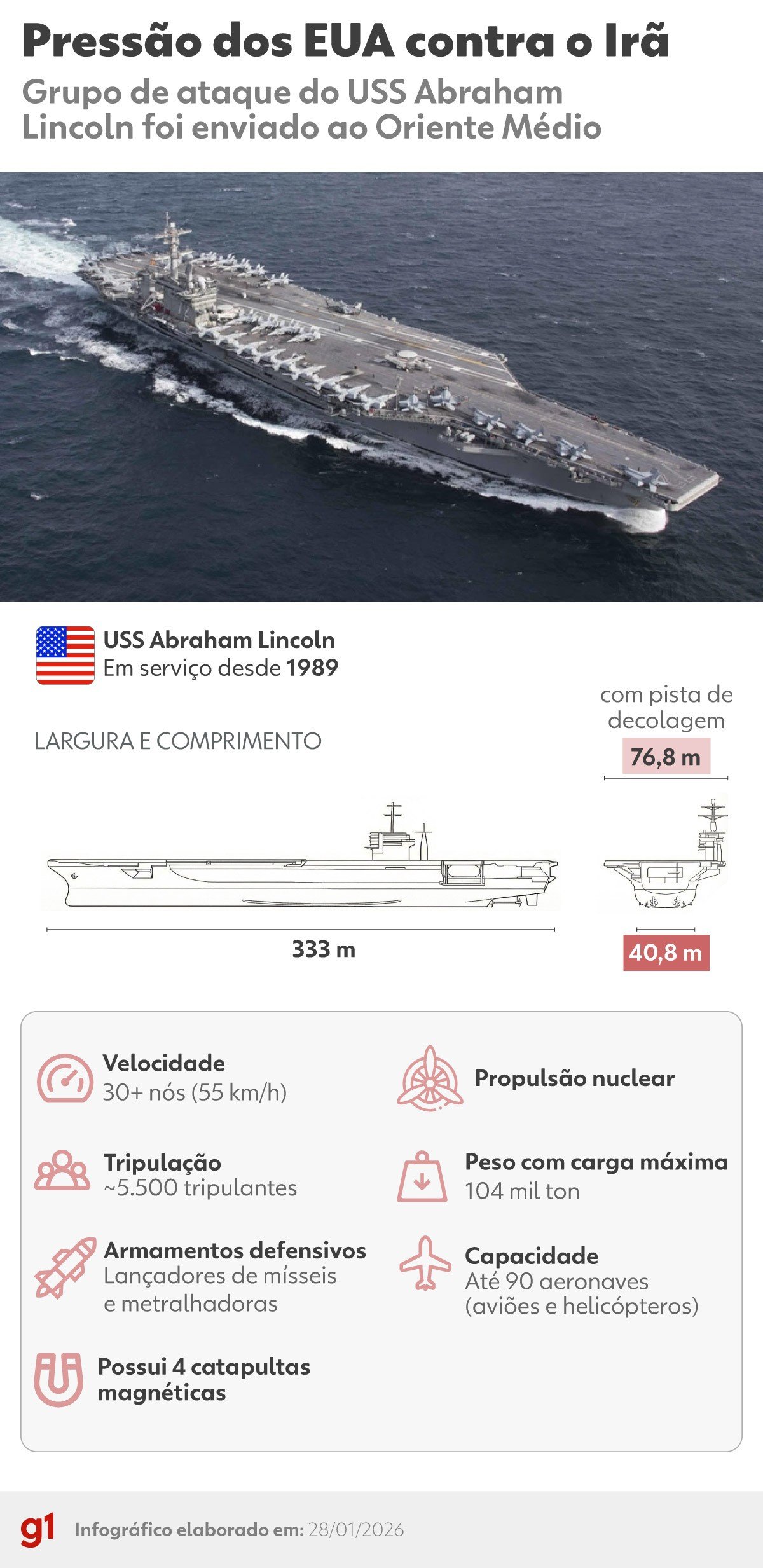
Iran has hardly managed to repair the damage to its arsenal caused by the 12-day war against Israel and the USA in 2025. According to analysts interviewed by g1, the damage caused to the country’s defenses now gives Donald Trump an “excellent” opportunity to attack again and put pressure on Ayatollah Ali Khamenei’s regime. The US president threatens Iran with military action if the regime refuses to negotiate limitations on its nuclear program. The pressure has escalated in recent weeks with the sending of a large force to the Middle East, with warships and fighter jets (see below). ✅ Follow the g1 international news channel on WhatsApp It is not yet known whether Trump’s military siege will be enough to make the Khamenei regime negotiate a nuclear agreement, however, one thing is certain: the USA has a great opportunity to attack Iran, Ana Karolina Morais, researcher at the University of São Paulo (USP) and the Center for Research in International Relations (NUPRI), told g1. “From a tactical point of view, I think it is difficult, but not impossible, for Trump to do something bolder or even try to depose the Ayatollah. The US has an excellent opportunity to attack Iran, because Russia has turned its attention to Ukraine, and Bashar al-Assad has been deposed. It is as if Syria were the only thing left standing in the way of the US and Israel’s escalation against Iran,” said Ana. Trump is considering everything from bombings to incursions inside the country to push for regime change, according to US media. USA. Tehran says that any US military aggression will be interpreted as an act of war and says it is ready for an “overwhelming response”. Holes in defense x Iranian discourse Despite the Iranian regime’s rhetoric of strength, the country would face serious problems defending itself against a US bomber and responding effectively, Vitelio Brustolin, professor of International Relations at UFF and Harvard researcher, told g1. “Iran spent many of its missiles against Israel last year and they certainly were unable to replace them. Iran’s air defense has uncovered areas and this became clear in last year’s bombings. These deficiencies were hardly repaired over the months following the bombings,” said Brustolin. The Iranian government, however, claims to be ready for war and says it has increased its stocks of missiles and drones. According to General Reza Talaei-Nik, spokesman for the Iranian Ministry of Defense, “the country’s anti-missile defense capabilities have been strengthened and become more effective thanks to the experiences gained during the war.” However, the Iranian regime’s speech is viewed with caution by analysts. According to them, the country tries to show itself strong all the time — it even declared itself the winner of the war against Israel and the USA, which did not happen. Another factor that contributes to partially discrediting the official statements are the international sanctions imposed on Iran, which hinder its ability to acquire new weapons and air defense batteries and also to repair the missile industry (read more below). For Vitelio Brustolin, given the current situation of the Khamenei regime, Trump is even in a position to try to remove the Ayatollah from power and place someone aligned with US interests, just as the White House did in Venezuela. See the videos that are trending on g1 Attack by air A US attack against Iran would necessarily be by air, as the countries are not neighbors and there are no signs of preparations for a land invasion from countries that border the Iranians. In this case, the US Army would launch missiles and jets from warships and air bases located in allied countries in the Middle East. It is also likely that Israel will join an American offensive. The US Army’s siege of Iran Trump sent the USS Abraham Lincoln strike group, which contains the aircraft carrier of the same name and at least three destroyers as escort. On board the USS Abraham Lincoln there are at least 60 war aircraft. See the military strength below: USS Abraham Lincoln (aircraft carrier); USS Spruance, USS Michael Murphy, USS Frank E. Petersen Jr. and USS Delbert D Black (destroyers); Around 56 F-35 and F-18 jets (on board the aircraft carrier); At least 1 Virginia-class nuclear submarine; Each of these destroyers has the capacity to carry up to 96 Tomahawk missiles, which are long-range and difficult to detect. The vessels recently joined the US Army Central Command region, which responds to the Middle East. In total, there are at least ten US warships within reach of Iran, according to “The New York Times” (see below). The aircraft carrier and destroyers Spruance, Michael Murphy and Frank E. Petersen Jr. are in the Arabian Sea, south of Iran. The Delbert D Black is close to the Israeli port of Eilat, on the other side of the Arabian Peninsula and about 1,200 km from Iranian territory. According to the US Navy, five other destroyers are part of the USS Abraham Lincoln strike group and should be together with the aircraft carrier, they are: USS Milius, USS Decatur, USS Kidd, USS Dewey and USS Wayne E. Meyer. These vessels are accompanied by several jets and other aircraft. Some are on board the USS Abraham Lincoln and others are stationed at 19 military bases in different countries in the Middle East, such as Qatar, Saudi Arabia, Bahrain, Iraq, the United Arab Emirates and Kuwait. Gui Sousa/Arte g1 Editoria de Arte/g1 What are Iran’s arsenal and defenses like today? In June 2025, Iran and Israel fought a 12-day war with exchanges of bombings. Around a thousand people died and another 5,000 were injured in Iran. In Israel, 28 were killed and around 3,300 were injured. The US became involved in the conflict and bombed three Iranian nuclear facilities — Fordow, Isfahan and Natanz. After the end of the war, Iran rushed to replenish its missile arsenal, consisting of ballistic and cruise projectiles, and in August held military exercises to demonstrate strength. According to estimates by specialized institutes, Tehran used between 500 and 600 missiles and more than 1,000 drones in the conflict. Iranian missiles Counting the missiles used and the possible losses due to Israeli bombings, which targeted military installations and warehouses, it is possible that Iran’s missile arsenal has fallen from an estimated 3,000 in the first half of 2025 to around 1,500 currently. According to Vitelio Brustolin, it is almost unlikely that the Iranian government has managed to replenish its arsenal, taking into account the sanctions it faces, despite Tehran’s statements. Inside one of the “missile cities” where a large quantity of Kheibar Tansim ballistic missiles are stored Air defenses The same happens with Iran’s air defenses. Israel claims that it has destroyed around 40 highly advanced Russian-made S-300 systems. Data from the International Institute for Strategic Studies (IISS) from the beginning of 2025 states that Iran had at least 42 S-300 and S-200 batteries as an asset in its air defense. Iran has air defenses considered robust, especially because they are reinforced by Russian technology. They are a multi-layered system, with dozens of medium-range devices and hundreds of short-range batteries. However, this entire apparatus failed during Israel’s attacks, according to Ana Karolina Morais. According to the IISS, one of Iran’s strengths is its military industry, which “has reached a high level of proficiency in the production of some types of advanced weapons”, such as missiles and drones. The attack drones produced by Tehran are among the most technological in the world, and the Khamenei regime has hundreds of thousands of these projectiles in its arsenal. The combination of its missile program and strong attack drone industry makes up for Iran’s air force, which is “incapable,” according to the IISS. Despite having more than 270 jets manufactured in the USA and Russia, the lack of parts caused by sanctions affects the readiness of this force. See below the jets that Iran had in the first half of 2025: 69 F-5; 55 F-4; 35 Mig-29; 29 Su-24; 18 F-7s; 12 Mirage; 10 F-14s; 6 Azarakhsh; 6 HESA Saegheh.
Source link
USA x Iran: how is the military siege in the Middle East and what are the ‘holes’ in Iranian defense
61
