
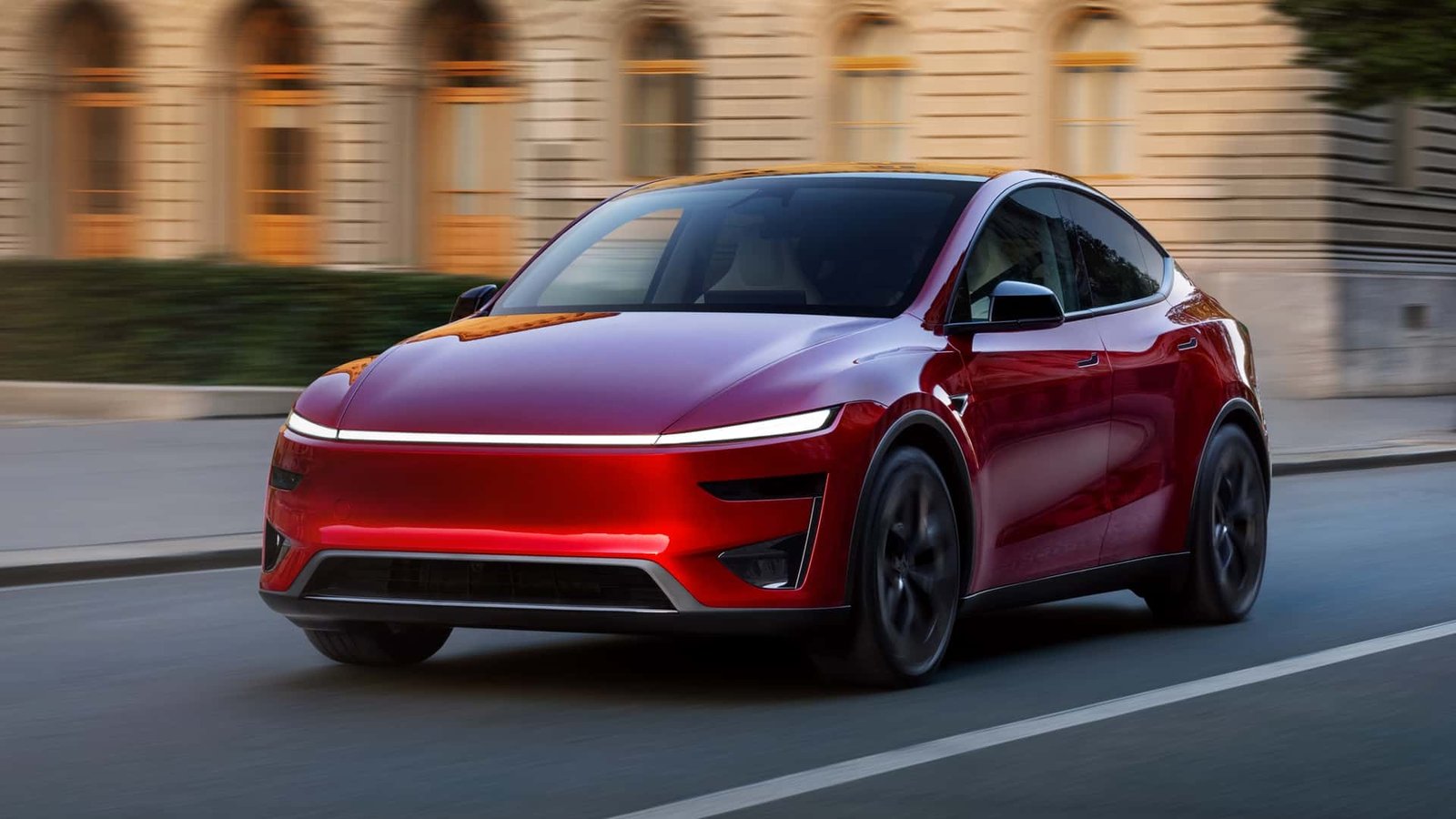
- EVs reached a 22.6 percent share in the EU last month.
- Pure gas cars accounted for 22.5 percent of European sales in December 2025.
- For the full year, hybrids were the most popular: 34.5 percent.
You’ve probably read your fair share of sensational headlines bemoaning the downfall of EVs. I’m here to tell you that, on a global scale, it’s simply not true. A study published last week by Benchmark Mineral Intelligence shows electric cars grew in virtually all regions in 2025, except North America.
Worldwide, demand for cars without combustion engines surged 20 percent to 20.7 million units. The study confirms China remains the driving force, accounting for more than half of all electric cars sold last year: 12.9 million units (+17 percent year over year).
Separately, the latest data published this week by the European Automobile Manufacturers’ Association (ACEA) points to what may be a tipping point in the “duel” between gas and electric on the continent. For the first time ever, EVs outsold pure gasoline vehicles in the 27 countries of the European Union. That milestone was reached last month, when EVs captured a 22.6-percent market share, 0.1 percent more than gas-only vehicles.
Photo by: Skoda
Once you factor in the United Kingdom and the countries that are part of the European Free Trade Association (Iceland, Liechtenstein, Norway, and Switzerland), the gap widens considerably. EVs held a 26.3-percent share in the EU+UK+EFTA area in December, while gasoline cars accounted for 21.7 percent of total volume.
Over the full year, however, conventional gasoline cars still finished ahead, with a 26.1-percent market share versus 19.5 percent for electric models in the EU+UK+EFTA region. THAT’S it figures show the share of gasoline-powered cars dropped by 6.9 percent last year, while EVs grew by 4.1 percent compared to 2024.
Diesel engines continue their slippery slope, with market share falling from 10.4 percent in 2024 to 7.7 percent last year. In its heyday, diesel peaked at over 50 percent roughly a decade ago. Its downfall began after the Volkswagen Group’s Dieselgate scandal and after most automakers decided to drop diesel engines from their smaller cars.
Overall, hybrids reigned supreme in the EU+UK+EFTA region last year, claiming a 34.4-percent market share. Plug-in hybrids, which outsold diesels for the first time in history, accounted for 9.6 percent of total volume.
EU+UK+EFTA Sales In 2025 Based On Powertrain
| Type Of Powertrain | Share |
| Hybrid | 34.4% |
| Gasoline | 26.1% |
| Electric | 19.5% |
| Plug-In Hybrid | 9.6% |
| Diesel | 7.7% |
| Others | 2.7% |
As for what drove EV growth in Europe last year, the Tesla Model Y still finished on top despite sales falling 28 percent. Automotive News Europeciting Dataforcereports the electric crossover recorded 151,331 units. Next came the Skoda Elroq with 94,106 units, followed by the Model 3 at 86,261 vehicles. The Renault 5 E-Tech placed fourth, ahead of three Volkswagen models: the ID.4, ID.3, and ID.7.
Europe’s Best-Selling EVs In 2025
| Model | 2025 Sales |
| Tesla Model Y | 151,331 |
| Skoda Elroq | 94,106 |
| Tesla Model 3 | 86,261 |
| Renault 5 E-Tech | 81,517 |
| Volkswagen ID.4 | 80,123 |
| Volkswagen ID.3 | 78,667 |
| Volkswagen ID.7 | 76,368 |
| BMW iX1 | 69,816 |
| Let’s EV3 | 66,802 |
| Skoda Enyaq | 65,787 |
Motor1’s Take: The rise of EVs is likely to continue this year as new, more affordable models hit the market. Volkswagen is launching the ID. Polo, Renault is bringing out the Twingo, and Dacia is preparing a budget-friendly electric car designed to undercut nearly everything that isn’t built in China. Of course, Chinese automakers already have a growing presence in Europe and, generally speaking, produce the world’s most affordable EVs thanks to access to abundant resources and low-cost labor.
Looking further ahead, 2027 is shaping up to be another strong year for electric cars in Europe. Volkswagen plans to launch an ID. Polo crossover and an even cheaper hatchback positioned below the ID. Polo. Some of these VW newcomers will spawn Skoda and SEAT derivatives, giving buyers even more options when choosing their next EV.
Sources:
European Automobile Manufacturers’ Association (ACEA), Automotive News Europe, Dataforce, Benchmark Mineral Intelligence
