

The docking of the Chinese hospital ship Silk Road Ark in the Port of Rio de Janeiro, last week, revived analyzes of the naval dispute between China and the United States, in a move seen by experts as a demonstration of soft power and not as a direct threat to Brazil.
In the field of international relations, the concept of soft power refers to a country’s ability to influence others through indirect means, such as diplomacy, cooperation, humanitarian aid, culture, and science, rather than the explicit use of military force.
In the case of China, medical missions, hospital ships, which are military, and exchange actions function as instruments of political rapprochement and image building, while at the same time expanding its institutional and logistical presence in strategic regions. Unlike traditional military power, soft power it seeks to shape perceptions, reduce resistance and open space for long-term geopolitical interests.
Although officially presented as a humanitarian and health cooperation mission, the episode brought to light diplomatic warnings about the advance of the Chinese presence in regions historically influenced by the United States – in addition to the real risk of espionage against Brazilian structures and ports.
For the CEO of the Casa Política consultancy and president of the Democracy Monitor Institute, Márcio Coimbra, the reading of the episode must go beyond the official narrative. According to him, the mission is part of China’s broader strategy to expand its global influence without direct confrontation.
“These missions operate like a modern Trojan horse. By offering medical services and scientific exchange, China normalizes the presence of its navy in the South Atlantic, maps port logistics and collects strategic data in a region that has always been under American influence”, says Coimbra.
The expert highlights that there is no immediate threat to Brazilian territory, but highlights the geopolitical symbolism of the operation. “It is not a movement against Brazil. It is a message to the United States. China is saying that its naval projection capacity is no longer restricted to the Indo-Pacific”, he explains.
In the same vein, political scientist Adriano Gianturco, coordinator of International Relations at IBMEC, states that even legitimate foreign aid missions fulfill clear political functions.
“Humanitarian aid is never neutral. It creates links, symbolic dependence and accustoms the population and local authorities to the presence of that country. This is soft power in its classic form”, he explains.
According to Gianturco, in addition to the humanitarian aspect, there is a demonstration of maritime capacity. “It is also a way of showing naval power, logistical capacity and global reach. And, inevitably, this works as a message of defiance to the United States and the West”, he says.
SEE ALSO:
-
Brazilian doctors are prevented from inspecting a Chinese ship
-
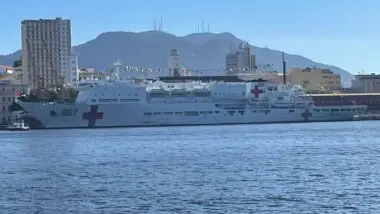
Chinese ship docks in RJ and the Medical Council asks for explanations about services provided
Strategist cites distrust and intelligence reading
International strategist Cezar Roedel, PhD in Philosophy and student of international conflicts, assesses that the context in which the ship arrived in Brazil reinforces distrust about the real objectives of the mission.
“This ship is sent after American military movements in the Caribbean. timing it’s not random. It would be naive to believe that this is just a medical-hospital mission, especially considering the history of Chinese intelligence operations”, he states.
Roedel emphasizes that it is not a question of declaring a military threat, but of recognizing the pattern of action of great powers.
“China today has one of the largest intelligence services in the world. It is clear that a vessel of this size carries protocols for data collection, scenario mapping and logistical assessment. This is part of the geopolitical game”, he says.
For him, Brazil ends up occupying a passive role on this board. “The country has become a permissive space for this type of movement, which conveys to the world the image that any extra-regional power can use our ports as a stage for strategic signaling”, he states.
Naval rivalry in the background
The presence of Silk Road Ark in Brazil occurred amid the intensification of the naval dispute between China and the United States. Beijing already has — or is about to have — the largest naval fleet in the world and dominates much of the global shipbuilding and merchant fleet, responsible for around 90% of international maritime transport.
In the United States, shipyards and shipbuilders sued the government under the 1974 Trade Act, accusing China of unfair practices, state subsidies and dumping — sell at artificially low prices — to dominate the sector.
This scenario boosted Donald Trump’s speech about the need to revitalize the American Navy. The former president defends the creation of a new class of missile-launching battleships, as part of a plan to regain US naval supremacy.
According to Márcio Coimbra, the Chinese movement must be read in light of this dispute. “Beijing is testing the elasticity of American influence in the South Atlantic. Each docking without a firm reaction is a sign that the US containment perimeter is looser”, he states.
Chinese ship raised questions about legal limits
Despite the official reception, the visit generated questions in Brazil. The Regional Council of Medicine of Rio de Janeiro (CREMERJ) asked for clarification on the possibility of medical care being provided by foreign professionals without local validation. The Rio de Janeiro Health Department (SES-RJ) and the Brazilian Navy deny any direct assistance to the Brazilian population.
In response to CREMERJ, authorities from the Rio de Janeiro government reported that there was no request, order or administrative process related to the medical performance of the Chinese ship docked in the Port of Rio.
The documents stated that there was no authorization granted, nor any health operation involving care for the population or the work of foreign doctors. The state government also highlighted that it was not responsible for international authorizations, validating diplomas or coordinating this type of mission, and that it had not received any requests from the Union or Chinese authorities on the topic.
Authorization for the ship’s entry was granted on November 13th by the federal government and published in the Official Gazette of the Union on the 18th of that month, according to the General Staff of the Navy, a body of the Brazilian Navy. The Chinese ship was docked in Rio de Janeiro between January 8 and 15, 2026.
Under the United Nations Convention on the Law of the Sea (UNCLOS), state ships enjoy jurisdictional immunity when docked in foreign ports, which limits internal inspections without the consent of the flag country.
Context of the global mission and precedents in Brazil
O Silk Road Ark is part of the Harmony 2025 Mission, the longest ever carried out by the Chinese navy, with an estimated duration of 220 days. The operation includes stops in countries in Oceania, the Caribbean and Latin America, such as Mexico, Jamaica, Peru, Chile and Brazil — the mission’s first South American destination.
China maintains one of the largest fleets of hospital ships in the world, often used as instruments of humanitarian diplomacy.
For experts, the episode reinforces that Brazil is not the target of the Chinese operation, but the chosen scenario for a larger dispute. “The ship doesn’t “point” cannons at Rio. It “points” at Washington”, summarizes Gianturco.
Brazil has a history of authorizing the entry of foreign military vessels. In 2023, a German research vessel was expelled after operating without authorization in a sensitive area, which demonstrates that the country reacts to proven irregularities.
SEE ALSO:
-

Chinese hospital ship bars Brazilian inspection
