
Marseille are beginning to show what a coherent Roberto De Zerbi team looks like. In the Italian’s second season at the club, the ideas are visible, the attacking output is striking, and the ceiling is high enough to trouble elite opponents. What remains unclear is whether this progress can survive at a club that tends towards inconsistency and uncertainty.
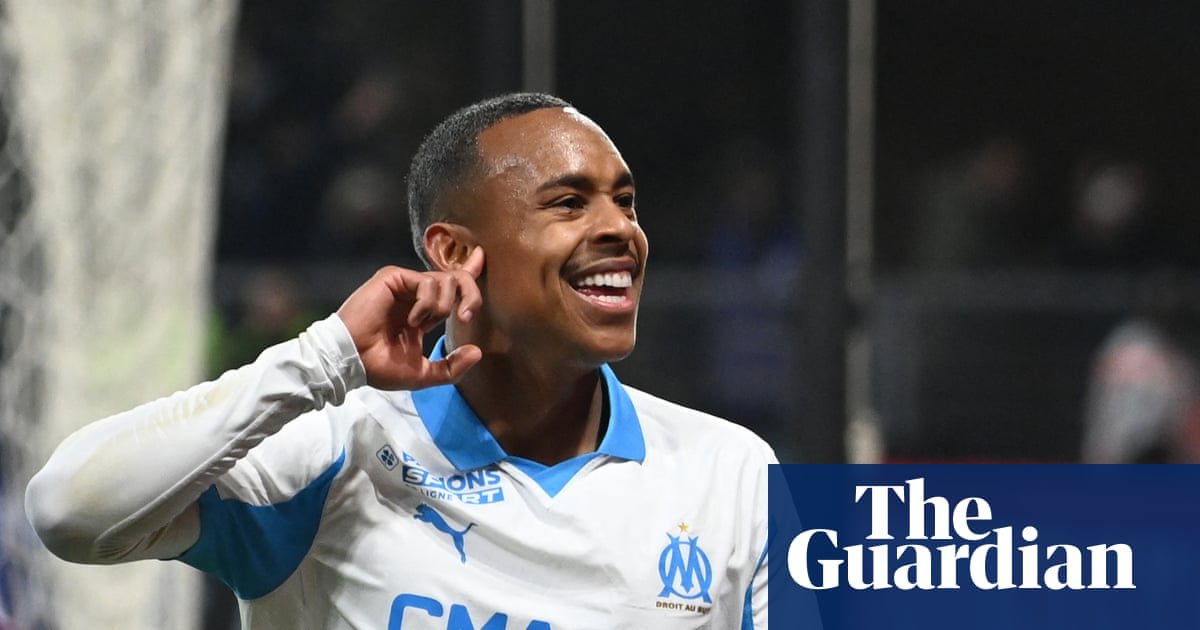
“This was the best first half since my arrival,” said De Zerbi after his team’s 5-2 win at Angers on Saturday. It’s hard to dispute that assessment. Marseille raced into a four-goal lead, with four different players producing a series of stylish goals. It was the clearest illustration yet of what his team are capable of when the stars align.
With 41 goals in 18 league matches this season, Marseille boast the most prolific attack in Ligue 1. They have scored 16 goals in all competitions since the turn of the year (including a 9-0 thrashing of sixth-tier Bayeux in the Coupe de France), a total that only Bayern Munich can match in Europe’s top five leagues. Marseille are on their best attacking run for half a century but, for all the goals and attacking fluency, a sense of impermanence is never far away.
Inconsistency is a theme De Zerbi himself has returned to repeatedly, even in moments of encouragement. After the win against Angers at the weekend, he challenged his team. “The objective, as I told the players at half-time, is to string together 10 matches at this standard with me on the bench,” he said. The refrain was a familiar one: the quality is visible but reproducing it remains a challenge.
Their results in January are a stark representation of this pattern. Marseille began the year with a 2-0 defeat to Nantes that left them eight points behind league leaders Lens. Four days later, they produced one of their most complete displays of the season against Paris Saint-Germain in the Trophée des Champions, only to lose on penalties after a dramatic 2–2 draw in Kuwait. The contrast was jarring, even by Marseille’s standards.
The emotional swing was captured vividly by De Zerbi afterwards: “I have never cried after a defeat, but tonight I cried when I returned to the dressing room. Against Nantes, there was nothing. Tonight, there was everything: the football, the character, the defensive work, the technique.” The implication was clear: Marseille’s problem is not reaching a high ceiling, but rather falling to a low floor.
The challenge is psychological as much as tactical. De Zerbi arrived with a reputation for imposing structure, rhythm and patience. Slowly, his ideas have begun to settle. Yet moments of coherence continue to exist alongside abrupt regression, reinforcing the sense that progress must be fought for constantly rather than assumed.
The swing between promise and regression is also structural. Since De Zerbi’s arrival, the squad has been in a near-constant state of churn. In the summer of 2025 alone, the club brought in more than a dozen players and moved on even more. That turnover has produced uneven results. Some arrivals have lifted the technical level of the side and fitted into De Zerbi’s framework quickly, whereas others have struggled to impose themselves or have required time – something the club rarely affords.
Even academy players have proven transient. Marseille have shown a willingness to cash in on emerging assets, with teenage forward Robinio Vaz sold to Roma last week for €25m after only a handful of appearances. Midfielder Darryl Bakola is also being linked with an exit this month. It is a pattern shaped less by sporting impatience than by economic necessity, and one that reflects the wider financial reality facing French football.
That context helps to explain the surprising tone struck by Medhi Benatia, the club’s director of football. Speaking after the defeat to PSG in the Trophée des Champions, Benatia was candid about the difficulty of building for the long-term. “At Marseille, it’s hard to project yourself,” he said. “I just look at tomorrow. In Marseille, you never have time. It’s always adversity, criticism – that’s the truth.”
De Zerbi has since tethered his own future to the club’s director of football. “If Benatia leaves the club, I will leave as well, 100%,” he said. “I am someone who is loyal. It was Medhi and Pablo [Longoria] who brought me here.” Benatia has previously suggested that he is at Marseille for a good time, not for a long time, which has thrown up more questions about the coach.
That sensitivity helps to explain why speculation linking De Zerbi with Manchester United has landed so sharply, even if the coach has sought to shut it down. “No critics – whoever they are and wherever they come from – will change my opinion of my work or my desire to stay at the club,” he said.
The immediate task for De Zerbi and his team is to follow up their win at Angers with a similar performance against Liverpool in the Champions League on Wednesday night. When asked about that challenge at the weekend, he reiterated his desire for more consistency and continuity. “They are a very strong team, but we have to be the team we were tonight in every match – for 90 minutes, and across the 38 games of the season. That is our margin for improvement. We can play very well against Liverpool but, if we’re not at it, we can lose against anyone. If we are well prepared; we can compete with everyone.”
Marseille and De Zerbi have spent months insisting the club is building something coherent. The ideas are now visible. What remains to be seen is whether this coherence can be protected long enough to become something durable.
This is an article by Get French Football News
