
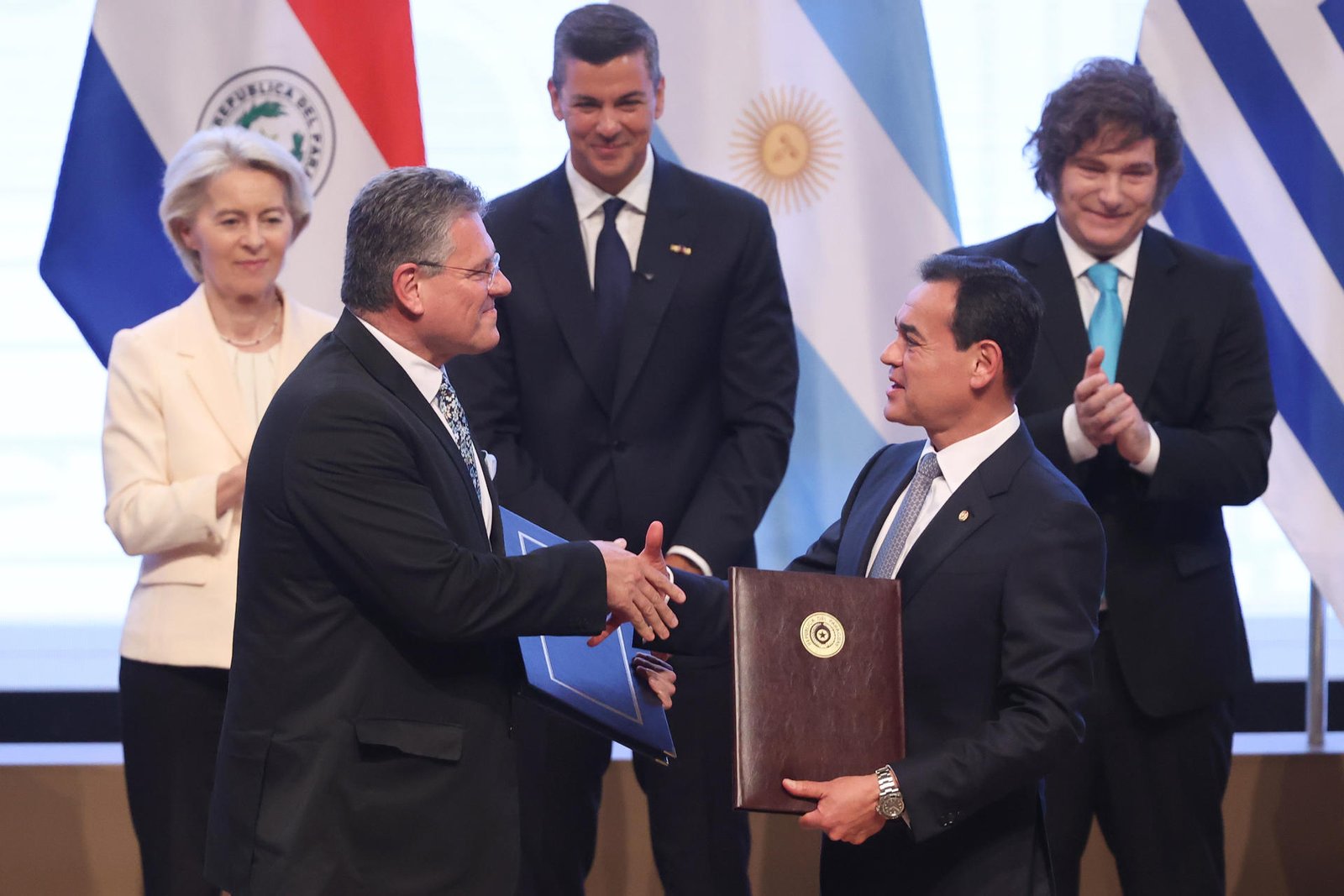
Leaders of Mercosur and the European Union (EU) signed the trade agreement this Saturday (17), after more than 25 years of negotiations. The treaty creates one of the largest free trade zones in the world.
Present were Santiago Peña, president of Paraguay; Javier Milei, president of Argentina; Yamandú Orsi, president of Uruguay; Rodrigo Paz, president of Bolivia; José Raúl Mulino, President of Panama, Ursula von der Leyen, President of the European Commission; and António Costa, president of the European Council.
President Lula (PT) did not attend the event. The Brazilian government decided that the signing should involve only Foreign Affairs representatives from South American countries. Mauro Vieira, Brazilian Minister of Foreign Affairs, represented Brazil.
The presence of heads of state at the ceremony was invited by the president of Paraguay, Santiago Peña, who currently presides over Mercosur. In his speech, Peña remembered the Brazilian president and stated: “without him, there would be no agreement.” During the ceremony, Rodrigo Paz and Javier Milei took the opportunity to show solidarity with the Venezuelan people after the arrest of Nicolás Maduro.
Agreement between Mercosur and the European Union moves towards ratification processes
The agreement provides for the gradual reduction or elimination of import and export tariffs, which affect more than 90% of trade between the blocs. It establishes common rules for industrial and agricultural products, investments and regulatory standards.
Despite the signing, the treaty still needs to go through internal ratification processes. In the case of the European Union, the European Parliament will analyze the text and, depending on the legal interpretation, parts of the agreement may have to be approved by the national parliaments of the member countries.
In Mercosur, the agreement will have to be approved by the national congresses of Brazil, Argentina, Paraguay and Uruguay. Meanwhile, the EU and Mercosur countries will be able to discuss the provisional application of parts of the treaty, especially regarding the reduction of fees, which will make it possible to anticipate some economic effects before full ratification.
The agreement only becomes fully valid after all internal approvals are completed in both blocks.
Lula received the president of the European Commission on Friday
Brazil accounts for more than 82% of European imports originating in Mercosur and for around 79% of the bloc’s exports to the EU. With this scenario, Argentina, Uruguay and Paraguay occupy a secondary position in the dynamics of the agreement. The European Union conducts negotiations essentially based on its relationship with Brazil.
Lula received Ursula von der Leyen, president of the European Commission, on Friday (16), in Rio de Janeiro. He classified the delay in concluding the agreement as “25 years of suffering and attempted agreement” and highlighted that the treaty brings together around 720 million people and a Gross Domestic Product (GDP) of US$22 trillion (R$118.4 trillion).
“This is a partnership based on multilateralism,” stated Lula. “This partnership agreement goes beyond the economic dimension. The EU and Mercosur share values such as respect for democracy, the rule of law and human rights. More political dialogue and cooperation will guarantee high standards for labor rights and environmental protection”, he continued.
Agreement faces resistance from European countries
An EU diplomat and Poland’s agriculture minister said 21 countries supported the deal, while Austria, France, Hungary, Ireland and Poland voted against it. Belgium abstained. To approve the treaty, the support of at least 15 countries representing 65% of the bloc’s total population was required.
After confirming European support, French Agriculture Minister Annie Genevard stated that she will adopt unilateral measures if the country’s agricultural and livestock sector is harmed by the agreement. She cited the recent suspension of imports of agricultural products treated with substances banned in the EU, especially of South American origin.
The agreement connects Mercosur and the European Union in a market of more than 700 million people and integrates flows of goods and investments between South America and the euro zone, marking a decisive step in global economic integration.
