
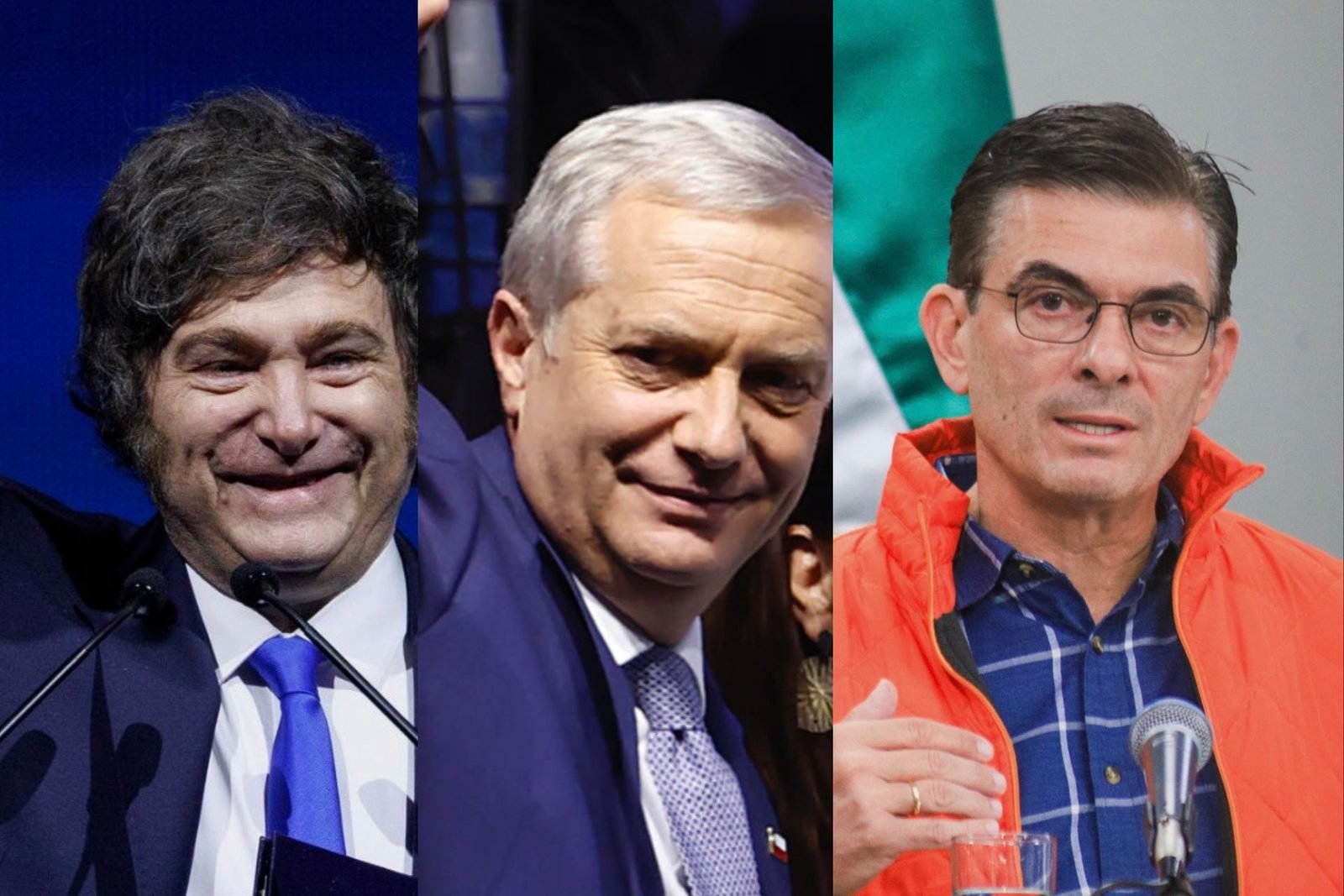
The capture of Nicolás Maduro occurs at a time of profound political changes in Latin America with the victory of right-wing leaders in the region.
Recently, Chile, Honduras and Bolivia decided to abandon the left by choosing conservative rulers to lead the management of the countries. This regional political shift coincides with a moment of direct involvement by the United States in the Venezuelan crisis and with discussions about a possible democratic transition in Caracas, creating an environment that can facilitate the resumption of diplomatic relations and a new impetus for economic and social recovery in Venezuela.
As soon as the US announced the operation on the 3rd, which resulted in Maduro’s removal from power, Argentina, governed by the right since 2023, was one of the first countries in the region to express support for the Trump government.
In an extensive statement, President Javier Milei defended that the fall of the Chavista dictator allows the country to undergo a political transition led by the president legitimately elected in the 2024 elections, the candidate opposing the regime, Edmundo González Urrutia, chosen “by popular will at the polls”, says an excerpt from the official publication.
Argentina also highlighted that it supports the full recovery of democracy, human rights and the “rule of law” in Venezuela. Milei even commented that he would be willing to contribute to the transition of power in Caracas, a first demonstration that neighboring countries could directly participate in this political transformation.
The Argentine is Trump’s main ally in the region. Although the White House leader has not explicitly signaled that he could seek regional reinforcements to rebuild Venezuela and ensure its stability, this possibility is seen as indispensable to prevent criminal groups from seeking refuge in neighboring countries and the Axis of Evil, led by China, Russia and Iran, from continuing to form strategic bases of influence in Latin American nations governed by the left.
On Thursday (8), Paraguayan President Santiago Peña reported that he maintains direct contact with regional leaders and that his government is prepared to support a possible transition process in Venezuela.
“I’m talking to several presidents in the region about how we can collaborate in a transition to which Paraguay certainly has a lot to contribute,” the president told journalists after participating in a ceremony inaugurating military installations in the department of Guairá (eastern Paraguay). Venezuela severed relations with Paraguay in January 2025 after Peña recognized González Urrutia as the winner of the 2024 presidential elections.
Another reason that may motivate these countries in the region to collaborate with Venezuela is the damage caused by years of instrumentalization of drug trafficking by the Chavista regime and the migration crisis generated by the country’s precarious situation.
Countries such as Argentina, Chile, Bolivia, Peru and Paraguay can be useful if there is a need for a stabilizing security force on the ground, as well as to promote the eventual reconstruction of public institutions and Venezuelan infrastructure, scrapped during the regimes of Hugo Chávez and Nicolás Maduro.
As in any complex crisis, there is no way to predict exactly what the next steps will be to form a more dignified future for Venezuela.
