
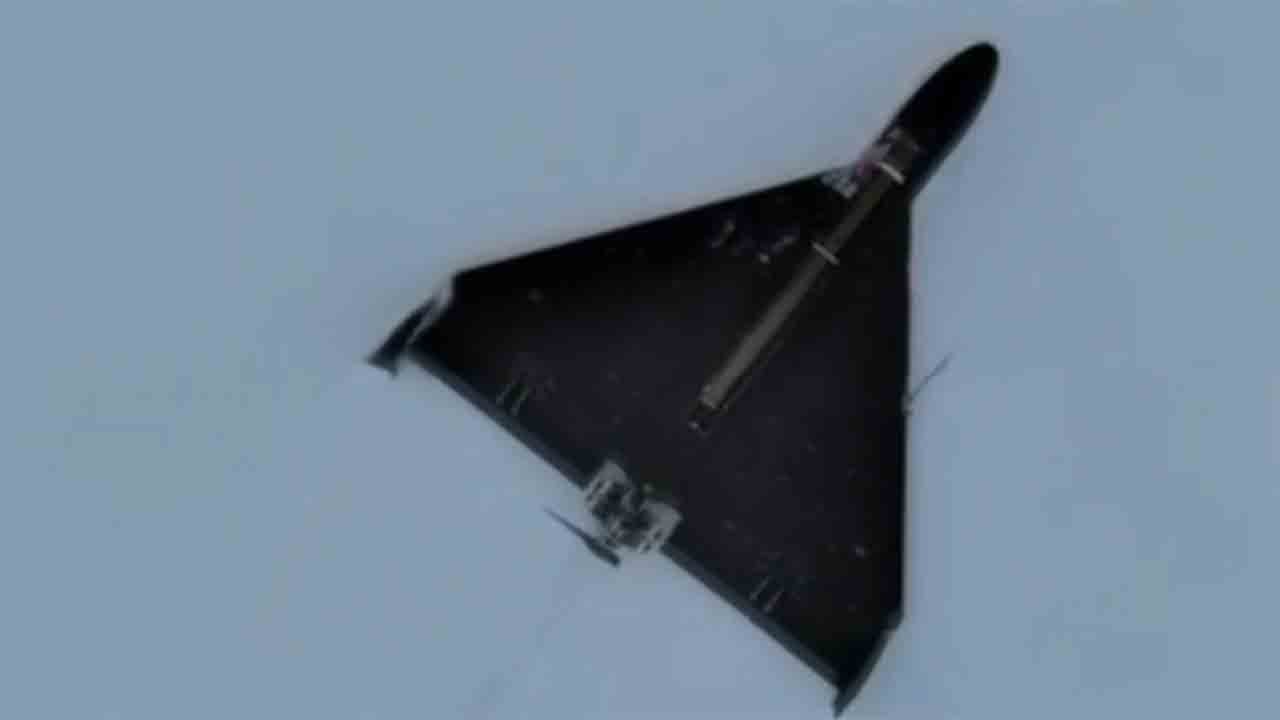
Soldiers from the Darknode Battalion, from the SBS’s 412th Nemesis Brigade, shot down a Russian Shahed attack drone equipped with a man-portable anti-aircraft missile system (MANPADS).
The information was published by the Command of Unmanned Systems of the Armed Forces of Ukraine on its official social media pages.
+ British and French planes attacked the underground hideout of the Islamic State in Syria
According to the statement, the drone was equipped with a radio modem and camera, which allowed remote control directly from the territory of the Russian Federation. In addition, the UAV was also capable of using weaponry, in this case a portable anti-aircraft missile installed on the platform.
+ Click here to watch the video

This is the second known version of armed Shahed drones being used to attack Ukrainian aircraft. The first case involved a Shahed that had been converted to carry an R-60 air-to-air missile. In both scenarios, the use of the weapon requires the aircraft — a plane or helicopter — to be in front of the drone, allowing the Russian operator to spot the target and launch the missile.
These drones are controlled remotely through a mesh-type communication network that was initially tested on Gerber decoy drones and later integrated into operational Shaheds. According to experts, the effectiveness of such solutions against the fighter jets of the Ukrainian Air Force is limited. At the same time, the system can pose a potential risk against helicopters and light aircraft, although no successful deployments have been confirmed so far.

The evolution of Shahed drones
Since their introduction into the 2022 conflict, the Shahed attack drones have undergone significant development. In Russia, their production was installed in factories located in the cities of Yelabuga and Izhevsk in the territory of the Republic of Tatarstan, where they are produced under the names “Geran” and “Harpia”.
Compared to the original Iranian Shahed-136 model, the drones currently in use show significant improvements, including new, more destructive warheads, improved navigation systems, and increased resistance to Ukrainian electronic warfare measures. The solutions used include the use of more directional CRPA antennas and, more recently, the introduction of antennas capable of navigation using VOR/DME radio navigation beacons.
In addition, there are also attempts to neutralize air defense systems with non-traditional means, for example, by installing infrared reflectors on the Shaheds, which are intended to make it difficult for pilots to see at night during interceptions.
A 9K333 Verba MANPADS

The portable air defense missile system mounted on the downed drone has been identified as the Russian 9K333 Verba system. The identification was made possible by the markings on the transport and launch container (9P333) as well as characteristic visual characteristics. The marking also indicates the system’s year of manufacture: 2025.
The Verba system was officially regularized by the Russian army in 2015; it is a relatively new development developed by the Mashinostroeniya design office in Kolomna. The complex is a 9K38 Igla-S derived from Igla means its further development.
Compared to the Igla, the Verba has a longer range and wider engagement envelope, and is capable of destroying targets up to a distance of 6,000-6,400 meters and an altitude of 3,500-4,500 meters, depending on the source.
Source and images: Telegram @usf_army | @army_tv | Militarnyi. This content is generated with the help of artificial intelligence and verified by the editors.
