
With South America currently divided between six left-wing governments (Brazil, Venezuela, Colombia, Guyana, Suriname and Uruguay) and six right-wing governments (Argentina, Paraguay, Ecuador, Bolivia, Peru and Chile – this one, already counting the inauguration of elected José Antonio Kast in March), three presidential elections in the subcontinent could break the tie in 2026.
The first will be in Peru, in April; Then, there will be presidential elections in Colombia, in May, and in Brazil, in October.
With the new United States national security doctrine emphasizing prioritizing Latin America, President Donald Trump is expected to devote great attention to these disputes.
In the first year of his second term, the republican came into conflict with the left-wing governments of Brazil and Colombia.
In the Andean country, President Gustavo Petro will not be able to seek re-election, as local law does not allow consecutive presidential terms. Senator Iván Cepeda will be the candidate of Petro’s party, the Historic Pact, and will have as his main opponent fellow senator Paloma Valencia, chosen on the 15th as the presidential candidate of the Democratic Center, a party led by former president Álvaro Uribe (2002-2010).
In October, Petro, his wife, Veronica del Socorro Alcocer Garcia, his eldest son and a minister in his government became targets of economic sanctions by the Trump administration, under the justification that the leftist president allowed drug cartels to “flourish” in Colombia during his term.
Previously, in September, the US State Department had already canceled the Colombian president’s visa, after he participated in a pro-Palestine protest in New York in which he “urged American soldiers to disobey orders and incite violence”.
Trump also called Petro a “drug trafficker” and said that, after the dictator of Venezuela, Nicolás Maduro – who, according to him, his days are “numbered” –, the Colombian president “will be the next” target of American actions against drug trafficking in Latin America.
The American president also withdrew aid to Colombia and is projected to try to exert influence against Cepeda in the 2026 election.
As for Brazil, where Luiz Inácio Lula da Silva will seek a fourth term, Trump called the PT member a “radical left lunatic” in 2022 and asked for votes for his ally Jair Bolsonaro (PL), who nominated his son, senator Flávio Bolsonaro (PL-RJ), to run for president in 2026.
In 2025, Trump applied a 50% tariff on imports from Brazil, most of it based on an emergency declaration in which he claimed that “recent policies, practices and actions of the government of Brazil threaten the national security, foreign policy and economy of the United States” and cited Jair Bolsonaro’s judgment in the Federal Supreme Court (STF).
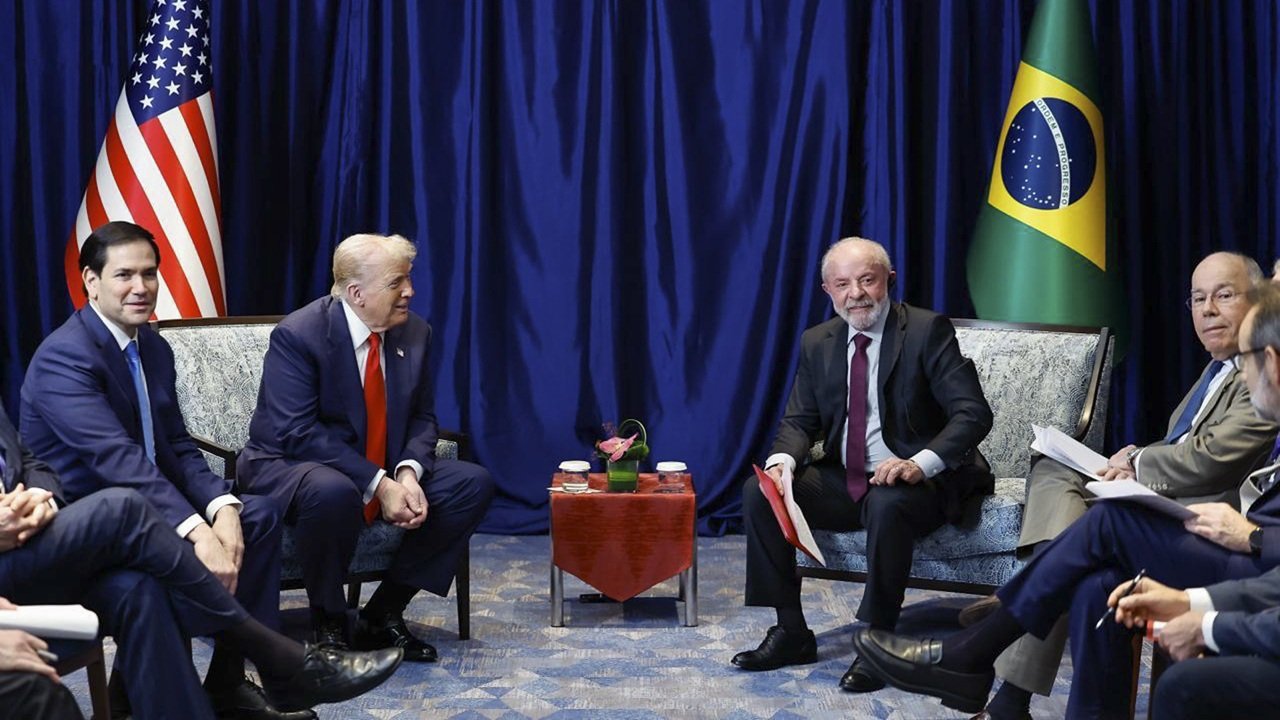
However, after that, came the unexpected meeting with Lula at the UN General Assembly, in New York, in September, when the two presidents expressed that they felt “chemistry”, and both began talking directly – one of them in person, in Malaysia, in October.
SEE ALSO:
-
Next target? The similarities and differences in Trump’s offensives against Maduro and Petro
In November, Trump removed 50% tariffs on meat, coffee and other agricultural products from Brazil, to reduce prices in the United States.
However, the vice-president and minister of Development, Industry, Commerce and Services, Geraldo Alckmin, said that 22% of Brazilian exports to the North American country are still subject to tariffs.
The US government cited the approval of the dosimetry PL in Congress, which could benefit Bolsonaro, as one of the justifications for removing the names of STF minister Alexandre de Moraes, the Lex Institute of Legal Studies and Viviane Barci de Moraes, the judge’s wife and director of the institute, from its list of targets for economic sanctions via the Magnitsky Law.
As Lula plans to veto the PL, it is not known whether the “chemistry” with Trump will be compromised.
Peru will hold a presidential election in 2026 to end another complicated political cycle: two presidents, Pedro Castillo and Dina Boluarte, have been impeached since the previous election, in 2021, and the presidency is now occupied by the conservative José Jerí, who was leader of the country’s Congress.
Among the best-known candidates for the 2026 election are a former mayor of Lima, the conservative Rafael López Aliaga, and Keiko Fujimori, daughter of former president Alberto Fujimori (1990-2000) and who will try to become president for the fourth time (she was defeated in 2011, 2016 and 2021).
A sample of how Trump will treat these elections came in 2025, when he threatened to cut aid to Argentina and Honduras if Javier Milei’s party (president who received billion-dollar aid from Washington to stabilize the dollar) did not win the legislative elections in October and if Nasry “Tito” Asfura, from the conservative National Party, did not emerge victorious in November’s presidential election in the Central American country. In both disputes, the result desired by the Republican was achieved.
In an interview with People’s GazetteLeo Braga, professor of the international relations course at Faculdade Presbiteriana Mackenzie Rio, said that, under Trump, the United States is no longer leaving Latin America aside.
“The end of the ‘forgetfulness’ phase comes with the new American stance, let’s say, of Trump, now characterized by being more assertive and ideologized, with attention to American interests in security, trade and, in a blunt way, containment of China”, said Braga, who stated that South America is no longer a peripheral space for American foreign policy and has become a strategic axis.
“This new American stance was called the ‘Trump Corollary’ in the US national security doctrine and largely echoes the Monroe Doctrine, from the 19th century, when it seeks to restore American preeminence in the hemisphere and prevent extra-hemispheric powers – such as China and Russia – from controlling strategic assets here in the region. This highlights unequivocal political priorities, which impact the daily life of the region and makes it once again a geopolitical space in dispute”, said the analyst, for whom the pressure on Petro already indicates how Trump should continue seeking to influence Latin American elections.
“It is possible to predict that the 2026 presidential disputes in the region will be highly internationalized and marked by explicit interventionism on the part of the USA, as was already manifested in the legislative elections in Milei’s Argentina,” said Braga.
