
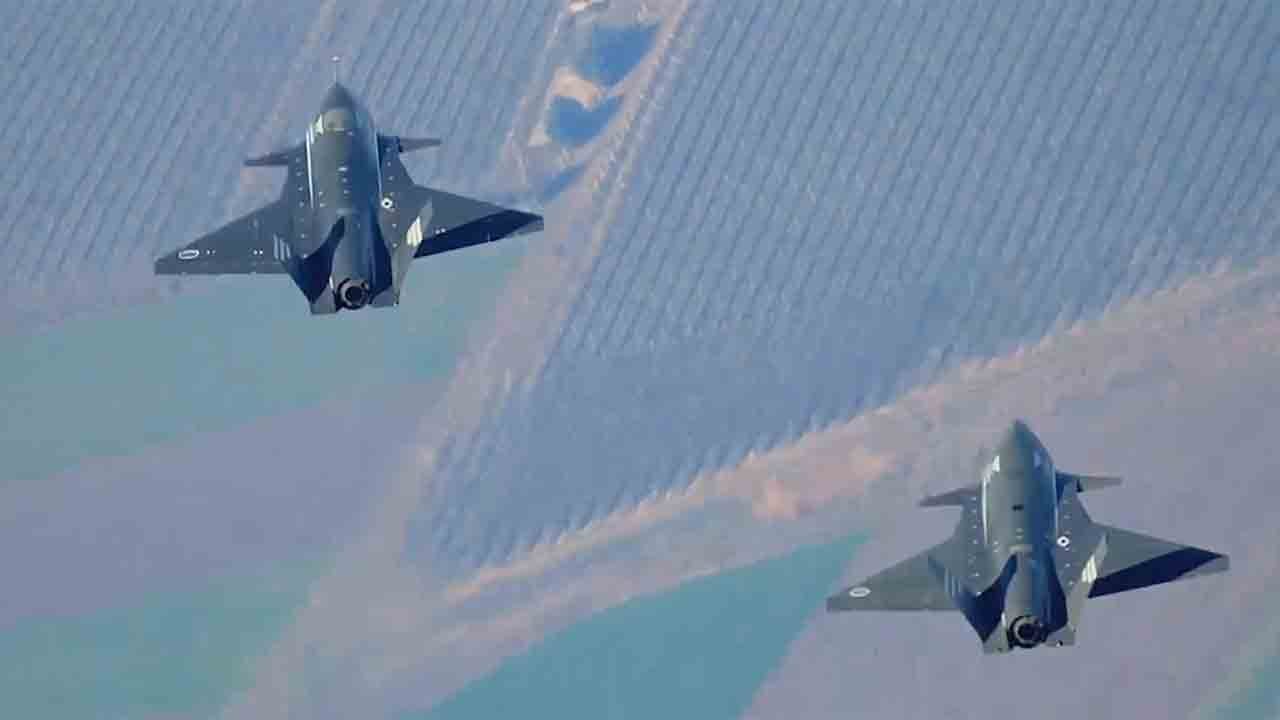
The Baykar Bayraktar KIZILELMA unmanned combat aircraft reached a historic milestone by carrying out, for the first time in the world, a fully autonomous coordinated flight between two unmanned fighter aircraft, without any human intervention.
The achievement underscores Turkey’s progress in developing next-generation aerial combat systems.
Developed entirely with domestic resources, the Bayraktar KIZILELMA, the country’s first unmanned fighter aircraft, continues to set global aviation firsts. About a month ago, the model had already made history by becoming the world’s first unmanned fighter to shoot down an aerial target, firing a beyond-visual-range (BVR) air-to-air missile guided by its internal AESA radar.
+ Click here to watch the video

Coordinated flight without human intervention
In the latest test, the KIZILELMA PT3 and PT5 prototypes took off in sequence and executed a close-formation flight under the control of advanced fleet-autonomy algorithms developed by Baykar. During the mission, the aircraft autonomously adjusted their relative positions, maintaining formation and flight integrity, practically demonstrating coordinated operations between unmanned platforms.
According to the company, this marks the first time in military aviation history that two unmanned combat aircraft have performed a fully coordinated flight, operating as an aerial formation without direct human pilot supervision.
Combat Air Patrol also validated
In addition to formation flight, the trial included the successful execution of a Combat Air Patrol (CAP) mission, one of the pillars of modern air combat. In this phase, the prototypes followed a pre-determined route, conducting the air-defense mission supported exclusively by the fleet-autonomy software.
The demonstration confirmed that tasks traditionally assigned to manned fighters—such as continuous air surveillance, protection of sensitive areas, and threat response—can be transferred to fleets of unmanned combat aircraft operating autonomously.

Path toward the future of air combat
Throughout the testing process, the aircraft’s joint-operation capabilities, tactical coordination, and autonomous decision-making were closely monitored. According to Baykar, the KIZILELMA’s intelligent fleet-autonomy infrastructure paves the way for complex air operations involving multiple unmanned platforms operating in an integrated manner.
The advance is seen as a watershed moment for military aviation, indicating that beyond cooperation between manned and unmanned aircraft, fully autonomous fighter fleets could, in the future, play central roles on the aerial battlefield.
+ UK Ministry of Defence delays Challenger 3 production with no fixed timeline

Source and images: X @SavunmaSanayiST. This content was created with the assistance of AI and reviewed by the editorial team.
