
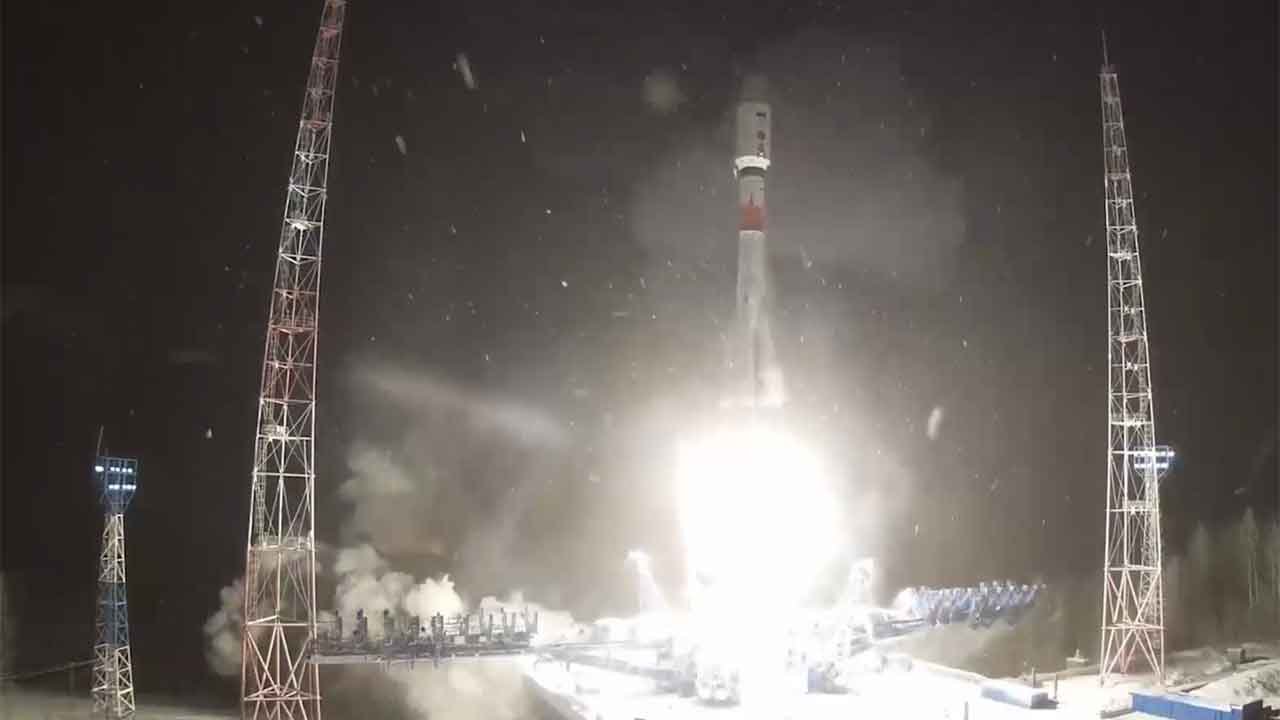
At 17:11 on December 25 (Thursday), a combat unit of the Russian Federal Aerospace Forces Space Force successfully carried out the launch mission of the medium-sized launch vehicle “Soyuz-2.1a”
The launch took place at the Ministry of Defense’s State Experimental Cosmodrome in the Arkhangelsk Oblast, also known as the Plesetsk Cosmodrome.
+ Video: UAC delivers the last batch of Su-35S fighters of the year to the Russian Aerospace Forces
According to official reports, the rocket launch and the satellite’s entry into the established orbit were carried out normally without any abnormalities. After liftoff, Soyuz-2.1a was tracked and monitored by the automated ground control system of the Herman Stepanovich Titov Main Space Test Center.
+ Click here to watch the video
Within the scheduled time, the satellite successfully entered the designated orbit and was controlled by the Space Force’s ground system. Relevant departments confirmed that stable telemetry communication with the spacecraft has been established and maintained, showing that all onboard systems are operating within normal parameters.

This launch further highlights the regular space missions carried out by the Russian Aerospace Forces from Plesetsk. The base is one of Russia’s major military space operations centers and is mainly used for launch missions in polar orbits and high-inclination orbits.
Alliance-2.1a

Soyuz-2.1a is a Russian medium-sized launch vehicle belonging to the new generation Soyuz series. It is designed to launch satellites into low Earth orbit (LEO), as well as polar orbits and sun-synchronous orbits. This model is a direct evolution of the classic Alliance-U and Alliance-FG, incorporating a modern control system and greater operational flexibility.
Main technical characteristics
- Height: about 46 meters
- Launch mass: approximately 308 tons
- Level: three levels
- Payload capacity: approximately 7 tons in low-Earth orbit
- Propulsion system: kerosene (RP-1) and liquid oxygen (LOX) engines
Soyuz-2.1a is widely used by Roscosmos and the Russian Ministry of Defense. It is one of the main vehicles for carrying out military launch missions from Plesetsk, especially high-inclination orbit missions. Its high reliability and rich operational record make it continue to be an important pillar of contemporary Russia’s space program.
Source and image: Telegram @mod_russia | Roscosmos. This content is produced with the assistance of AI and reviewed by the editorial team.
