
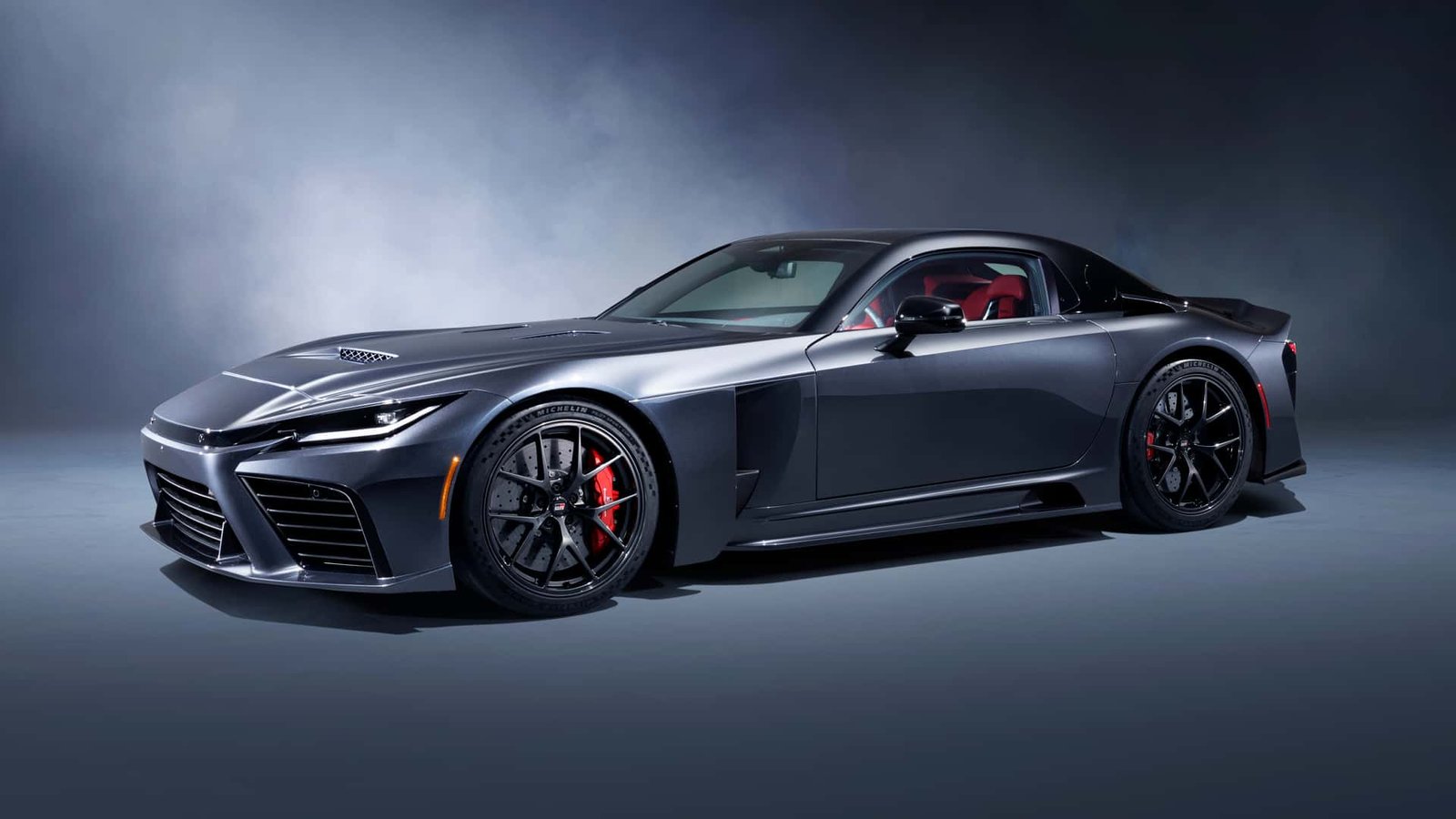
It started with the legendary Toyota 2000GT. Decades later, Lexus gave us the LFA. Now, Toyota’s Gazoo Racing division arrives with its latest flagship sports car. This is the GR GT, and Toyota calls it a road-legal race car.
Three key elements define the GR GT’s development. The center of gravity must be low, the curb weight should be relatively low, and the car needs to be quite rigid to maximize aerodynamic performance.
Those three tenets serve as the through-line of the car, and based on the numbers, Toyota seems to have stuck to its guns. The GR GT boasts at least 640 horsepower. That center of gravity is down by your knees, and the weight is surprisingly low thanks to Toyota’s first all-aluminum frame.
Power arrives courtesy of a brand-new twin-turbocharged V-8 engine with a single electric motor integrated into the transaxle. Toyota is targeting the aforementioned 640 hp figure as well as a healthy 627 pound-feet of torque. All of the oomph is shoved rearward through a newly developed eight-speed automatic gearbox.
32
Source: Toyota
One thing to note here is that Toyota described the power figures as minimum targets for the prototype. The production GR GT will deliver these numbers… or higher.
The GR GT marks Toyota’s first use of an all-aluminum frame. Body panels are made of carbon fiber-reinforced plastic and aluminum. Chasing weight reduction is crucial in a car such as this. As you drop the weight, so many aspects of performance improve. You wind up with a lower center of gravity, better handling, and the aerodynamic elements can perform their job more effectively.
The brakes can shed speed more efficiently as well. That shouldn’t be an issue with the GR GT, since the car is fitted with massive carbon-ceramic stoppers front and rear. Twenty-inch wheels are shod with Michelin Pilot Sport Cup 2 tires—the rears running on 325 section-width rubber.
Toyota has set a curb weight goal of 3,858 pounds or less. That’s an important goal and a substantial number. By comparison, the lightest example of the Porsche 911 GTS is just north of 3,500 pounds. The GR GT, however, should produce at least 110 more horsepower than the Porsche and considerably more torque.
A fairer comparison comes when you pull up the spec sheet for the Chevrolet Corvette E-Ray. GM’s hybrid sports car is slightly heavier, delivers somewhat more horsepower, but offers a bit less torque. The GR GT versus E-Ray shootout should be a good one.
Inside, you’ll find an expectedly driver-focused cabin. There are no Toyota badges, as this is truly a GR product. The carbon-backed Recaro bucket seats look awesome. And the entire interior leans further toward Lexus than it does toward Toyota. GR does a terrific job blending sport and luxury on this one.
Toyota leans heavily into the road-legal race car vibe. The low roofline sets off an overall excellent stance. The GR GT boasts a height of just 47.0 inches. That leaves it sitting shorter than both the aforementioned 911 GTS and Corvette E-Ray. Out back, the quad-exit exhaust looks almost evil, tucked into the rear aero elements.
Along the side, the vent and lower sill appear to be plucked straight from a GT3 car. And the nose somehow still says Toyota, but in an almost cartoonish manner. I mean that positively, mind you, as the dash-to-axle ratio on the GR GT is off the charts.

Photo by: Toyota
As for the GT3 comparison, there’s a reason for that. Gazoo Racing developed the car alongside the GR GT3 race car version. The two vehicles share suspension components and the twin-turbocharged V-8 portion of the powertrain.
There’s a new flagship sports car in the Toyota family. It looks properly angry—let’s just hope the sound from that V-8 matches the visual fury shown off today.
