
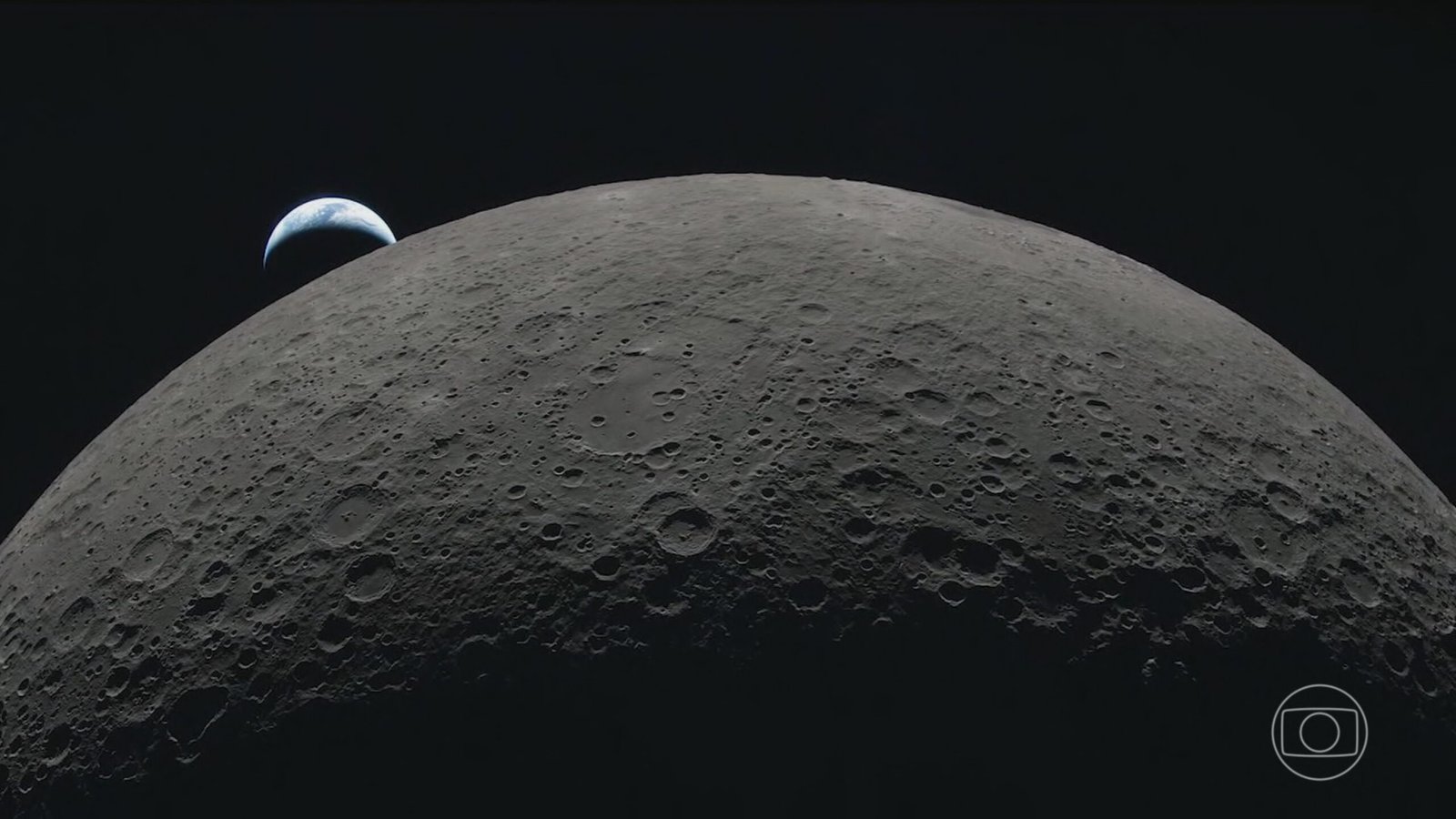
Astronauts photograph the far side of the Moon During their unprecedented journey, astronauts on NASA’s Artemis II mission spent around seven hours observing the lunar surface from a distance of 6,500 kilometers. The proximity allowed a detailed view of regions that, until today, were only studied by probes and satellites. Through the windows of the Orion spacecraft, Reid Wiseman, Victor Glover, Christina Koch and Jeremy Hansen captured stunning photos of rarely seen celestial phenomena. Among the images are the “set of the Earth” and a prolonged solar eclipse. Artemis II astronauts delight the world with new photos of the Moon and Earth Jornal Nacional/ Reproduction They reported unusual colors, such as greenish and brown tones, and wavy patterns on the surface — very different from the uniform gray appearance normally associated with the Moon. These formations were observed especially on the hidden side, an older, mountainous and cratered region, in contrast to the visible side of the Moon, marked by large dark plains of volcanic origin. The experience also allowed unprecedented comparisons between the Earth and the Moon seen from deep space. In one moment, the astronauts managed to observe both at the same time. “The Earth looks much brighter,” said astronaut Christina Koch, highlighting the difference in reflectivity compared to the moon. The four Artemis II astronauts became the first humans in decades to observe a part of the lunar territory Joe Raedle/Getty Images Equipment such as the Lunar Reconnaissance Orbiter had already mapped the Moon in high resolution, but only the human eye is capable of identifying patterns, contrasts and details that are not always captured by automated instruments — in addition to translating these perceptions into direct descriptions. “The moon is about three to four times the size of Earth and is almost full, just a small crescent out there. It’s magnificent! A majestic view from here,” said Reid Wiseman. Astronauts have traveled further from Earth than any human has ever gone. On April 6, 2026, they reached approximately 406.7 thousand kilometers away, surpassing the Apollo 13 record, held since 1970. The ‘Earth sunset’ One of the most striking images of the mission was the so-called “Earth sunset”, when the planet appears disappearing behind the lunar horizon.
[BBC] The Earth seen from the Moon in an image taken during the Artemis II NASA mission via Getty Images The scene is considered a kind of successor to the famous “Earthrise” photo, recorded by the Apollo 8 mission in 1968. This time, however, the movement is reversed: the Earth appears partially illuminated and, little by little, hides behind the cratered surface of the Moon. In the image, it is possible to see details such as clouds over the region of Australia and Oceania. In the foreground, the Ohm crater appears, with layered edges and central peaks formed after the impact that created it. The photograph was taken on the far side of the Moon and became the first public image of the mission in that region. “This is the most beautiful view a human being can ever experience,” Wiseman said. The crew also photographed the “rise of the Earth” through the window of the Orion spacecraft, during its passage over the hidden side of the Moon. The Earth appears as a delicate crescent, with only the upper edge illuminated. “The planet’s soft blue hue and scattered white cloud systems stand out against the darkness of space, while the underside blends into the night,” explains NASA. Earthrise captured through the window of the Orion spacecraft on the Artemis II NASA mission ‘A lamp with little holes in it’ The astronauts were given a final list of 30 targets that they should observe on the lunar surface. Among them was the Orientale Basin, which is 3.8 billion years old and known as the “Grand Canyon” of the Moon. The crater is almost 600 miles (965 kilometers) in diameter. Located at the transition between the visible and hidden sides, the formation has a target-like shape, with concentric rings. According to NASA, it was the first time that humans were able to observe the entire basin directly. Up close, the structure was impressive with its symmetry. “It has a very organized look…much more circular than I remember seeing during our training,” Wiseman said. During the flight, the crew also suggested names for two new craters: “Integrity”, in reference to the Orion spacecraft, and “Carroll”, in honor of Wiseman’s deceased wife. Earth is visible in the darkness of space, beyond the illuminated edge of the Moon. At the bottom left is the Orientale NASA lunar basin. Lighting also helped reveal previously unseen details. When flying over the so-called lunar terminator — the line that separates day and night on the Moon — the crew saw long shadows cast over craters and mountains, highlighting the relief more dramatically than in direct light. In this scenario, craters such as Jule, Birkhoff and Stebbins stood out, as did regions of high terrain around them. Close observation also allowed for more subjective perceptions. Astronaut Christina Koch compared the glow of small craters to an object lit from within. “It looks like a lamp with little holes in it and light shining through them. They’re very bright compared to the rest of the Moon,” Koch said. Rare and prolonged solar eclipse Another remarkable moment was the observation of a solar eclipse from the perspective of the lunar surface — something completely different from what is seen from Earth. From the crew’s perspective, the Moon blocked the Sun for about an hour, much longer than the typical few minutes of a total eclipse observed from our planet. Moon in eclipse in image taken by Artemis II Disclosure/Nasa The astronauts were able to clearly see the solar corona, the outermost layer of the Sun’s atmosphere, forming a bright halo around the dark disk of the Moon. The darkness also revealed stars and even the planet Venus, visible in the background in one of the recorded images. “It’s really hard to describe. It’s an incredible sight, said astronaut Victor Glover. Partial view of the Moon during the solar eclipse. The silver glow is the planet Venus. NASA Additionally, during the eclipse, the crew observed flashes on the lunar surface caused by meteor impacts. “There was a little bit of vertigo,” Wiseman said of the flashes he saw. There are photos of geological events like impact flashes, the phenomenon was seen in real time by humans this time.
Source link
What astronauts saw on the Moon that no one had seen before
14
