
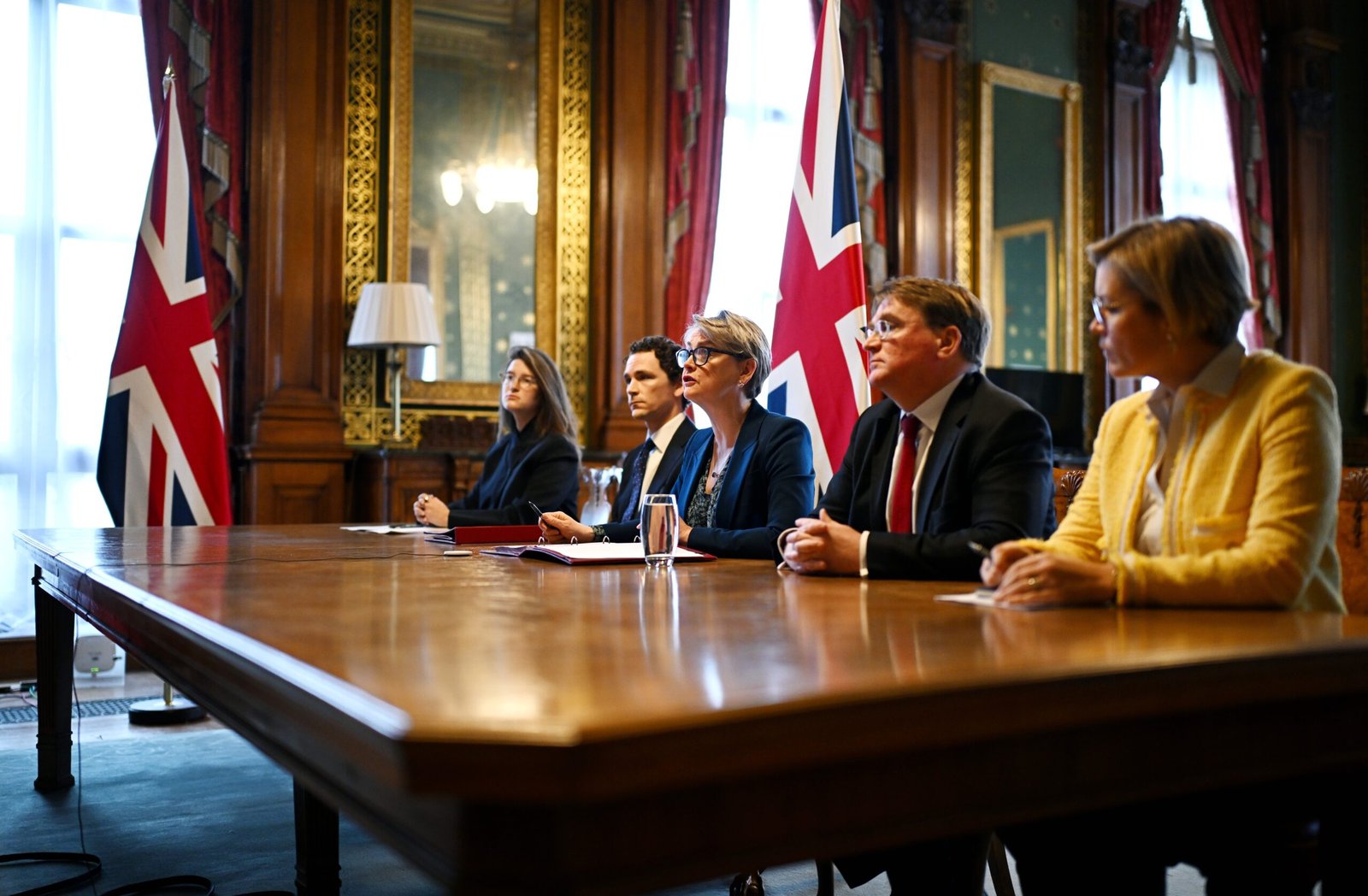
Gulf countries advocate use of force to reopen Strait of Hormuz The UN Security Council is expected to vote on a Bahraini resolution to protect commercial shipping in the Strait of Hormuz, diplomats said on Friday. However, China, Russia and France — who have veto power — are opposed to authorizing any use of force, which puts the approval of the text in doubt. According to The New York Times, the three countries frustrated efforts by Arab states to obtain Council approval for military action against Iran, rejecting any language that would allow the use of force to reopen the sea route. Two diplomats said the 15-member meeting and vote had been rescheduled for Saturday morning instead of Friday, which is a UN holiday. Oil prices have soared since the United States and Israel attacked Iran at the end of February, triggering a conflict that has lasted more than a month and practically closed the region’s main shipping route. UK Foreign Secretary Yvette Cooper, center, speaks during a virtual summit at the Foreign and Commonwealth Office in London on Thursday, April 2, 2026, with around 35 countries to discuss ways of reopening the Strait of Hormuz. Leon Neal/Pool via AP Diplomats said Bahrain, the current president of the Council, has finalized a draft resolution that would authorize “all necessary defensive means” to protect commercial shipping. The text provides for the measures to be applied for at least six months. Still, the proposal faces strong resistance. China’s UN envoy, Fu Cong, said that authorizing the use of force “would legitimize the illegal and indiscriminate use of force” and lead to an escalation with “serious consequences.” According to diplomatic sources, a previous version of the text had the so-called “silence procedure” broken by China, France and Russia — a clear sign of opposition. These countries had also already pressured to remove harsher sections of the proposal. The impasse comes after weeks of negotiations behind closed doors. According to The New York Times, the central point of contention is a section that authorizes countries to use “all necessary means” to guarantee passage and prevent attempts to block the strait. A Security Council resolution needs at least nine votes in favor and cannot be vetoed by any of the five permanent members: the United States, the United Kingdom, France, Russia and China. Infographic shows Strait of Hormuz TV Globo/Reproduction Bahrain’s Foreign Minister, Abdullatif bin Rashid Al Zayani, stated that Iran’s “illegal and unjustified attempt” to control shipping threatens global interests and demands a “decisive response”. According to him, the country would also have attacked civil structures, such as airports and ports. Iran, for its part, has indicated that it intends to maintain supervision of traffic in the Strait of Hormuz even after the end of the war. The blockage of the road — through which around a fifth of the world’s oil and gas passes — has already caused significant impacts on the global economy, increasing energy, transport and insurance costs. According to The New York Times, the union of Arab countries against Tehran in the Security Council represents a profound deterioration in regional relations, after years of attempts at diplomatic rapprochement. Analysts assess that the resolution led by Bahrain has more symbolic than practical weight, as the Gulf countries have limited military capacity and depend heavily on support from the United States. French President Emmanuel Macron also criticized the idea of reopening the strait by force. According to The New York Times, he classified the proposal as “unrealistic”, warning of the risks of attacks and the presence of missiles and Iranian Revolutionary Guard forces in the region. Meanwhile, the United States says it will continue attacks, but has not yet presented a clear plan to reopen the strait — which has fueled new spikes in oil prices and concerns about the safety of international shipping.
Source link
UN votes on use of force in Hormuz; China, Russia and France oppose
29
