
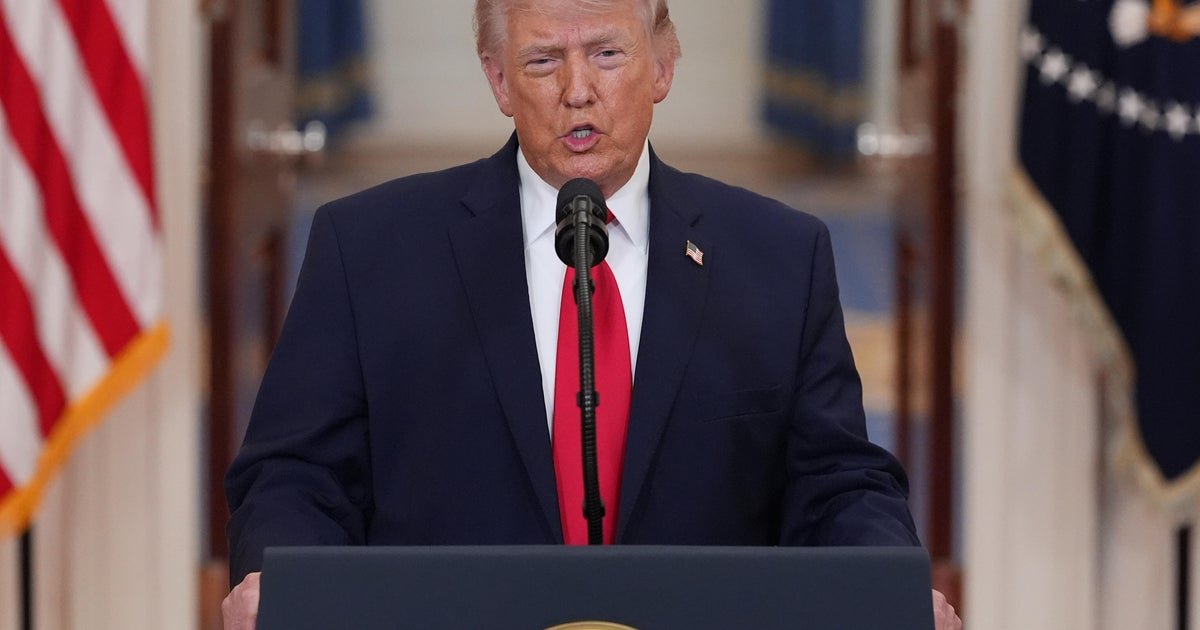
Washington — President Trump predicted in a prime-time address Wednesday that the U.S. will complete its military mission in Iran “very shortly,” and said U.S. forces have achieved “overwhelming victories,” but he did not offer a definitive timeline as questions swirl about when and how the over month-long war could wrap up.
The president, in his roughly 19-minute address from the White House, said the U.S. will hit Iran “extremely hard” over the next two to three weeks. He also threatened to obliterate all of Iran’s electric generating plants and target its oil sites if the country’s leaders don’t make a deal.
“I’ve made clear from the beginning of Operation Epic Fury that we will continue until our objectives are fully achieved,” the president said. “Thanks to the progress we’ve made, I can say tonight that we are on track to complete all of America’s military objectives shortly, very shortly. We are going to hit them extremely hard over the next two to three weeks. We’re going to bring them back to the stone ages, where they belong.”
The president addressed the nation as the war surpasses the one-month mark. In the past, he and his team offered a timeline of four to six weeks before the operation concludes. He said Tuesday that he expects the war to last another two or three weeks, unless Iran reaches a deal — a rough timeframe that he stuck to in Wednesday’s speech.
Mr. Trump reminded America that past wars — World War I, World War II, the Korean War, the Vietnam War and wars in Iraq and Afghanistan — lasted for years, while he expects this operation to end soon. “We are in this military operation, so powerful, so brilliant, against one of the most powerful countries for 32 days, and the country has been eviscerated,” he said.
“In the meantime,” he continued, “discussions are ongoing. Regime change was not our goal. We never said regime change. But regime change has occurred because of all of their original leaders’ death. They’re all dead. The new group is less radical and much more reasonable.”
But if “no deal is made, we have our eyes on key targets,” he said, warning that the U.S. could “hit each and every one of their electric generating plants very hard and probably simultaneously.” The president also threatened to hit Iranian oil industry targets.
Mr. Trump made the case that the war has been successful.
“In these past four weeks, our armed forces have delivered swift, decisive, overwhelming victories on the battlefield,” the president said. “Victories like few people have ever seen before.”
The president lauded the destruction of Iran’s navy and the country’s “dramatically curtailed” ability to launch missiles and drones. He claimed the “core strategic objectives” of the war are “nearing completion,” a version of what the White House has been saying in recent days.
“Never in the history of warfare has an enemy suffered such clear and devastating large-scale losses in a matter of weeks,” he continued. “Our enemies are losing and America, as it has been for five years under my presidency, is winning, and now winning bigger than ever before.”
The president took a moment to recognize the 13 American servicemembers who “have laid down their lives in this fight to prevent our children from ever having to face a nuclear Iran.”
“We salute them and now we must honor them by completing the mission for which they gave their lives,” he said.
The president reiterated an argument he has made before: That without this intervention in Iran, the “most violent and thuggish regime on earth would be free to carry out their campaigns of terror, coercion, conquest and mass murder from behind a nuclear shield.”
Mr. Trump also claimed there would be “no Middle East and no Israel right now” had he not terminated the Obama-era Iran nuclear deal, and alleged Iran was “right at the doorstep” of building a nuclear weapon.” The U.S. intelligence community assessed last year that Iran did not have an active nuclear weapons program, and was several months away from turning its highly enriched uranium into a nuclear weapon if it chose to do so.
“They were also rapidly building a vast stockpile of conventional ballistic missiles and would soon have had missiles that could reach the American homeland, Europe and virtually any other place on earth,” he said.
The president blamed rising U.S. gas prices on the Iranian regime.
“Many Americans have been concerned to see the recent rise in gasoline prices here at home,” he said. “This short-term increase has been entirely the result of the Iranian regime launching deranged terror attacks against commercial oil tankers and neighboring countries that have nothing to do with the conflict. This is yet more proof that Iran can never be trusted with nuclear weapons.”
The president also said countries that heavily rely on the Strait of Hormuz, a major fuel route which Iran has effectively shuttered, “must take care of that passage” and “grab it and cherish it.”
He said countries that can’t purchase sufficient fuel should purchase oil from the U.S.
“We have plenty, we have so much,” he said.
He also called on those countries to “go to the strait and just take it, protect it.”
When the conflict is over, “the strait will open up naturally,” Mr. Trump said, repeating a version of the line he’s said before.
A White House official told CBS News the president will use Wednesday’s speech to restate his two-to-three-week timeline and “highlight the United States military’s success in achieving all of its stated goals prior to the operation.” The official said the military operation is meeting or exceeding all of its benchmarks so far.
Still, hundreds of U.S. Special Operations Forces and thousands of Marines and Army paratroopers are now in the Middle East, giving Mr. Trump additional military options in Iran if he chooses to expand the war, sources told CBS News earlier this week. If needed, those forces could participate in operations to reopen the Strait of Hormuz, target Iran’s Kharg Island oil terminal or seize Iran’s stockpile of enriched uranium.
Even as Mr. Trump insists a main goal is ensuring Iran never attains a nuclear weapon, he told Reuters he doesn’t care about the highly enriched uranium Iran has stored in underground tunnels. If further enriched, the material could be used for nuclear weapons, but seizing such material would likely require a risky U.S. ground operation. The U.S. intelligence community assessed last year that Iran was not actively trying to build a nuclear bomb.
“That’s so far underground, I don’t care about that,” the president said of Iran’s enriched uranium, much of which is believed to be buried underneath rubble from a previous round of U.S. strikes last summer. “We’ll always be watching it by satellite.”
Mr. Trump said he will also mention NATO allies in his speech Wednesday night, particularly his frustration over what he views as their failure to help the U.S. open the Strait of Hormuz, which normally carries one-fifth of the world’s oil supply. Iran’s effective closure of the strait has disrupted the supply of oil and sent prices sharply higher.
The president said he is “absolutely” considering withdrawing the U.S. from the treaty organization formed in the wake of World War II, in response to allies’ decision not to help the U.S. with the strait.
He told CBS News senior White House correspondent Weijia Jiang on Tuesday that he’s not ready “quite yet” to abandon his attempts to force Iran to open the strait to all shipping traffic. The president said other countries that are reliant on Middle Eastern oil “have to come in and take care of it.”
“Iran has been decimated, but they’re going to have to come in and do their own work,” he said.
Earlier in the war, Mr. Trump has suggested he may ramp up attacks on Iran and target the country’s energy infrastructure if it doesn’t allow ships to sail freely through the Strait of Hormuz.
Meanwhile, the war abroad is affecting prices at home in a time when Americans view the economy as struggling and fear the war will make that worse. The average price for a gallon of gas in the U.S. topped $4 this week for the first time in nearly four years. Diesel prices have also soared, and consumer good prices are likely to increase with them.
A CBS News poll from last month shows most Americans aren’t sold on the Iran war, with 60% disapproving of the U.S. taking military action in Iran and 67% saying they are unwilling to pay more for gas during the conflict, though an overwhelming majority of Republicans support the war.
Asked about spiking gas prices, Mr. Trump said Tuesday: “All I have to do is leave Iran, and we’ll be doing that very soon, and they’ll come tumbling down.”
