
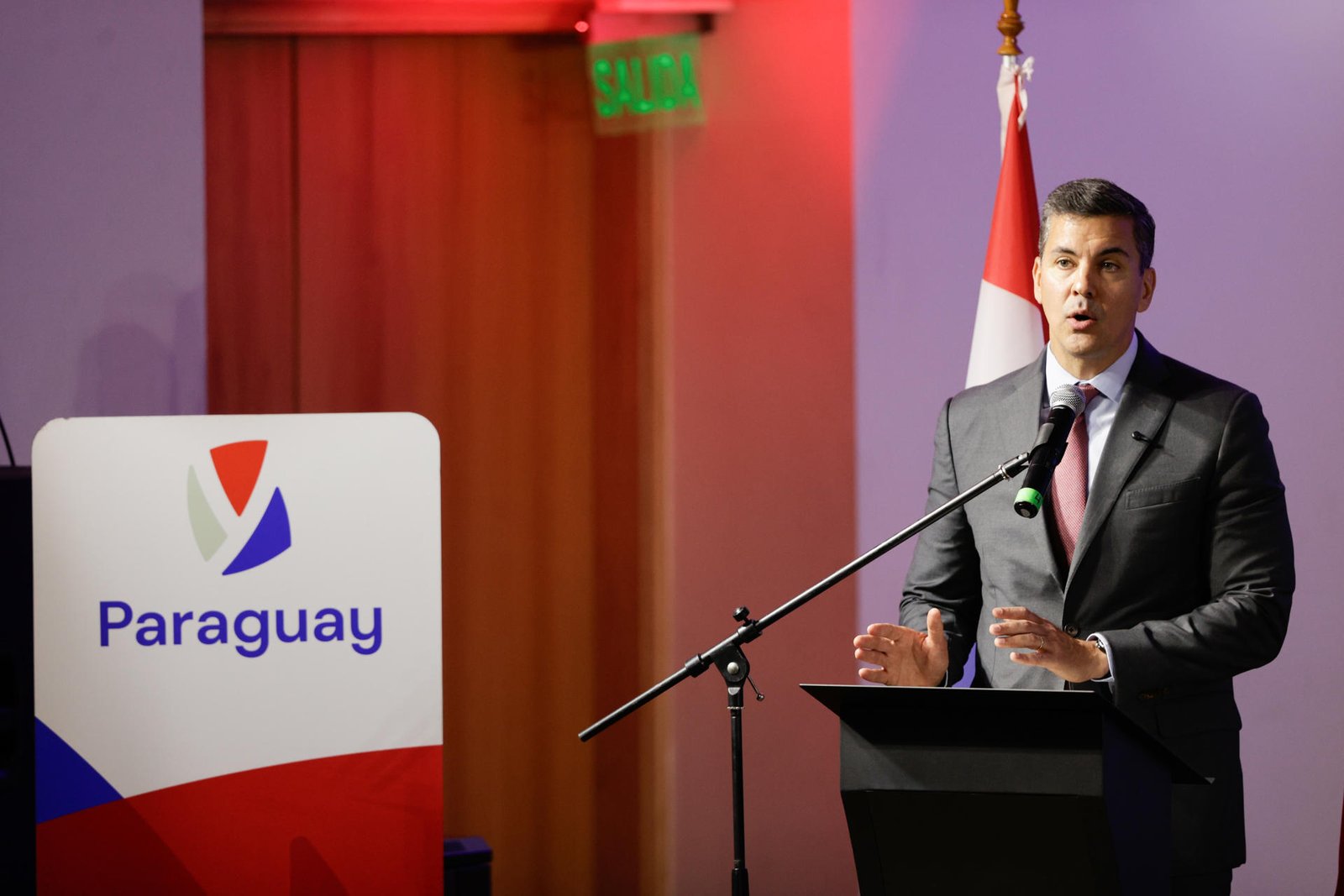
Paraguay has intensified its rapprochement with the United States amid the movement towards greater American presence in Latin America, driven by signals from Donald Trump. The country seeks to take advantage of this scenario to take its economic “miracle” to a new level.
The renewed partnership between the conservative government of President Santiago Peña and the government of Donald Trump, mainly in the area of defense and critical mineralshe can leverage Paraguay’s international visibilitygiving even more support to this economic growth already seen, according to Adriana Melo, specialist in Finance and Taxation.
Peña has been one of Trump’s support arms in South America, alongside Argentine Javier Milei, Ecuadorian Daniel Noboa and Chilean José Antonio Kast. Under his management, Paraguay joined a White House strategic plan to explore rare earths and other critical minerals. The aim of the American program is to reduce dependence on China and shield US industry from supply chain shocks.
“Paraguay and the United States commit to intensifying cooperative efforts to accelerate the secure supply of critical minerals needed to support the manufacturing of advanced and defense technologies, as well as the strengthening of their respective industrial bases,” Paraguay’s Ministry of Foreign Affairs stated in February.
In this context, To attract private investment in the sector, the Paraguayan government is preparing an update to its mining code. In January, Paraguay’s Deputy Minister of Mines and Energy, Mauricio Bejarano, stated that “indications” of the existence of rare earth elements had been detected in the country.
In the field of security, Peña sanctioned, in March, a strategic military partnership with the United Stateswhich allows the deployment of American military personnel in the South American country, in the so-called Status of Forces Agreement (Sofa, for its acronym in English).
The text allows military personnel and civilian employees of the US Department of War who are on mission in Paraguay to be under the responsibility of American Justice. It also authorizes the movement of American troops, equipment and military aircraft upon notification to local authorities.
The new partnership reinforces that one of Washington’s objectives will be greater surveillance of the Triple Border, a region where organized crime has expanded its operations. Along these lines, Paraguay made another nod to the United States by designating Brazilian factions, including the Primeiro Comando da Capital (PCC), as terrorist groups. Trump has been pressuring Brazil to do the same, but the PT administration refuses.
The movement has been accompanied by public signs of approach. Recently, US Undersecretary of State Christopher Landau described the Paraguay as “a great friend” of the USA.
Agreements may extend to other areas
The partnership between the US and Paraguay can go beyond mineral exploration and security. Economist Cláudio Shimoyama, professor of Economic Sciences at the Pontifical Catholic University of Paraná (PUCPR), cites possible agreements in the areas of energy, technology and agriculture.
Last year, the secretary of American State, Marco Rubio, suggested that the White House would be interested in purchasing Paraguayan energy produced at the Itaipu hydroelectric plant with the purpose of fueling artificial intelligence (AI) projects.which would be installed in Paraguay.
“Hydroelectric energy is an important source of income for Paraguay, with the Itaipu plant being one of the largest in the world”, recalled Shimoyama.
If the agreement is signed, according to the economist, negotiations with Brazil on a review of the binational Itaipu administration treaty could undergo changes based on American influence.
Agriculture, recalls the expert, can be boosted by increasing exports of agricultural products to the USA. Last year, sales of Paraguayan beef to the USA doubled, placing Americans as the second largest buyers of Paraguayan beef, behind only Chile.
Paraguay becomes the “Guarani tiger” and attracts foreign investment
Until a few years ago, a peripheral region in America, Paraguay is now experiencing a strong influx of investment, including from Brazilian companies, which earned it the nickname of “guarani tiger” – reference to the Asian tigers (South Korea, Taiwan, Singapore and Hong Kong) that grew rapidly in the 1990s.
The country’s Gross Domestic Product (GDP) estimated for this year is 4%, driven by the services, industry and construction sectors. The country also stood out with one of the lowest inflation rates in Latin America, standing close to 3.1% at the end of 2025 (accumulated over 12 months), as a result of exchange rate stability and the drop in fuel prices last year.
Marcos Freitas, CEO of the consulting company Be AP and a specialist in business evolution, highlights that the country managed to create a simple environment, with a low tax burden and less bureaucracy, a “dream” for every investor.
“When he [investidor] finds a place where it can operate clearly and the cost does not swallow the operation, the migration movement is natural. With this, Paraguay stops being a ‘sidekick’ in the region and becomes a real and strategic alternative for those who want to serve the South American market efficiently, without carrying a piano on their back”, says Freitas.
Economic growth attracts foreigners and boosts tourism
Another metric of Paraguay’s growth is the increase in the entry of foreigners. In 2025, the country received 47,687 residence applications, an increase of more than 63% compared to the previous year, according to data from the National Directorate of Migration. Of this total, 40,600 authorizations were granted, with growth exceeding 42%. Brazilians easily lead this movement, accounting for more than half of the residences granted.
Tourism has also been gaining strength in the country. Last year, Paraguay received 3.6 million international visitors, a jump of more than 91% compared to the previous year, according to official data. Most of the visits came from neighboring countries, especially Argentina and Brazil.
In this vein, the Paraguayan government is preparing a plan to celebrate 500 years of Asunción, focused on revitalizing the capital. The project is coordinated by the federal government, the municipality of Asunción and the private sector and the target for delivery is 2037, the year in which the city completes five centuries of its foundation.
