
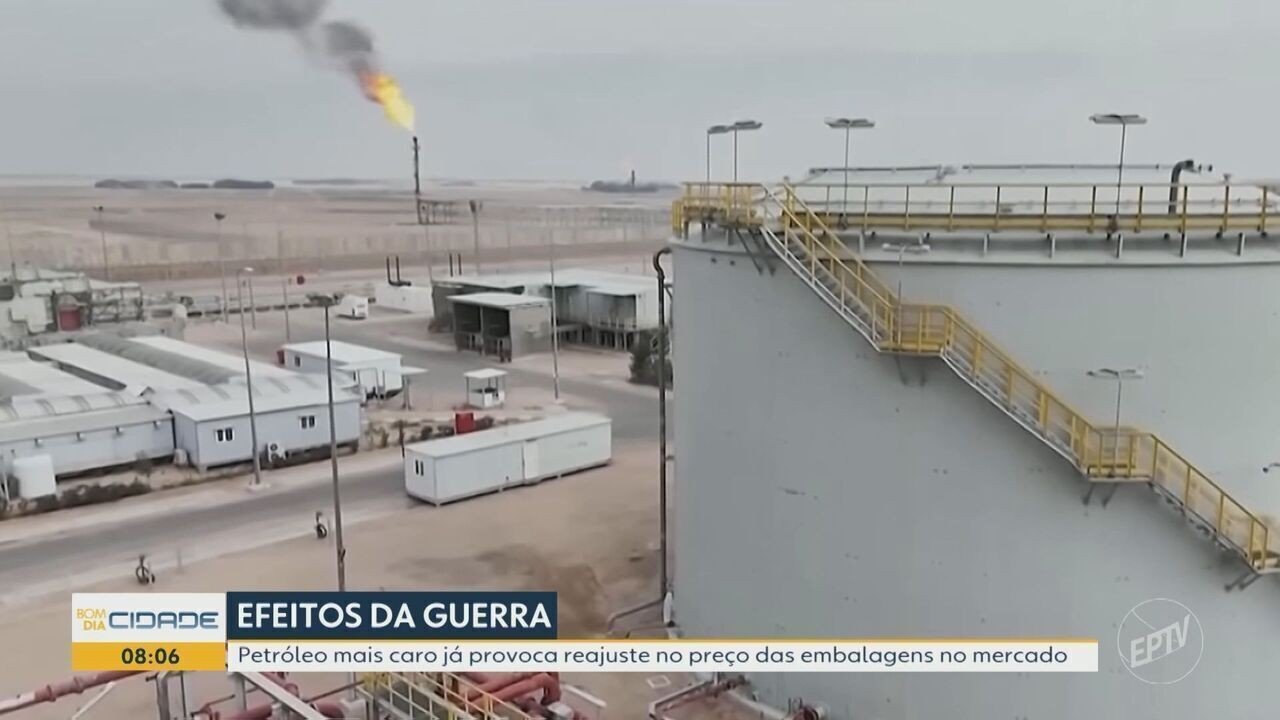
Rising oil pressures packaging prices in Brazil Global oil prices fell and stock markets soared after the United States and Iran pledged a two-week ceasefire agreement that includes the reopening of the crucial Strait of Hormuz waterway. The price of Brent oil, an international reference, fell around 13%, to US$94.80 (R$488.48) a barrel, while oil traded in the US fell more than 15%, to US$95.75 (R$493.40). 🗒️Do you have any reporting suggestions? Send to g1 But prices remain higher than before the conflict began, on February 28 — at the time, a barrel was traded at around US$70 (R$360.97). How this affects Brazil Brazil can benefit from this new scenario, as the drop in Brent oil will invariably hit the national market, which, until then, only had help from a package from the federal government to contain the rise in fuel prices in the country and the impact of the rise in kerosene on the price of airline tickets. Diesel worries the Lula (PT) government, as it is the main fuel that powers the transport of goods and agricultural crops in Brazil. The Palácio do Planalto had already announced, on March 12, R$30 billion to mitigate its increase. The objective was to guarantee a discount of R$0.64 per liter on the price at the pump, by combining tax reductions and a subsidy of R$0.32 per liter produced in Brazil or imported. The subsidy is an incentive given directly to companies by the government. In this second set of actions announced now, the Lula administration increased this subsidy, which will reach R$ 1.12 for a liter produced in the country. There is also an exemption from federal taxes (PIS and Cofins) for aviation kerosene (QAV) — generating savings of R$0.07 per liter of fuel —, two lines of credit worth R$9 billion for the sector and the extension to December of the Brazilian Air Force navigation fees for April, May and June. The problem is that this package is threatened, especially the measures linked to diesel, which have not yet fully reached consumers due to limitations in the implementation of the subsidy. This is because three large companies in the sector (Vibra — the former BR Distribuidora —, Ipiranga and Raízen), responsible for half of private diesel imports, did not adhere to the policy. The lack of adherence would be related to the obligation to follow limits for the price of diesel, established by the National Agency for Petroleum, Natural Gas and Biofuels (ANP), based on market values. In this sense, therefore, a drop in global prices can help overcome the lack of adherence to the government package. The situation in Asia Oil plummets after the announcement of a ceasefire between the US and Iran: how this affects Brazil Costfoto/NurPhoto via Getty Images The main stock indices in the Asia-Pacific region rose on Wednesday morning (8/4). Japan’s Nikkei 225 rose 5%, while South Korea’s Kospi jumped nearly 6%. Hong Kong’s Hang Seng index rose 2.8%, while Australia’s ASX 200 rose 2.7%. U.S. stock market futures also pointed to a higher open on Wall Street. The cost of energy had soared in this region as oil and gas supplies from the Middle East were severely disrupted after Iran threatened to attack ships that tried to use the Strait of Hormuz. Despite his threats, Trump was likely wary of letting energy prices rise further by intensifying the conflict, says Xavier Smith of market research firm AlphaSense. That could have led to a “self-inflicted economic wound” that few would risk, especially considering the looming pressure of approval ratings on Trump’s leadership, said Smith, who is director of polling. More oil tankers stranded near the strait may be able to pass through the waterway during the ceasefire, providing some relief for markets in the coming weeks, says analyst Saul Kavonic of financial services firm MST Marquee. Despite the conflict, some ships passed through the Strait of Hormuz, although in much smaller numbers than usual. Asian countries — including India, Malaysia and the Philippines — have negotiated safe passage for their ships in recent weeks. China has also admitted that several of its ships have crossed the strait since the start of the war. And a Maltese-flagged container ship belonging to French company CMA CGM crossed the sea route, media organization BFM TV, which belongs to the shipping company, confirmed on Friday. A Japanese ship carrying natural gas also managed to exit the strait, shipping giant MOL confirmed. Kavonic said that although there is a ceasefire in place, it is still unlikely that energy production in the Middle East will fully resume until there is confidence in a lasting peace agreement. He added that resuming production could also take months due to the damage caused to the region’s energy infrastructure. Iran has attacked energy and industrial infrastructure across the oil-rich region in retaliation for US and Israeli attacks. Repairing the damage could take years and cost more than $25 billion, according to research firm Rystad Energy. Energy prices soared in mid-March following attacks on Qatar’s Ras Laffan industrial hub, which produces about a fifth of the world’s liquefied natural gas. The hub’s owners said the attacks reduced the country’s export capacity by 17% and that it will take up to five years to repair the damage. Asia has been particularly hard hit by the economic fallout from the war with Iran, as many countries rely heavily on energy from the Gulf. Governments and companies across the region have announced measures in recent weeks to address high energy prices and fuel shortages. On March 24, the Philippines, which imports 98% of its oil from the Middle East, became the first country to declare a national energy emergency after gasoline prices more than doubled. Many airlines in the region have increased fares and reduced flights in response to rising jet fuel prices. Developing countries in Asia have been especially hard hit by the conflict, as many do not have their own refineries or sufficient oil reserves, says Ichiro Kutani of the Japan Institute of Energy Economics. “The ceasefire is good news for Asian countries. If it holds, oil prices will return to normal levels, although this will take time.”
Source link
Oil plummets after announcement of ceasefire between US and Iran: how this affects Brazil
24
