
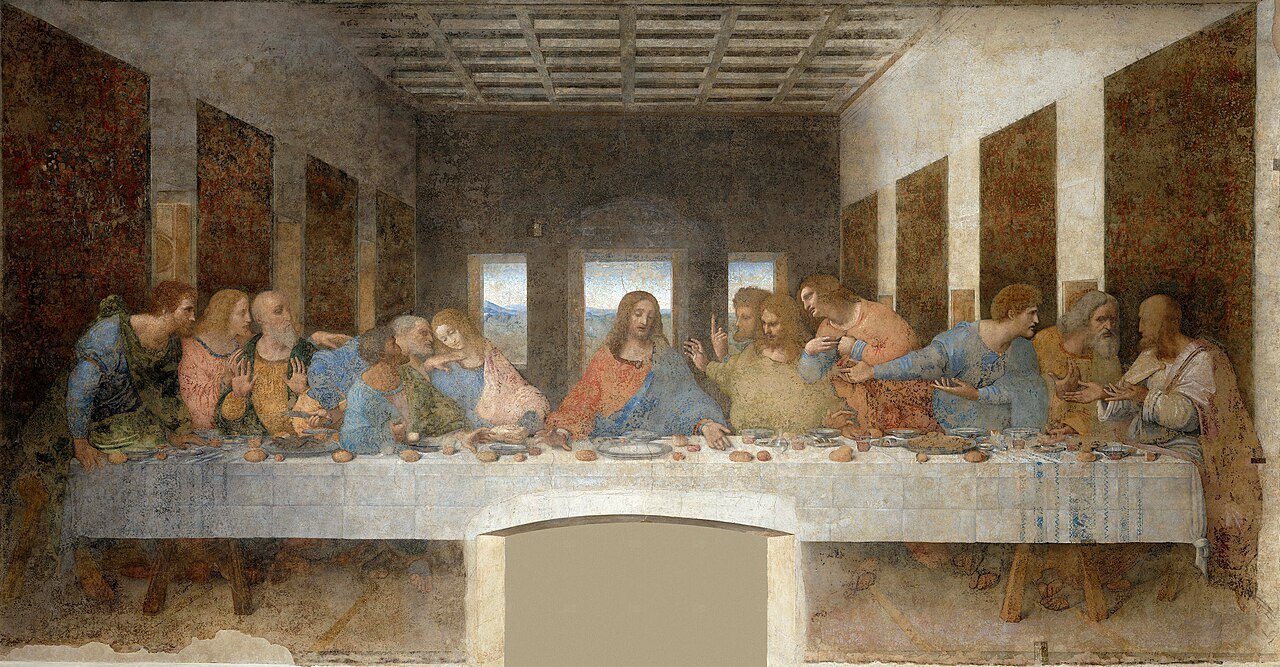
In 2025, an international team of researchers managed to decipher dozens of ancient inscriptions on the walls of one of the most symbolic sites of Christianity in Jerusalem. The records, which were invisible to the naked eye for centuries, reveal the presence of pilgrims from different parts of the medieval world, including Austrian nobles, who visited the place known as the Room of the Last Supper.
O study was conducted by experts from the Austrian Academy of Sciences (ÖAW) and the Israel Antiquities Authority (IAA). In total, the researchers identified around 40 elements of ancient graffiti in archeology on the walls of the building known as the Cenacle, located on Mount Zion.
Among the finds are inscriptions, religious symbols and five coats of arms of European noble families.
History and faith: how does the site of the Last Supper preserve the marks of pilgrims for centuries?
According to Christian tradition, the Room of the Last Supper is the space where Jesus would have had his last meal with the apostles before his crucifixion. The current building was built during the Crusades in the 12th century, but the site has been revered by pilgrims since at least the 4th century.
Over the centuries, visitors have left signatures, drawings and messages on the walls. Silent marks of faith and devotion that today help to reconstruct aspects of medieval Christian history.
Graffiti reveals medieval pilgrims and connections between Europe and the Middle East
Among the most relevant discoveries is one of the so-called Austrian graffiti from Jerusalem: a coat of arms associated with the region of Styria in present-day Austria. Researchers attributed the symbol to the nobleman Tristram von Teuffenbach, who took part in a pilgrimage to Jerusalem in 1436.
He was part of a delegation led by Frederick III, then Archduke of Austria and future emperor of the Holy Roman Empire. The trip brought together around one hundred nobles who traveled the Holy Land visiting places considered sacred.
Another important discovery is an Armenian inscription with the expression “Christmas 1300”. The record may help clarify a historical debate over the possible passage of Armenian king Het’um II of Armenia through Jerusalem after his army’s victory in the battle of Wādī al-Khaznadār, in Syria, in 1299.
In addition to these marks, the researchers identified medieval inscriptions at the sacred site left by visitors from different regions. There are records linked to pilgrims from Armenia, Syria, Serbia and territories that today correspond to Germany and the Czech Republic.
Curiously, the largest group of graffiti was produced by Arabic-speaking Christians from the Middle East. These records help to broaden our understanding of the cultural and geographic diversity of the medieval pilgrims who traveled to Jerusalem.
Technology helped reveal inscriptions and expand understanding of medieval pilgrims
Many of the inscriptions were extremely worn and practically invisible. To reveal them, researchers turned to digital technology to decipher inscriptions, combining multispectral photography with a technique known as Reflectance Transform Imaging (RTI).
This method records the surface of the walls with different lighting angles, allowing very subtle marks to be identified. After documentation on site, the images were analyzed in the laboratory, where the photographic records were digitally combined to make the inscriptions legible.
Among the most curious finds is a fragment of an inscription in Arabic that mentions “…ya al-Ḥalabīya”. The grammatical form indicates that the graffiti was left by a Christian pilgrim from the city of Aleppo, in present-day Syria – a rare material trace of female pilgrimage in the Middle Ages.
The researchers also identified drawings and symbols associated with the Christian tradition, such as representations of objects linked to the Last Supper. One of them shows a cup, a plate and a round loaf of bread with a hole in the center, similar to traditional Jerusalem bread.
According to historian Ilya Berkovich, a member of the research team, the set of these inscriptions offers a broader portrait of the circulation of pilgrims in medieval Jerusalem.
“When analyzed together, the inscriptions provide a unique insight into the geographic origin of the pilgrims. This diversity was much greater than suggested by the traditional research perspective, dominated by Western sources,” he stated in a press release.
For researchers, graffiti are not just marks left by travelers. They constitute a valuable historical religious heritage and a direct testimony to the devotion and experiences of medieval pilgrims who crossed continents to visit places considered sacred in Christian history.
