
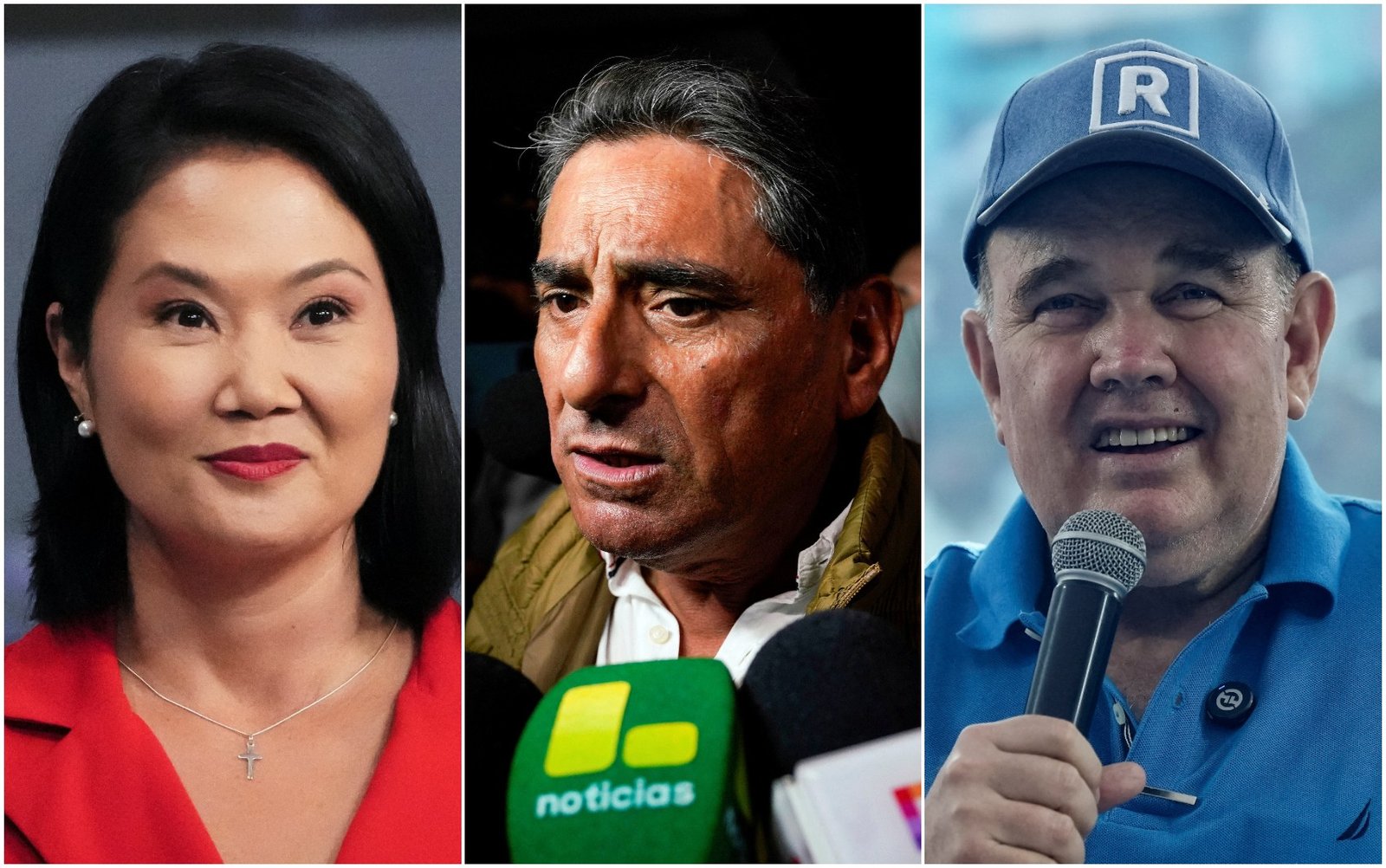
Election in Peru: Peruvians go to the polls in a dispute with a record number of candidates Voters in Peru go to the polls this Sunday (12) to choose the future president, and the only certainty is that there are only uncertainties in this Peruvian election. Two types of numbers that show this. One is the number of candidates: 35 presidential candidates running for office – a record and a clear symptom of a fragmented, weakened and discredited party system. The second number is even more eloquent: the fragmentation of voting intentions, with the main candidates unable to even break the 20% barrier just a few days before the election. That is, no one actually leads: everyone just survives in this campaign. ➡️If none of the candidates reaches half the votes, the election will go to a second round, scheduled for June (12). Photo shows political advertising in Lima, Peru, on April 8, 2026. The country goes to the polls on Sunday (12) in an election with a record number of presidential candidates. Reuters/Angela Ponce The 3 main candidates, all from the right, are: Keiko Fujimori, Carlos Álvarez and Rafael Lopez Aliaga Reuters/Angela Ponca; Reuters/Leslie Moreno; Reuters/Angela Ponce Keiko Fujimori, daughter of former president Alberto Fujimori, appears with 15% of voting intentions, according to the Ipsos-Peru 21 survey. It is her fourth attempt to come to power, and this persistence reveals that she has a loyal electoral base, but it also shows Fujimorism’s inability to produce alternatives. Close behind is Carlos Álvarez, with 8%. Humorist and screenwriter, he is the model of “outsider” taken to the extreme: he defines himself simultaneously as “right, left and center” and proposes measures such as the death penalty, in addition to the country’s withdrawal from the American Convention on Human Rights. Hot on his heels is Rafael López Aliaga, with 7%. Former mayor of Lima and representative of an ultra-conservative right. A fervent Catholic, he himself says that he self-flagellates with a hair shirt to avoid falling into sexual temptation and he himself says that he has not had sexual relations since 1981. But, to make the scenario even more intricate, there is the businessman and former mayor of Lima, Ricardo Belmont, aged 80, who would be in a technical tie between Álvarez and Aliaga, according to some surveys. And due to this atomization of votes, the Parliament that emerges from these elections will also be made up of small groups, which will mean that the next president will not have his own majority. Peru elects new president amid deep political crisis History of political crises Peru has had 9 presidents in the last 10 years: 3 elected and 7 interim. The president who will be elected will be the tenth in a decade. All presidents elected this century went to prison for corruption scandals and one for attempting a self-coup. And a fact of fantastic realism: the official portraits of the penultimate president, José Jerí, were ready precisely in the week of his dismissal. They were delivered to ministries minutes after Congress voted to impeach him. The paintings had barely arrived and the president had already left. What is the reason for so much instability in Peruvian politics? Peru has a peculiar system, which is neither presidential nor parliamentary. It’s a bizarre mix. When a president has a parliamentary majority, problems do not occur, as was the case between 2000 and 2016 with Alejandro Toledo, Ollanta Humala and Alan García. They all had a parliamentary majority. And that’s why they governed calmly. However, between 2015 and 2016, several corruption scandals began to emerge that affected major political parties. In those years, former presidents Toledo, Humala and García were accused of corruption in the Peruvian edition of the Odebrecht case. Toledo fled the country for the United States. He was later extradited, tried in Lima and is now in prison; Humala is in prison; and Alan Garcia, when the police arrived to detain him, chose to commit suicide. In 2016, amid the crisis of political parties, the presidency passed to Pedro Pablo Kuczinzky, who was elected without a parliamentary majority. It was at this moment that the fragmentation that still plagues the country began. In 2018, Kuczsinzky was ousted in a scandal that also shook the main opposition party, the Fujimori family. His deputy took office, but was later removed. This generated an immense weakening of presidents before the Legislative Power. Parliament has become accustomed to overthrowing presidents, as impeachment procedures are fast. In 2021, Pedro Castillo was elected, with a minority party in Parliament. A year later Castillo attempted a self-coup d’état. But he failed and was dismissed and arrested. His deputy, Dina Boluarte, took office. But without any parliamentarian to support her, Boluarte was removed from office last year. José Jerí then took over, who lasted 4 months in office, and now José María Balcázar governs on an interim basis. Nothing on the political horizon indicates that this instability will end. It only tends to remain with these Sunday elections.
Source link
Election in Peru: Peruvians go to the polls in dispute with a record 35 candidates and unpredictable scenario
7
