
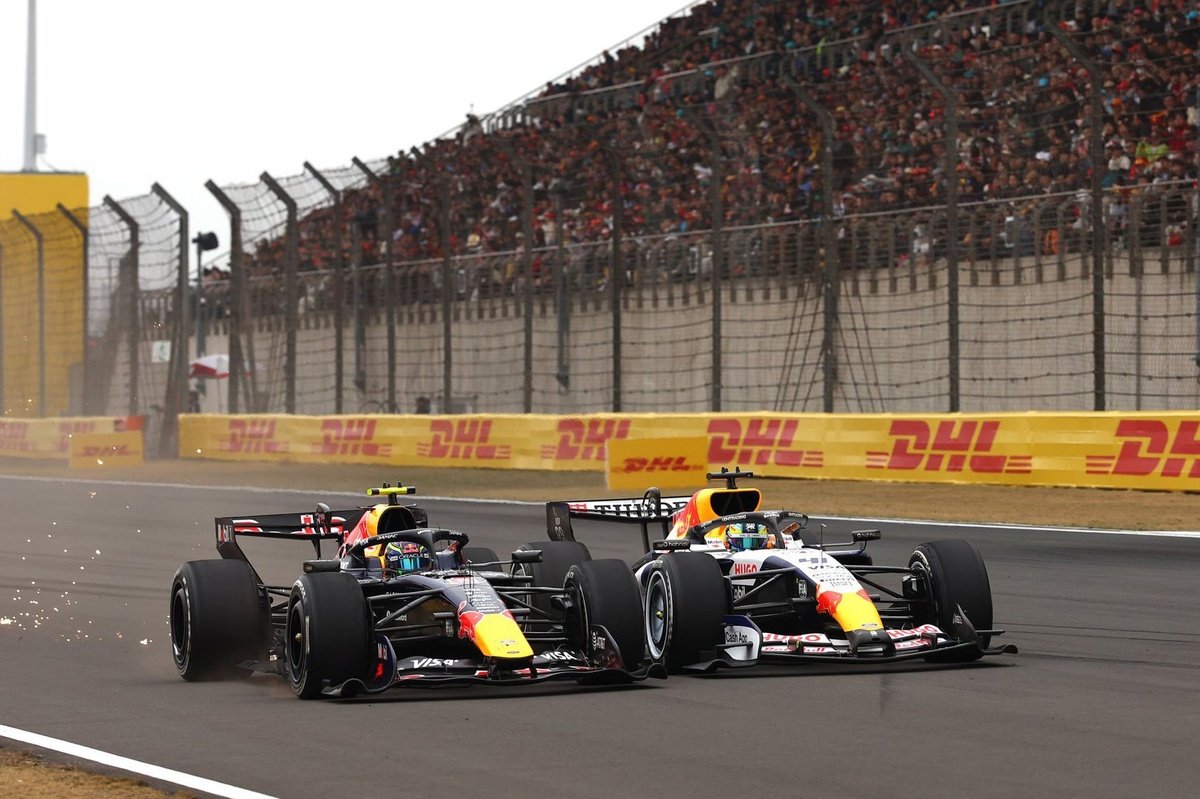
The first two races of the Formula 1 season have revealed an under-the-radar trend, one that offers a clearer picture of what had been hinted at in the Bahrain tests and of certain characteristics of the Red Bull power unit.
As seen in Melbourne and confirmed in China, the Racing Bulls VCARB 03 is one of the most difficult cars to overtake on the entire grid.
This was something that Oliver Bearman found to his detriment during the Australian Grand Prix, and the young Englishman spent many laps behind Arvid Lindblad without managing to find a gap to overtake.
Part of the explanation lies in a specific quality of the Red Bull-Ford power unit, which seems to have transformed top speeds into an invaluable tool in qualifying and duels.
This was also evident last weekend in Shanghai, where Racing Bulls repeatedly managed to keep their closest rivals behind. On a track like China, where battery management allows for significant energy storage for the long back straight and thus allows for an attack, this factor can be less decisive.
But on other circuits, where the electric component plays a different role and top speed becomes more important again, the advantage becomes decidedly more pronounced.
Melbourne is the perfect example. The myriad straights and limited opportunities for energy recovery forced anyone trying to overtake one of the two VCARB 03s to consume a lot of battery, with the real risk of finding themselves vulnerable in the next part of the circuit. It’s precisely in this scenario that the Racing Bulls’ high top speeds seem to make the difference in defence.
Arvid Lindblad, Racing Bulls
Photo by: Lars Baron / Getty Images
This characteristic seems to be linked above all to the operating philosophy of the Red Bull powertrain. Already in the first few days in Bahrain, very high top speeds were seen, a sign of a different use of the hybrid compared to its rivals; the Red Bull PU tends to favour maintaining higher top speeds in the final part of the straights, where others suffer more marked derating.
It’s no surprise, then, that on particularly energy-critical tracks with long stretches of flat-out racing, Racing Bulls managed to establish itself as the top midfielder in qualifying. In the race, however, the picture changes slightly: the Faenza-based team tends to suffer through longer stints a bit more compared to Haas, which appears to have a very competitive chassis – but also limitations due to the way its Ferrari power unit is operated.
The same can be said of Red Bull, which in Melbourne had placed a car on the second row, ahead of McLaren and Ferrari. However, it should be remembered that Ferrari had suffered deployment issues in Q3, a factor that had widened the gap to Mercedes more than it should have.
Conversely, on a track that offers more opportunities for recharging and emphasises less wide-open throttle, rivals have made a step forward, closing the gap thanks in part to what they learned from the new power units in Australia. On this front, Alpine is the most obvious example: from a stinging elimination in the early stages of qualifying in Melbourne, they moved on to finish in the points with both cars in China.
By contrast, Red Bull itself struggled to break out of the midfield in China. This was partly due to first-lap mishaps involving both drivers, but also because throughout the weekend, the car showed a growing gap to the leaders – not only in power unit terms, but also due to chassis deficiencies.
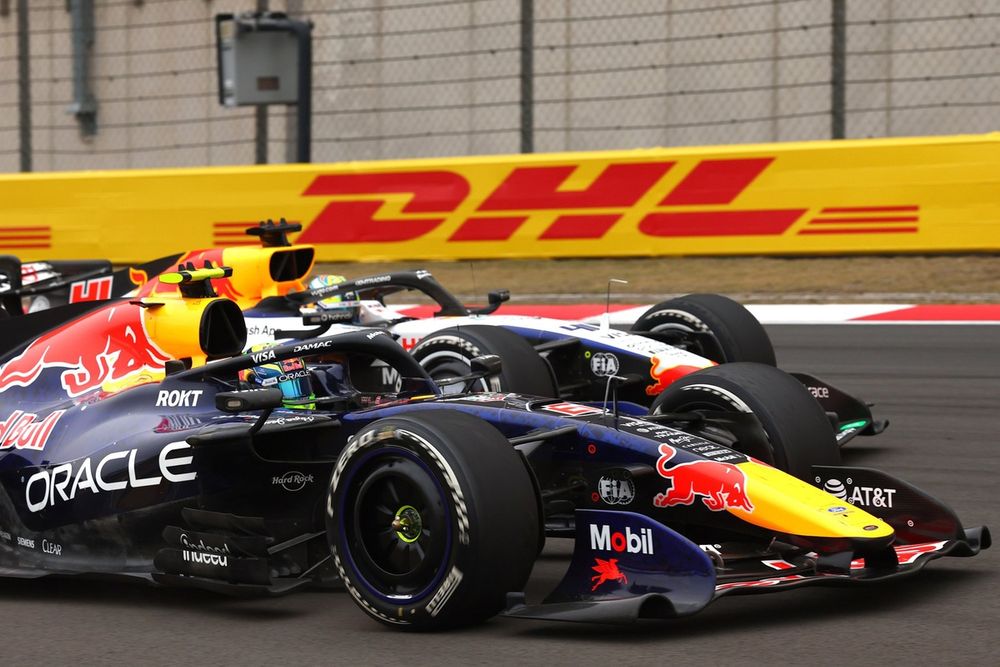
Isack Hadjar, Red Bull Racing, Arvid Lindblad, Racing Bulls
Photo by: Andy Hone/LAT Images via Getty Images
Racing Bulls is thus exploiting some of the characteristics of the power unit better than Red Bull, which has shortcomings both aerodynamically and in terms of weight, which is more pronounced – sources have suggested the RB22 is around 15-20kg overweight.
During the race, Racing Bulls had been somewhat unlucky: incidents and close duels ended up widening the gap to other midfield teams. Despite everything, the Italian squad still finished an excellent seventh courtesy of Liam Lawson’s excellent drive, curiously ahead of Isack Hadjar’s Red Bull. The Frenchman had spun early on, but the deployment of the safety car allowed him to close the gap and realign himself strategically.
This doesn’t mean that the VCARB 03 is necessarily more competitive than Red Bull’s RB22, but it demonstrates different characteristics of the good work done in Milton Keynes on the power unit side. Let’s not forget that this is the first engine built in-house, albeit with high-level technicians.
What the two teams currently have in common, compared to their closest rivals, appears to be a lack of outright power rather than a problem solely related to the power unit. There’s certainly room for improvement on the engine front, but that’s not where the bulk of the gap lies. And, especially if the benchmark is Ferrari and Haas, the power unit no longer seems to be the main differentiator.
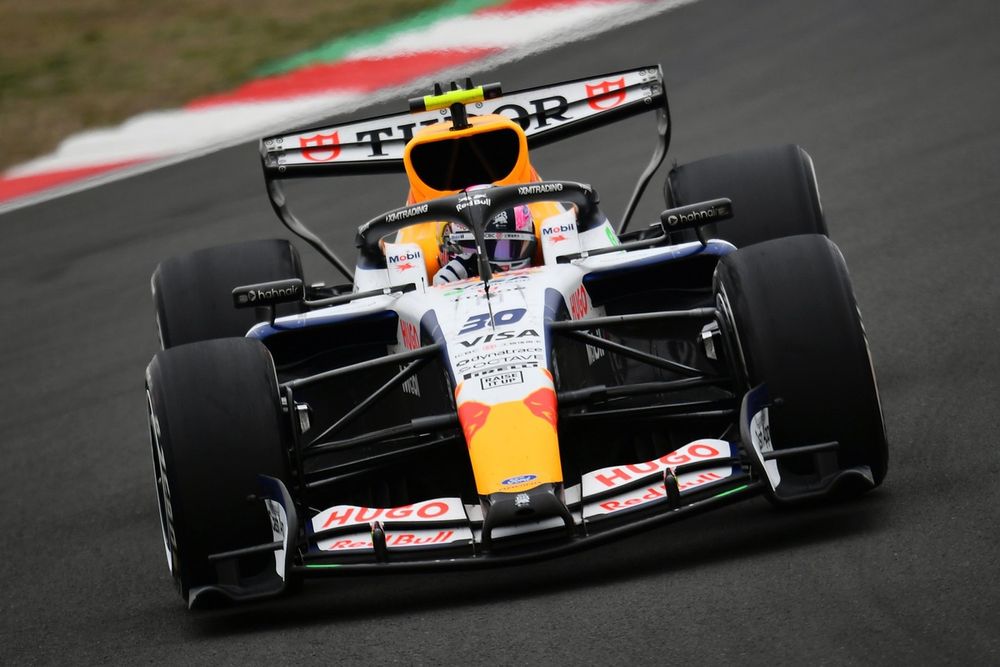
Liam Lawson, Racing Bulls
Photo by: James Sutton / Formula 1 / Formula Motorsport Ltd via Getty Images
We want to hear from you!
Let us know what you would like to see from us in the future.
– The Autosport.com Team
