
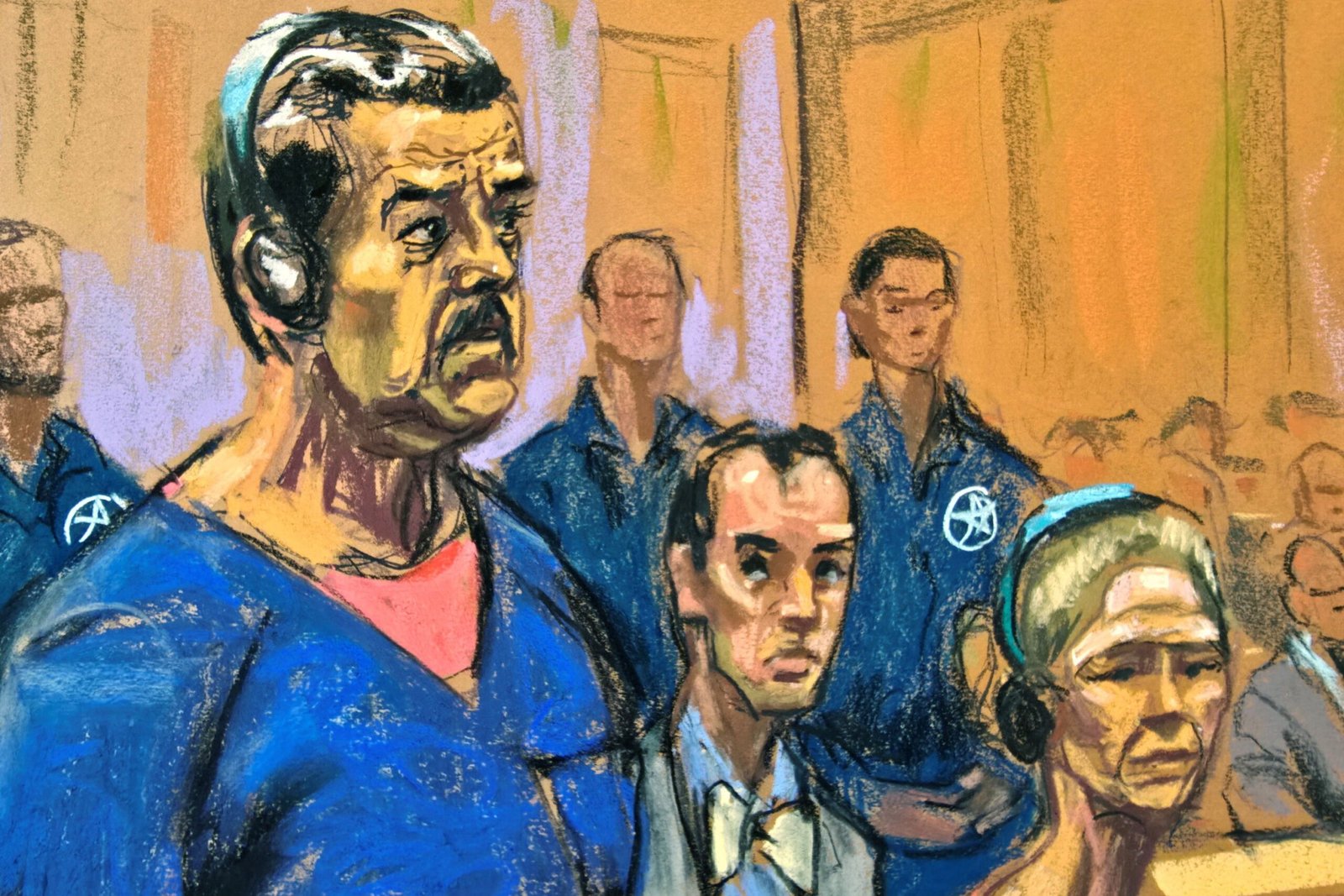
Maduro pleads innocent at a hearing in New York and claims he is still the president Captured on January 3, the former Venezuelan president, Nicolás Maduro, and his wife, Cilia Flores, appear at the second hearing of the legal process they are facing in the United States this Thursday (26), at the Southern District Court of New York. ✅ Follow g1’s international news channel on WhatsApp Judge Alvin K. Hellerstein analyzes the motion to dismiss the case presented by Maduro and Flores’ lawyers, who allege that the Treasury Department interferes with their constitutional right to defense by denying access to Venezuelan State resources to cover the fees of their legal teams. “The government of Venezuela, in accordance with its laws, has the obligation to pay for Mr. Maduro’s defense expenses,” states the motion presented on February 26 by the former president’s lawyer, Barrick Pollack, to the court. Pollack is an American lawyer recognized for his skills as a litigator and has won victories in cases of great public exposure, such as the release of Julian Assange, the creator of Wikileaks. He specializes in white-collar crime, public corruption, national security, competition law, civil litigation and appellate matters. The motion presented to the court recalls that the Treasury Department’s Office of Foreign Assets Control (OFAC) granted a license to authorize Maduro’s defense to receive resources from Caracas, despite US government sanctions against Venezuelan authorities. “However, unilaterally and without any explanation, OFAC subsequently modified this license so that it now prohibits the receipt of funds from the government of Venezuela for defense expenses,” the document states. “As a consequence, Mr. Maduro, who does not have the resources to hire legal assistance, is being deprived of his constitutional right to a lawyer of his choice.” In response to the motion, the Prosecutor’s Office opposed this argument and denied that the defendants’ right to defense had been violated. “Now it is up to the judge to examine the arguments presented by the defense lawyers, examine the arguments presented by the Prosecutor’s Office and, based on these arguments and the law (…) make a decision”, explained on his YouTube channel the Venezuelan lawyer Nizar El Fakih, who is closely following the case. Maduro is accused of the crimes of narco-terrorist conspiracy, conspiracy to import cocaine, possession of machine guns and destructive devices, and conspiracy to possess machine guns and destructive devices. Flores faces charges of conspiracy to import cocaine, possession of machine guns and destructive devices and conspiracy to possess machine guns and destructive devices. Both pleaded not guilty on January 5, during their first hearing in the Southern District Court of New York, two days after they were captured in a US military operation in Caracas. Ahead of the case’s second preliminary hearing, the director of the Criminal Defense Clinic at New York Law School, Anna Cominsky, recalls that the accused would have access to public defenders if the private lawyers withdraw. Nicolás Maduro and Celia Flores during a court hearing on January 5, 2026 REUTERS/Jane Rosenberg In this interview, Cominsky explains to BBC Mundo the phases of the legal process faced by Maduro and Flores, who remain in the Brooklyn Metropolitan Detention Center. BBC News Mundo – What are the phases of Nicolás Maduro and Cilia Flores’ legal process in the Southern District Court of New York? Anna Cominsky – In a trial of this type, once the accused is detained and brought before the judge, there is a first appearance and the reading of the charges, which is what happened in January. At this point, a declaration of guilt or innocence is made. There is then a very significant period between this appearance and the moment when, if it occurs, the trial is held. Everything that is happening now is what we call the preliminary phase. Different issues will be brought to court, the parties will appear to defend what they want and the court will make a decision. One of the most important aspects that will occur in the coming months is what we call the “discovery” of the case’s evidence (discovery phase). The prosecutor requests that Maduro be provided with the evidence against him. And in a case like this, [esse processo] it will be bulky and take a lot of time. The next step will be what we call pretrial motions, which is when the accused asks the court to take certain steps, and there will also be motions related to evidence. All of this needs to happen before we can even think about setting a trial date. BBC News Mundo – How long can the evidence presentation phase last? Cominsky – One of the reasons this will take time is because, first of all, it is simply the mechanical process by which the government provides evidence to the accused. In a case like this, where the investigation lasted for years, we are talking about an incredible amount of evidence: witness statements, documents, videos… The Prosecutor’s Office must provide the accused with anything they have that is evidence in the case. In what format will it be provided? How will it be handed over to the accused? This may take some time. And then the defense will have the opportunity to review everything and present arguments about what they received. This exchange of evidence takes time and then the review itself takes the same amount of time. The defense will need ample time to review and conduct its own investigation. BBC News Mundo – Is it possible to estimate deadlines? Six months, a year? Cominsky – Yes, because Maduro and Flores’ lawyers have not yet seen the evidence. This does not imply that they have nothing, but what we know is that they still do not have them, that the government has not yet provided all the evidence. We are in the first phase and the defense has not had the opportunity to carry out any investigation on its own, something that is common in the United States. In other countries, the defense simply receives the evidence provided by the government and reviews it. But in the United States, defense lawyers also conduct their own investigation and seek their own evidence. This may have started a little, but it certainly isn’t over yet. Nicolás Maduro aboard the USS Iwo Jima, in a photo shared by Trump. REUTERS BBC News Mundo – Did the conditions in which Maduro and Flores were detained influence the process in any way? How might the fact that President Donald Trump does not recognize Maduro’s legitimacy affect the judge’s decisions? Cominsky – It will depend on whether this issue is brought to the judge. Generally speaking, judges do not take politics into account; this is not part of their decision-making process. But this does not mean that a political issue cannot reach the judge. In that case, he would have to make a decision. There may be arguments from defense attorneys about whether or not the detention was legal and about what Maduro was or was not from the United States government’s perspective at the time of that detention. This could be a way for this issue to reach the judge. BBC News Mundo – What can happen to the allegation that the defendants’ right to defense is being violated because OFAC prevents access to Venezuelan resources to pay their lawyers? Cominsky – The basis of the motion to dismiss is an alleged violation of Mr. Maduro with regard to his right to the assistance of an attorney under the Sixth Amendment. And the argument presented is that, as the United States government does not allow Maduro’s defense to access Venezuela’s resources, this lawyer cannot continue the case because Mr. Maduro does not have the money to pay it. So the argument is that the government is preventing him from having the lawyer of his choice. BBC News Mundo – How can the judge interpret this motion? Cominsky – He basically has three options: the first is to grant the motion to dismiss; the second is to deny the motion, simply say no and that [os acusados] if they see themselves on their own; or the third is for the court to propose its own solution, its own appeal based on what has been presented. We don’t know how the judge will decide to handle this. I would not be surprised if, as often happens when the parties are before the court, a few more questions arise for the judge, because all the parties are there and can raise other points. But the main topic at this moment is the motion presented by the defense requesting the case be closed. BBC News Mundo – Can the argument that Maduro and Flores’ right to defense is being violated prosper? Cominsky – I think it is extremely unlikely that the court will dismiss the case. Now, it may happen that the judge proposes a different solution. If he denies the motion, the court will most likely allow the current attorney to resign from the defense. If Maduro cannot afford a lawyer on his own, the court will appoint one, so the news we will receive is whether Maduro will have a public defender or whether he will keep his current lawyer. Million-dollar investment that Maduro and Chávez made proved to be insufficient AFP BBC News World – Does it represent an important change in the quality of your defense, the fact that they assigned you a public defender instead of a private lawyer? Cominsky – It depends. There are phenomenal public defenders and there are bad public defenders, just like there are private lawyers. If they assign him a lawyer, we don’t yet know who that could be, so he may or may not have an excellent lawyer. The issue, in fact, is not just the quality of who will represent him. His argument is that he should be able to choose who his lawyer is and that the government is making it so he can’t make that decision. BBC News Mundo – How exceptional is this situation? Cominsky – Let’s start with the fact that this is someone who was the head of state of a country. It’s a gigantic case that was investigated for years and years. As we know, Maduro was brought to this country in truly unprecedented circumstances, so all of this together makes the case very unique. VIDEOS: most watched on g1
Source link
Where is Maduro? Former president of Venezuela returns to court in New York this week
34

previous post