
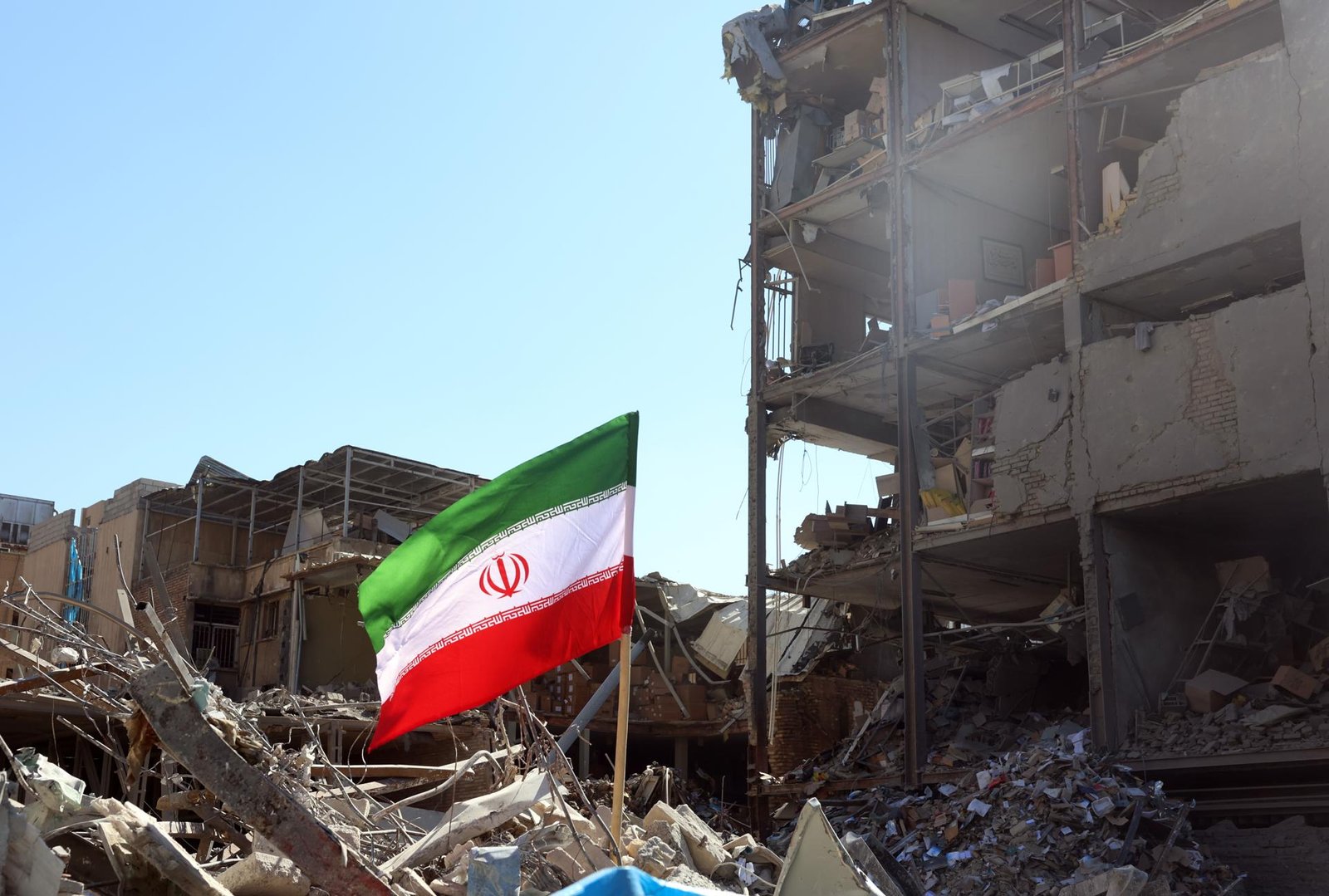
President Donald Trump has listed four objectives he intends to achieve with military operations in Iran: destroy its ability to produce missiles; annihilate the Iranian Navy; prevent the production of a nuclear weapon; and prevent Iran from arming and financing terrorist groups outside its borders.
The Pentagon reported in its first review of operations this Monday (2) that some of these intentions are already being achieved, amid the increase in military mobilization in Iran for the fourth consecutive day. American and Israeli planes bombed new targets in Persian territory, while Israeli fighter jets crossed the skies over the Iranian capital.
The US and Israel have already hit more than two thousand targets in Iran since Saturday (28), according to information from military authorities, without much resistance from Iranian air defenses, which demonstrates air superiority over Tehran.
In the early hours of this Tuesday (3), President Trump reiterated his position that the US can stay in the war for longer by stating through social media that the Army has an “unlimited supply” of weapons and that ammunition reserves have never been so high.
The first impacts on Iran
The most imposing coup to date was the elimination of the regime’s supreme leader, Ayatollah Ali Khamenei, and much of the Islamic country’s military leadership. In his first statement after Operation Epic Fury, President Trump minimized the difficulty in identifying Khamenei who, according to him, “died within an hour.”
The joint Israeli and American force targeted Iranian internal security institutions that have been linked to the repression of protests in recent months, including security forces along Iran’s northwestern borders with Turkey and Iraqi Kurdistan.
According to Iranian state media, on Sunday (1), the combined force attacked the Mehran Border Regiment in Ilam province, located along the Iran-Iraq border, killing 22 members of the security forces.
The US and Israel also attacked the Law Enforcement Command (LEC) Station in Tehran, which may have played an important role in the violent crackdown on protesters in Tehran during the most recent wave of protests in December 2025 and January 2026.
The two countries also carried out cyber attacks to counter the regime’s propaganda during the operation that began over the weekend.
According to the news agency Reuters, Hackers — likely American and Israeli — broke into several Iranian news sites and a religious calendar app with more than 5 million downloads with the message: “it is time for reckoning,” urging the armed forces to lay down their weapons and join the people.
In turn, the regime blocked the internet again in the country to prevent cyber activities from influencing the population to take to the streets to overthrow it. According to internet monitor Netblocks, the Persian country was operating with just 1% connectivity until last Sunday (1).
Operation targets Iranian nuclear program and missile development
The Israel Defense Forces (IDF) announced that it has begun to “systematically” dismantle Iran’s nuclear infrastructure.
According to analysis of the Institute for Science and International Security (Isis, its acronym in English), there is information about air strikes near the headquarters of the Atomic Energy Organization of Iran in Tehran, where the Tehran Research Reactor is located.
The International Atomic Energy Agency (IAEA) reported this Tuesday (3) about “recent damage” to the access buildings of the Natanz underground uranium enrichment plant in central Iran, although it highlighted that “radiological consequences” are not expected.
The IAEA indicated in a message on the social network
One of the shared goals of Israel and the United States is for Iran not to develop nuclear weapons.
O think tank americano Institute for the Study of War (ISW) highlighted that the US and Israel divided their lines of action according to their strengths: while the Americans focused on hitting strategic infrastructures, such as air defenses, command and control centers, logistics networks, industrial facilities and Iran’s military structure, the Israeli Defense Forces focus on hitting ballistic missile launchers and the Iranian leadership.
In addition to efforts against the nuclear program, the Israeli Air Force (IAF) has already destroyed an F-4 fighter and two Iranian F-5 fighters that were preparing to take off from the 2nd Artesh Tactical Air Base in Tabriz, East Azerbaijan province. The base houses three squadrons of tactical fighters that could threaten American and Israeli aircraft.
Israel had already destroyed part of Iran’s capabilities during the 12-Day War in June last year, when its Air Force attacked several buildings and damaged the runway at the 2nd Artesh Tactical Air Base.
The combined force managed to reduce Iran’s ability to carry out retaliatory strikes against American bases, Israel and other targets in the region by hitting Iranian missile launchers, missile bases and drone launch facilities on Sunday. Satellite images show the destruction of a launcher and a likely missile storage facility at the Esfahan North Missile Base, near Najafabad, Esfahan province.
The operation also targeted Iranian drone launch facilities in southeastern Iran, which the Persian country likely used to launch drones against its Gulf Arab neighbors.
Operations in Iran are in their infancy and “will take time,” says US Joint Chiefs of Staff
To date, there is no precise assessment of how Iran’s military capacity was affected. The chairman of the US Joint Chiefs of Staff, General Dan Caine, said on Monday that military operations against Iran are in their initial phase and “will take some time” to achieve their objectives.
Caine also acknowledged that these operations will require “a lot of work” and could cause new casualties among troops.
“This is not a one-day operation. It will take some time to achieve the objectives of Central Command and the joint force that have been assigned. In some cases, difficult and arduous work will be required. We expect to suffer additional casualties, but, as always, we will work to minimize them,” he said at a press conference at the Pentagon. The military chief also stated that the operation is “escalating” after 57 continuous hours of exercises which, according to him, are part of the “initial phase” and will require the deployment of new troops in the future.
To date, the deaths of the following high-ranking political and military figures in Iran have been confirmed:
- The Supreme Leader, Ali Khamenei;
- Minister of Defense, Amir Nasirzadeh;
- Chief of Staff, Abdolrahim Mousavi;
- Commander of the Revolutionary Guard, Mohammad Pakpour;
- Former President Mahmoud Ahmadinejad.
