
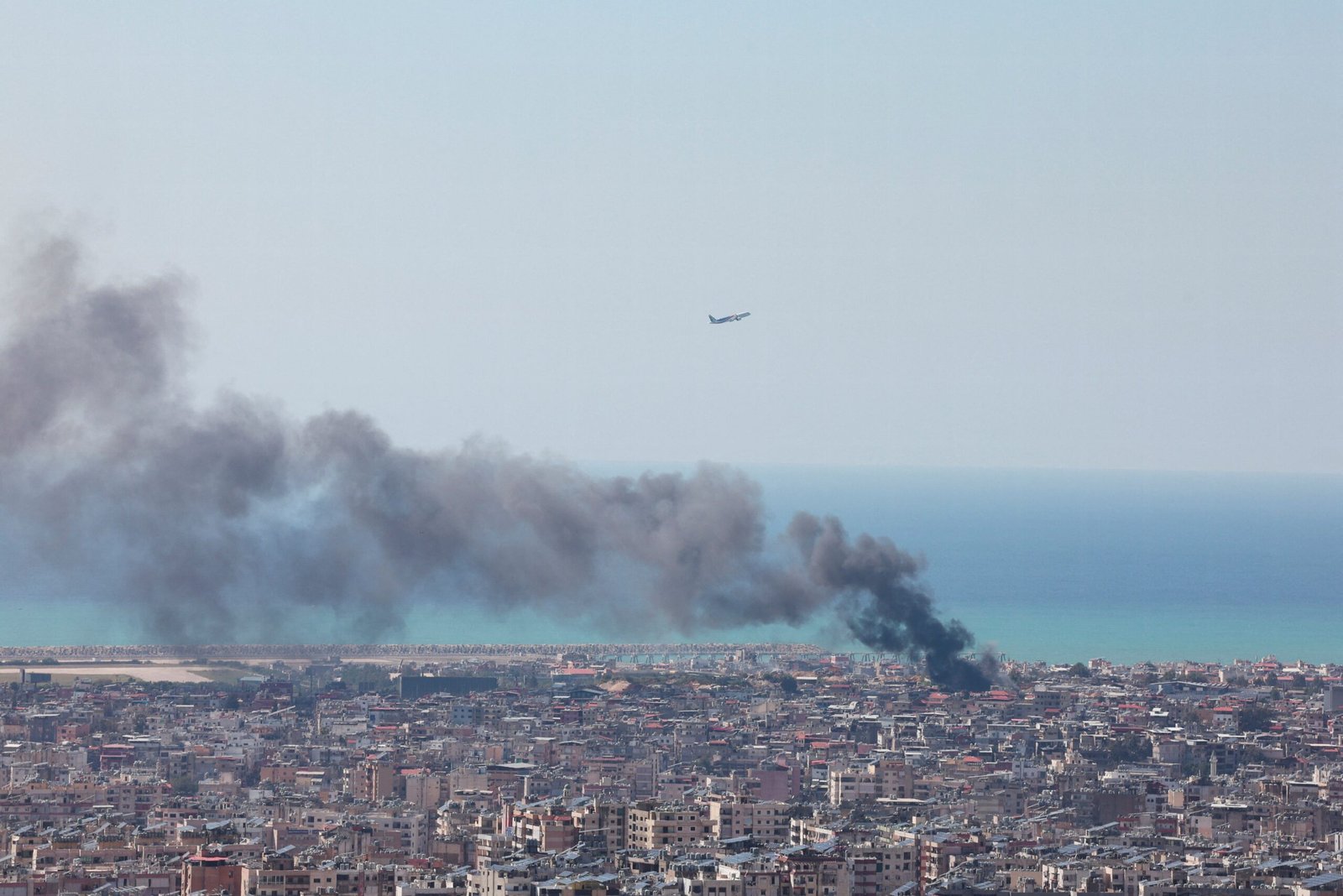
Israel attacks strategic bridge in southern Lebanon; see VIDEO Israel’s Prime Minister, Benjamin Netanyahu, stated this Wednesday (25) that his Army will expand the “buffer zone” in Lebanon. The previous day, Israeli Defense Minister Israel Katz had already said that he intended to take control of a 30km area in the south of the country. The statements represent an escalation in Israel’s ground offensive in Lebanon and raise fears that a full-scale invasion could be on the horizon. ✅ Follow the g1 international news channel on WhatsApp Israel says that the creation and expansion of this “security zone” would be to protect its population from Hezbollah, a Lebanese extremist group. The area would go as far as the Litani River, which is about 30km north of the border with Israel (see map below). In recent days, Israel has destroyed at least five bridges on the Litani River (see one of the explosions in the video above). Hostilities between Israel and Hezbollah resumed in early March, triggered by the US and Israeli war against Hezbollah’s ally Iran. The conflict has already caused more than 1.2 million Lebanese to leave their homes. Litani River, in southern Lebanon g1/Thalita Ferraz But this is not the first time that Israel has established a buffer zone in Lebanon. When the country invaded Lebanon in 1982, it maintained a buffer zone of between 10 and 20 km until its complete withdrawal in 2000. New conflicts in the region led the UN to create Resolution 1701 in 2006. It used the Litani River as a reference to create a buffer zone, establish another ceasefire and determine that Hezbollah should withdraw from areas in the south. But Israel accuses Hezbollah of not complying with the resolution. But after all, what is a buffer zone? The buffer zone is an area between two or more opposing powers, which aims to physically separate them, according to ScienceDirect, a database from publisher Elsevier, focused on scientific research. Just as the name says, it has the function of creating a physical barrier, a “buffer” between two sides. In English, it is called the buffer zone, that is, the buffer zone. “The buffer zone can be without troops or have an armed presence on one or both sides of the conflict. Furthermore, it can be temporary or permanent”, explains professor of International Relations at UFF and Harvard researcher Vitelio Brustolin. An example of a permanent buffer zone is the Korean demilitarized zone (DMZ), according to the expert. “It was created after the Korean War in 1953 and separates North Korea from South Korea. It is around 250km long and is one of the most militarized borders in the world”, he describes. The expert also highlights that “buffer zone” is not an official term, that is, it is not defined by a specific international rule. Despite this, it is commonly used in the political-military context and ends up being indirectly regulated by international laws. The reason is that buffer zone is an umbrella term that, in practice, can mean different ways of occupying this zone. It could be, for example, similar to a demilitarized zone, something regulated by the Geneva Conventions, according to the expert. ➡️Furthermore, to be considered legitimate, the buffer zone needs to be the result of an agreement between the two parties, according to Brustolin. “It needs the consent of the States involved and must then go through the UN security body”, he explains. He also highlights that there is a need to respect sovereignty. “In the case of the buffer zone that Israel wants to create in Lebanon, it would be within Lebanese territory, and would need Lebanon’s consent to be considered legitimate,” he says. Smoke column rises in the coastal region of Beirut, capital of Lebanon, after Israeli bombing on March 17, 2026. REUTERS/Mahmoud Hassano More than a thousand deaths and 1 million displacements Since the resumption of the conflict between Israel and Hezbollah, the Israeli Army has been bombing the country daily. The confrontation has already caused more than a thousand deaths and forced more than a million people to leave their homes, according to authorities. The population is terrified. One of the families affected was that of Abbas Qasem, 55 years old. She told AFP that her house was additionally destroyed in an attack carried out this Tuesday (24). “There was nothing left, everything burned,” he said. “What did I do to deserve it? I’m just an ordinary person,” he added, crying, as did his wife, upon discovering the devastation in their apartment. In Saïda, the main city in southern Lebanon, an attack hit a car on Wednesday morning (23) and killed two people, including a rescuer, near the seafront where displaced people sleep in their vehicles, according to the ministry. “I had never left my house until now,” Moustapha Khairallah, a refugee in Saïda, told AFP. But “they are attacking more and more civilians… I was forced to leave,” added the elderly man, leaning on two canes. This week, Israeli Defense Minister Israel Katz said that residents of southern Lebanon who have left their homes should not return: “They will not return to the south of the Litani River until the safety of residents of northern Israel is guaranteed,” he said. UN warning about Lebanon This Thursday (25), UN Secretary-General, António Guterres, stated that the “Gaza model should not be replicated in Lebanon”. Guterres said Hezbollah must stop launching attacks against Israel and that Israel must cease its military operations and attacks in Lebanon, which hit civilians hardest. See more: VIDEO: entire building collapses in Beirut after being hit by Israeli missile War is ‘out of control’ and could spread, says UN
Source link
What is a ‘buffer zone’, like the one Israel wants to expand in Lebanon
50
