
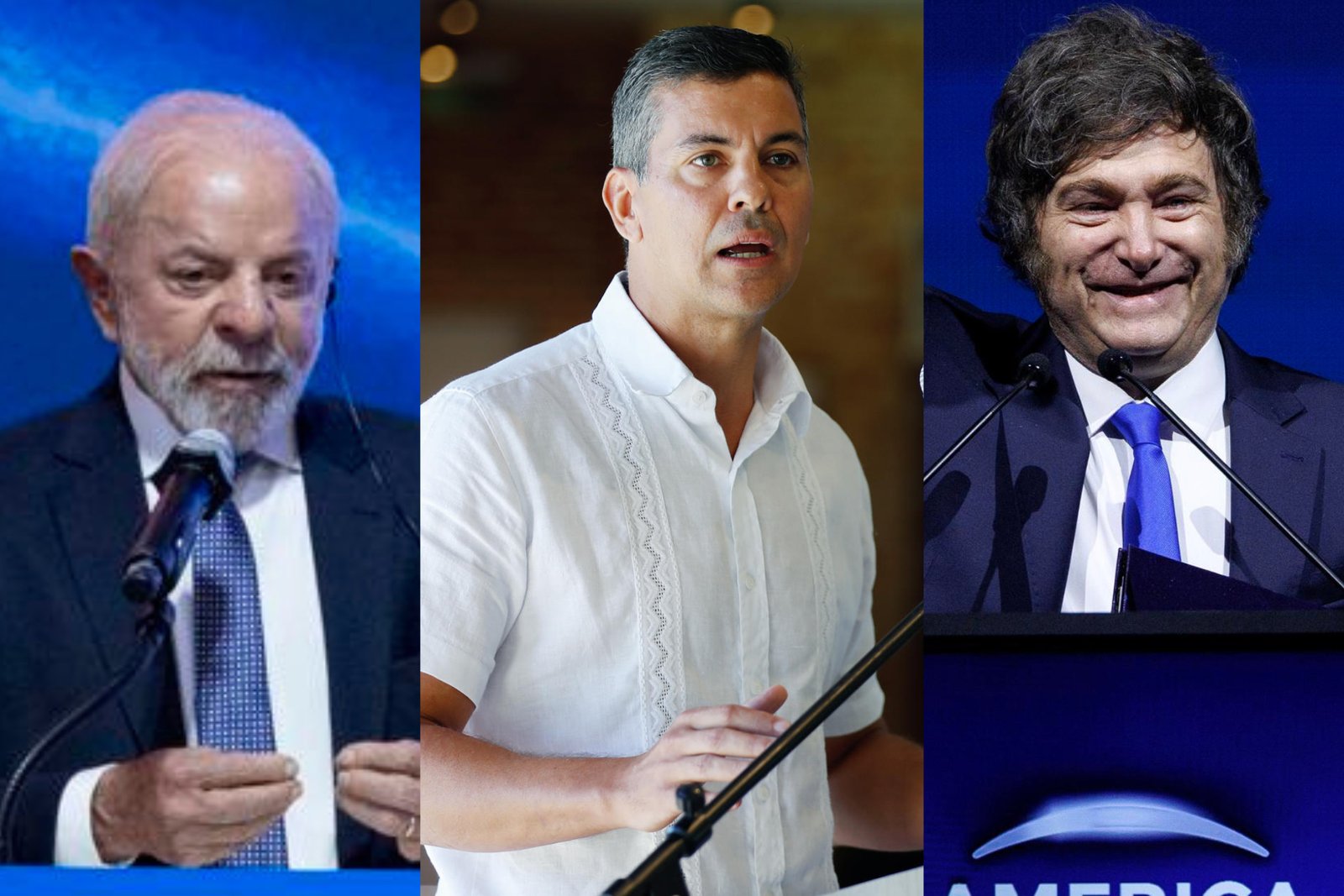
Donald Trump’s government has shown a growing interest in Latin America, especially in relation to the security of the region, which has become a strategic target for China in recent decades. One of the US focuses is the Triple Border, made up of Paraguay, Argentina and Brazil, where the country denounces that there is a strong presence of armed groups such as the First Capital Command (PCC) and terrorists, such as the Lebanese Hezbollah.
A few days ago, the Paraguayan government sanctioned a strategic military partnership with the White House, which allows the deployment of American military personnel in the South American country, in the so-called Status of Forces Agreement (Sofa).
Along with other initiatives already approved by Argentina, such as the installation of an American base in the country and the authorization for the entry of foreign troops, the measure attests that the region surrounding Brazilian territory will be one of the priorities of the republican administration.
As already signaled by the Trump administration, one of the objectives for the Triple Border will be to combat organized crime, which has been growing throughout Latin America. Recently, Brazil was informed that the White House is considering classifying the factions Red Command (CV) e First Capital Command (PCC) as terrorists, something that has worried the administration of Luiz Inácio Lula da Silva (PT) for opening the door to new friction between the two countries, after the tariff.
The PCC has also established a solid presence in Paraguay over the past few years. Last year, Santiago Peña’s government took the decision to classify Brazilian factions as terrorists, following the mega-operation against drug traffickers in Rio de Janeiro. Argentina followed the same path at the same time.
Main changes expected with agreement between the USA and Paraguay
The agreement put into effect between the US and Paraguay this month could bring a series of changes to the Triple Border region.
The most immediate, according to professor of International Relations and director of Ibmec Brasília Ricardo Caichiolo, are related to a greater surveillance and exchange of intelligence between these countries. According to him, the scenario will be one of greater monitoring and integration between local forces, and the main challenge will be to manage possible political tensions and the capacity of criminal networks to adapt to this increased pressure.
Among the clauses of the partnership are the temporary permission for the presence of military personnel from the Pentagon, civilians and American companies in Paraguay, with a focus on developing training, military exercises, logistical studies and exchange of technologies, repeating the cooperation model already seen in Argentina. All foreigners involved in missions will have immunity similar to that granted to diplomats.
One of the strategies that can advance with the partnership is the demobilization of criminal organizations and terrorist groups that the US claims are operating in the region. One of the arguments used by Washington to classify Brazilian factions as terrorists is the alleged connection with Hezbollah cells in the Triple Border.
Still during the first Trump administration, in 2018, the Deputy Assistant Secretary of Defense for the Western Hemisphere, Joseph Humire, defended before the American Congress that there was evidence of a relationship between the PCC and the Lebanese militia and that these groups had a solid presence on the border and within Brazil.
If Trump prioritizes advancing investigations, this could pressure the Lula government to take more direct measures against these groups that it avoids classifying as terrorists. Last year, the American government began offering a reward of up to US$10 million for information about Hezbollah’s financial mechanisms in the border region.
US reinforcement in the Triple Border generates isolation of Brazil in the region
For Brazil, the changes would have a double impact. “On the one hand, [o acordo] enhances the fight against cross-border illicit activities; on the other, it generates diplomatic discomfort and concerns about national sovereignty due to the presence of an extra-regional power in its immediate neighborhood”, assesses the director of Ibmec, Ricardo Caichiolo.
ESPM International Relations professor Denilde Holzhacker explains to People’s Gazette that one of the most direct impacts on Brazil with the new agreement signed between the USA and Paraguay is regional isolation.
She assesses that these military partnerships signed by the American government with regional allies, such as Argentina and Paraguay, can have practical implications for the Brazilian government, since possible operations against drug trafficking and terrorism may take place close to the border and require internal actions.
“Although the actions are in Paraguay, we can expect a greater flow of people and control at the Brazilian border”, says Holzhacker.
She also highlights the political impact of the American decision in a presidential election year, which exposes the Lula government’s resistance to adhering to Trump’s actions in the region, while right-wing pre-candidate Flávio Bolsonaro supports the measures and maintains direct contact with the Republican administration.
“With this, we can expect an impact on the dynamics of presidential debates on a very sensitive topic for the government and very important for public opinion, a possibly electoral impact”, he assesses.
In addition to these possibilities, the bilateral agreement could have a direct impact on Brazil’s relationship with China. Paraguay has become an important actor in the flow of trade in the Triple Border, both for the flow of Brazilian production to Asia and for the entry of Chinese products into Brazil.
Although Paraguay does not have political affinities with China, as it is one of the few countries in the world that formally recognizes Taiwan’s independence, the military agreement signals Washington’s increased attention to the Southern Cone (a region comprising Paraguay, Argentina, Uruguay, Chile and some parts of Brazil), aiming to reduce Chinese influence.
