
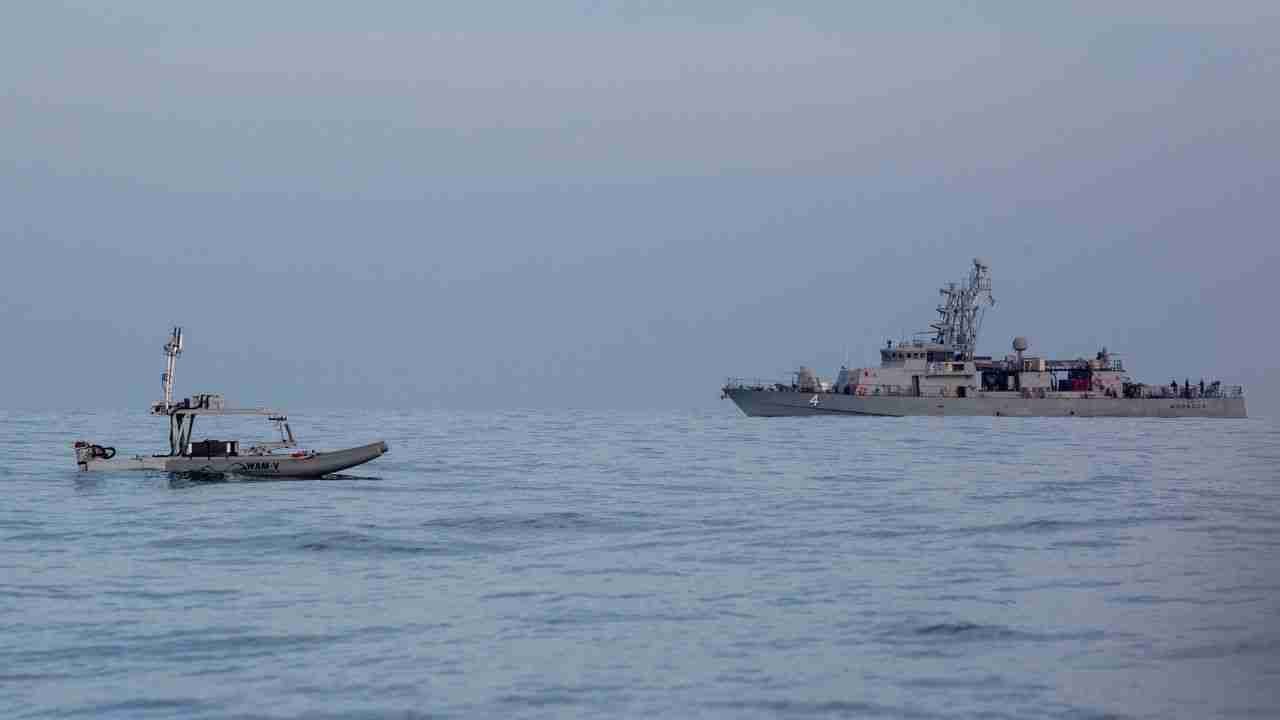
The United States Navy has once again reformulated its plans for unmanned vessels, adopting a “market” model to accelerate the acquisition of these systems.
The new strategy prioritizes the use of projects already developed by the industry, leaving long prototyping phases in the background. The initial focus is on medium-sized ships, capable of performing multiple roles using modular cargo.
The proposal seeks to reduce deadlines and costs, while increasing operational flexibility. These ships must operate autonomously, carry up to 25 tons and operate in challenging maritime conditions, in addition to carrying out missions for several days without direct communication. The Navy also wants to ensure technological integration and the ability to quickly adapt to different combat or support scenarios.
Another central point is the opening to different operating models, including vessels controlled by both the government and contracted companies. The companies’ industrial capacity will also be decisive, as the objective is to put units into operation by 2027, with scaled production and reduced deadlines.
+Mexico bets on Senator armored vehicle to reinforce security against organized crime
The change reflects a broader effort to modernize the naval force and overcome historical limitations, such as delays and high costs in building traditional ships. With this, the Navy is betting that it will finally be able to integrate more advanced unmanned vessels into its fleet, expanding its capabilities in an increasingly competitive global scenario.
Source: The War Zone | Photo: @USNavy | This content was created with the help of AI and reviewed by the editorial team
The character of warfare is changing rapidly. The Department of the Navy is adapting its acquisition system to deliver capability to our warfighters faster. We are harnessing the talent and ingenuity of the American tech sector by launching a market competition for the Medium…
— Secretary of the Navy John C. Phelan (@SECNAV) March 26, 2026
