
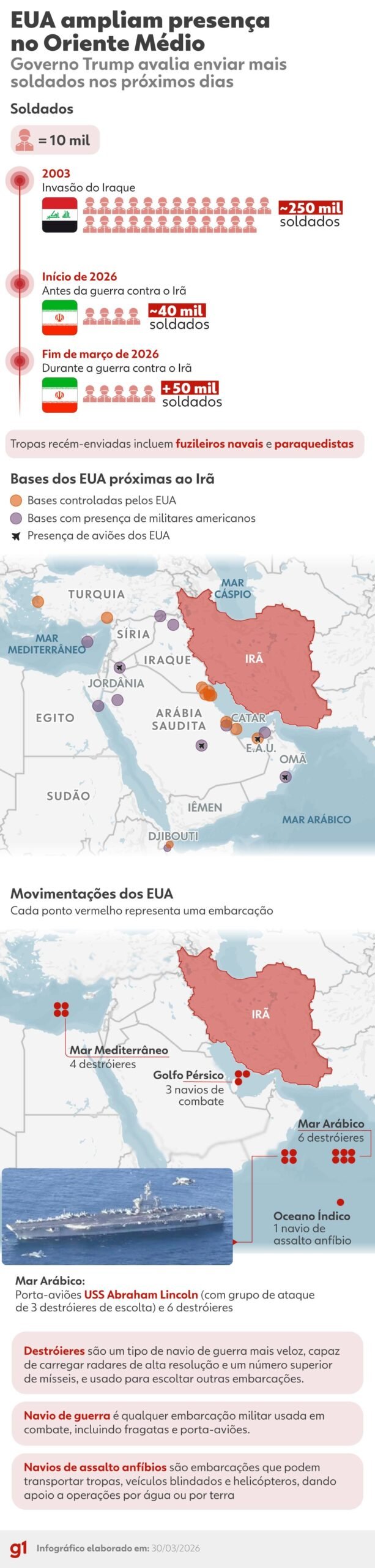
Understand the risks and possible targets of a US land offensive against Iran The United States has expanded its military presence in the Middle East in recent days, amid uncertainty about the direction of the war against Iran. According to the American press, more soldiers may be sent to the region. ✅ Follow the g1 international news channel on WhatsApp ▶️ Context: The war in the Middle East completed a month last Saturday (28). Even before the start of the offensive, the US had already reinforced the military apparatus in the region. The USA maintains 19 military bases in the Middle East: 8 controlled directly by the country and 11 with the presence of troops and equipment. At the beginning of the year, around 40 thousand soldiers were stationed in the region. Starting in January, faced with increased tensions with Iran, the US began sending ships, aircraft and soldiers to the Middle East. After the start of the war, more military personnel were mobilized. Data from the American press indicate that more than 50 thousand soldiers are in the region. Last week, at least 5,000 troops arrived in the Middle East — 2,500 sailors and 2,500 marines. Days earlier, another 2,000 soldiers had already disembarked, including paratroopers. According to The Wall Street Journal, the Pentagon is considering sending 10,000 more military personnel in the coming days. Despite the reinforcement, the number is still below that recorded at the beginning of the invasion of Iraq, in 2003, when more than 250,000 soldiers participated in the action. In recent days, the United States deployed an amphibious assault ship to the region, used to transport troops, land armored vehicles and provide logistical support. These movements, combined with reports from authorities in the American press, increased the alert for a possible ground operation against Iran. On the other hand, US President Donald Trump claims that negotiations for an agreement that would lead to the end of the war are underway. See the infographic below to see how the US is positioned in the Middle East. US military presence in the Middle East Arte g1 READ ALSO Ceasefire or land invasion? The US path in the conflict against Iran after 1 month of war Trump contradicts his own speech when he talks about negotiating with Iran and sending more troops Netanyahu says he has not set a deadline for the end of the war with Iran Contradictions The aircraft carrier USS Abraham Lincoln transiting the Strait of Hormuz in 2019 Zachary Pearson/US Navy via AP Contradictory signals have come from the White House in recent weeks about the war against Iran. At the same time as it is expanding its military presence in the region, the United States they also talk about negotiation to end the conflict. On Monday (30), Trump stated on a social network that he was negotiating an end to the war with Iran. According to him, there had been “great progress.” Despite this, the president has again threatened attacks on Iran’s energy infrastructure if an agreement is not reached soon. Days earlier, Trump had already extended the deadline for an ultimatum until April 6: according to him, if there is no agreement, the US will strike Iranian energy targets. The two countries have already said publicly that they have sent proposals with conditions to end the conflict. Trump said the complete opening of the Strait of Hormuz, a major oil shipping route, was among the conditions for a deal. On the other hand, The Wall Street Journal newspaper revealed that Trump told advisors that he is willing to end the war even if the Strait of Hormuz remains closed. The reports were obtained from authorities with knowledge of the conversation. According to the report, in recent days, Trump and advisers assessed that an operation to fully reopen the sea route would prolong the conflict beyond the six-week deadline promised by the president. Iran’s blockade of the Strait of Hormuz has put pressure on oil prices and affected several sectors around the world. The impact could harm the United States economy in a year of elections for the House and Senate. Given this, Trump would have stated that the US must focus on the main objectives of the war: weakening the Iranian navy and reducing the country’s missile capabilities. Thereafter, attacks would be reduced in an attempt to pressure Iran into reopening the Strait of Hormuz. If Iran continues to impede the flow of commercial ships in the region, Trump should pressure allies in Europe and the Gulf to take responsibility for reopening the sea route, according to the newspaper. VIDEOS: most watched on g1
Source link
US expands military presence in the Middle East amid uncertainty over war against Iran; INFOGRAPHIC
31

previous post