
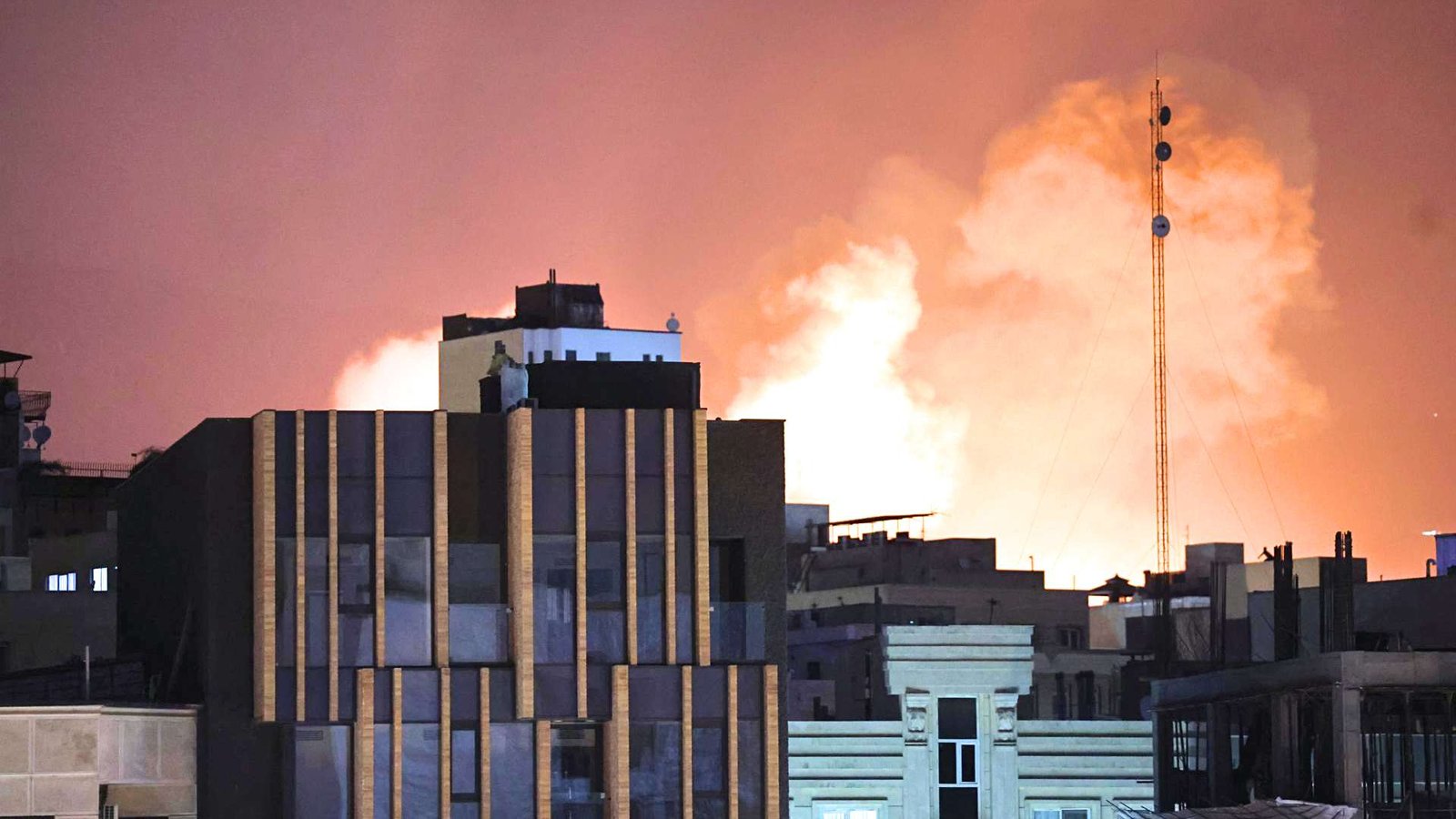
By attacking Iran alongside Israel on February 28, the United States justified the offensive as an effort to weaken Iran’s military power, contain its nuclear program and bolster the security of allies in the Middle East. A month later, Americans and Israelis make progress on the battlefield, but still deal with strategic, economic and political impasses that make it difficult to define an outcome to the war.
From a military point of view, US officials claim that the ongoing air campaign has managed to significantly degrade Iran’s defense structure. According to the Pentagon, more than 80% of the Islamic regime’s missile launchers have already been destroyed, reducing Iran’s ballistic missile launch capacity by approximately 90%.
US Central Command (Centcom), which leads ongoing operations in the Middle East, reported that More than 90% of the Iranian Navy’s largest vessels were destroyed or damaged.
The offensive also hit more than 10,000 targets in Iran – including several industrial facilities – and eliminated central figures from the regime’s high political and military ranks, such as Supreme Leader Ali Khamenei and the then head of the National Security Council, Ali Larijani. Furthermore, the US also established air superiority in parts of Iranian territory.
In this month of war, 13 American soldiers died and 303 were injured in combat, according to US Central Command (Centcom). In Israel, Iranian attacks have left 18 people deadaccording to a survey by the newspaper Times of Israel. Already In Iran, at least 3,300 people – including civilians, military personnel and authorities – died as a result of US and Israeli bombingsaccording to organization data Human Rights Activists in Iran (HRANA), headquartered on American soil.
Despite military and leadership losses, Iran continues to operate. The regime still carries out missile and drone attacks against Israel and US allies in the Middle East, also against American bases outside the region, and maintains actions against the energy infrastructure of Gulf countries, which supply much of the world.
Furthermore, Iran has preserved its ability to block the Strait of Hormuz, the strategic route responsible for the passage of around 20% of the world’s oil. Analysts say that, given this scenario, it is still not possible to achieve victory for the US and Israel in the war.
For Professor of International Law at Centro Universitário FAPI Cássio Eduardo Zen, the Iranian reaction capacity, especially the blockade of the Strait of Hormuz, increases the Islamic regime’s bargaining power and shows that the conflict is still far from being over.
The continuity of Iranian attacks highlights the limits of the strategy adopted by the United States and Israel in this war. According to Bárbara Neves, PhD in International Relations, internationalization coordinator at Universidade Positivo (UP), the use of air power has been effective in imposing costs and eroding specific capabilities of the Islamic regime, but it has not been enough to decisively change Iran’s behavior.
Professor of International Law and director of Ibmec Brasília Ricardo Caichiolo states that, as long as Iran has the means to carry out surprise attacks with cheaper weapons, such as drones, it will be able to prolong the war and exhaust American resources, preventing a clear military outcome.
Blockade of Hormuz is Iran’s main pressure point
Iran has used the threat of attacks against ships on the strategic route as a way to prevent vessels from passing through the region and increase the economic cost of the war for the United States, Israel and all their allies. By keeping the Strait of Hormuz at risk, Tehran puts direct pressure on the global energy market.
Since the start of the war, oil has risen by more than 70%, putting pressure on countries to take measures to contain energy prices. Furthermore, the regime has intensified threats against energy facilities in the Gulf, increasing regional risk. Several supply chains are being affected.
During this period, to try to contain the oil crisis, the US and allies decided to release millions of barrels of oil from their strategic reserves, trying to contain the rise in prices. The US also temporarily eased sanctions on shipped Russian and Iranian oil.
For Professor Zen, the impasse involving the strategic route became the main pressure point of the war. “From Iran’s point of view, it is clear that, even with limitations on their Navy, they are still able to block or make transit in the region extremely risky, which directly impacts the global economy,” he said.
In this way, the reopening of the Strait of Hormuz became a strategic priority for the United States. In the expert’s assessment, guaranteeing the flow of oil and containing the economic impacts of the war would allow President Donald Trump to present this result as a concrete achievement in the conflict.
US evaluates sending troops for ground operations
In recent days, the Pentagon has sent more than 2,000 Marines and more than 3,000 soldiers from the 82nd Airborne Division, an elite force of the United States Army, specialized in rapid response and operations in conflict zones, to the Middle East. It was also reported this Friday (27) that the Pentagon is considering sending another 10,000 American troops to the region.
With the new deployments, the US military contingent in the region would already exceed 50,000 soldiers, in addition to also including more warships, amphibious units and air support. According to authorities interviewed by the American press, the objective of this measure is to expand US operational capacity and prepare the ground for possible future scenarios.
Although President Trump has stated that he does not intend to carry out a large-scale ground invasion of Iran, the deployment of troops to the Middle East indicates that this option is not completely ruled out.
Analyst Bárbara Neves assesses that a land invasion of Iran would involve high risks, potential for regional escalation and high domestic political cost for Donald Trump’s government. “Despite the threats and harsher rhetoric, the most likely scenario is the continuation of a strategy of limited military containment, combined with political and economic pressure, and not a full-scale invasion,” he said.
On the other hand, a strategy based exclusively on aerial bombing has limitations. The use of troops on the ground, such as special forces, could occur with the aim of protecting the Strait of Hormuz and ensuring the passage of oil tankers, according to an assessment by Middle East expert Gabriel Schorr, a former soldier in the Israel Defense Forces (IDF).
One of the actions being studied by the Pentagon is the taking or blocking of Kharg Islandthe country’s main oil export center.
Negotiations with Iran are ongoing
This week, the United States sent Iran a 15-point ceasefire plan, through intermediaries such as Pakistan. The proposal includes restrictions on Iran’s nuclear program, mechanisms to reopen the Strait of Hormuz and possible easing of sanctions.
Trump stated on Tuesday (24) that there are already “important points of agreement” in the ongoing negotiations and even mentioned a possible “total resolution” of the conflict. According to him, Secretary of State Marco Rubio and Vice President JD Vance are directly involved in conversations with Iranian representatives.
Iran, however, has already rejected the initial terms of the American plan and presented a counterproposalmaking any agreement conditional on the total end of hostilities, guarantees that there will be no new attacks and payment of reparations for damage caused during the conflict.
According to Bárbara Neves, the most realistic scenario for ending the ongoing war involves a political solution that reduces the costs of the conflict, since the internal political strain that the war imposes on Trump limits the American government’s room for maneuver in negotiations.
In the analyst’s assessment, the outcome of the war must occur without regime change in Iran and without an explicit defeat by either party, in a scenario that she defines as “a pragmatic accommodation that allows the US to reduce its direct involvement and present the conflict as ‘contained’, even without resolving all the structural tensions in the region.”
The political and economic cost of the war for Trump in the USA
The decision to start the conflict against Iran generated negative political impacts for President Trump, both on the general US domestic scene and on the Republican electoral base.
The direct cost of the war already exceeds US$20 billion (around R$104.6 billion), according to estimates based on data from the government and analysis centers. Furthermore, the White House must ask Congress for a new package of more than US$200 billion (around R$1.4 trillion) to finance the continuity of military operations.
At the same time, the economic impact begins to directly affect American citizens, just a few months before the midterm elections, which are expected to define control of the US Senate and House. Since the start of the conflict, gasoline prices have risen by around 30%, putting pressure on the cost of living and increasing the political strain on the government.
The war also exposed divisions within the conservative camp itself. Part of the base linked to Trump’s “Make America Great Again” (MAGA) movement began to question the United States’ involvement in yet another conflict in the Middle East, while polls indicate that the majority of Americans disapprove of the conduct of the war.
