
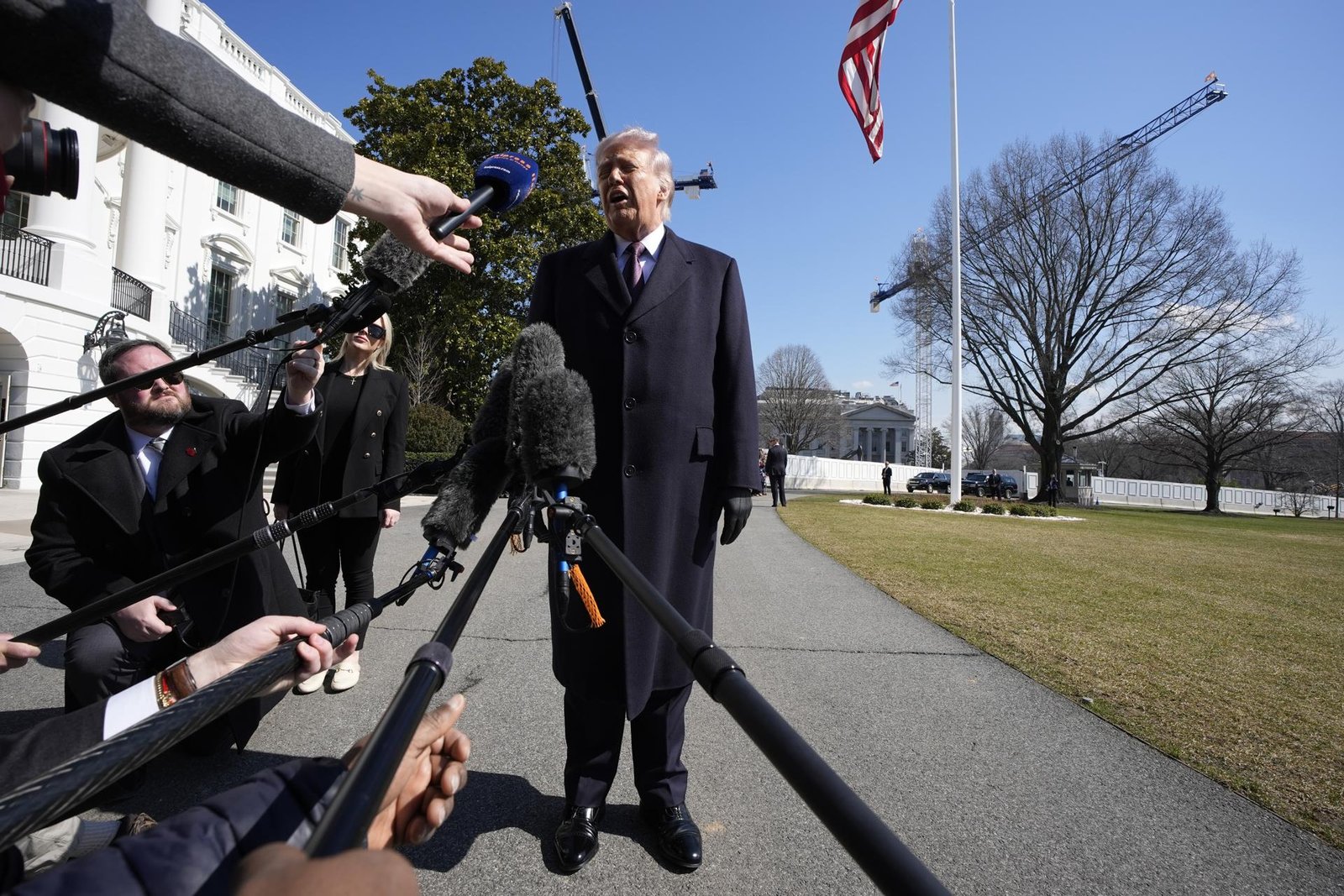
The president of the United States Federal Communications Commission (FCC), Brendan Carr, issued a warning this month to the country’s radio and television stations by stating that Vehicles that disseminate “distortions” or “fake news” on American soil may face “difficulties” in renewing their licenses. The statement came amid President Donald Trump’s criticism of American press coverage of the ongoing war against Iran.
In a post made on his X account on the 14th, Carr stated that US radio and TV stations that use public concessions must act in the “public interest” and that, if they insist on disclosing information considered “misleading” by the commission, they could suffer strong regulatory consequences.
At the time, the head of the FCC also argued that the US public’s trust in traditional media has fallen to historically low levels in recent years.
Research carried out by the Gallup institute, released in October last year, shows that only 28% of Americans say they trust newspapers, radio and television to report the news completely and accurately, the lowest rate ever recorded in the historical series. Among Republican voters, trust is even lower: just 8%, according to the survey.
Trump’s criticism of US press coverage of the war began after reports from the The Wall Street Journal and the The New York Times claim that Iran caused significant damage to American aircraft during an attack on Prince Sultan Air Base in Saudi Arabia on March 13. The day after the news was published, Trump accused the two newspapers, as well as American broadcasters, of distorting the facts.
According to the president, news reports about what happened were “intentionally misleading” by suggesting that the planes that were hit at the base in Saudi Arabia remained out of operation for prolonged repairs after the attack.
Trump also said that most of the aircraft targeted by the Iranian attack quickly returned to operations. The command of the operation in the Middle East avoided commenting on the case and the American press continued to maintain that the aircraft were undergoing repairs after the incident.
White House questions coverage of war
Since the beginning of the conflict against Iran, the American government has shown dissatisfaction with the way the US press portrays the war. The assessment within the White House is that the coverage often highlights risks, errors or costs of the confrontation, while minimizing military results considered positive by the Trump administration, such as the elimination of the Islamic regime’s command and attacks on the Persian country’s missile and nuclear program.
Members of the Trump administration point out that news that only presents operational flaws or negative impacts on the ongoing conflict can influence public opinion and reduce domestic support for the military effort against the Islamic regime.
Secretary of War Pete Hegseth recently criticized US press reports that he called “overly pessimistic” about the conflict and said the American press should begin to recognize more that the “United States and its allies” are making progress on the battlefield against Iran.
Pressure from the FCC comes up against press freedom
Carr’s warning gained repercussion because the FCC is responsible for regulating the use of radio and television frequencies in the United States, which are considered public concessions. Therefore, just like in Brazil, open radio and television stations need to obtain authorization from the federal government to operate and periodically renew their licenses – generally every eight years – based on compliance with rules that require action in the so-called “public interest”.
The FCC may apply administrative sanctions in specific cases, such as technical violations, non-compliance with operational standards or infractions related to prohibited content at certain times. During the license renewal process, the agency also assesses whether the broadcaster in question has complied with its legal obligations throughout the concession period.
Despite this, the agency’s actions find limits in the First Amendment of the United States Constitution, which broadly protects freedom of the press.. Over the past few decades, Supreme Court rulings have consolidated the understanding that the American government cannot directly interfere in journalistic content due to editorial disagreement or line of coverage.
Democratic Party parliamentarians classified the FCC chief’s threat to withdraw radio and TV licenses as “unconstitutional and authoritarian”. They claim that the government cannot “censor content” with which it “disagrees”.
Among Republicans, Senator Ron Johnson criticized the possibility of state interference in the American press, saying he was against government control over the private sector and reinforcing support for freedom of expression guaranteed by the US Constitution.
On the other hand, Victor Davis Hanson, a historian at Stanford University, and Rich Lowry, editor of the National Review, criticized the American media’s coverage of the war against Iran. For both, major outlets adopt an excessively negative tone that distorts the public’s perception of the conflict.
Lowry attributed this bias to the press’s antagonism toward Trump and the media’s historical skepticism about wars since Vietnam. Hanson added that the lack of independent reporters in Iran makes reporting dependent on information from the Islamic regime itself.
Trump has already sued several outlets
Since returning to the US presidency last year, President Trump has resumed confrontations with media outlets, which he accuses of distorting information about his government.
The first case occurred even before he won the presidential election and took office. In 2024, Trump sued the broadcaster CBS after an interview on the program 60 Minutes with the then vice president and Democratic presidential candidate, Kamala Harris. The case ended with a million-dollar settlement paid last year by the station’s controlling company to Trump.
At the time, the Republican accused the broadcaster of having edited the then candidate’s responses in a “misleading manner” to make it more “clear and coherent”, which, according to him, would have constituted electoral interference and violation of the rules that require action in the public interest by broadcasters operating under federal concession.
After winning the election, Trump filed lawsuits against ABCfrom Disney, for statements by a channel presenter – a case that ended with a financial settlement paid by the broadcaster to end the action – and against the newspapers The New York Times e Wall Street Journal – that are still open.
Trump also sued the British broadcaster BBC for a documentary about the protests on January 6, 2021. The president accused the network of misleadingly editing excerpts of a speech he made that day, in order to suggest that he had directly encouraged the invasion of the Capitol. THE BBC he even released a public apology for “editing errors”, but the lawsuit filed by Trump is still ongoing in the United States courts. He is asking for compensation of US$10 billion.
Trump also criticized American hosts such as Stephen Colbert and Jimmy Kimmel. In the case of Colbert, Trump even called the presenter “pathetic” after repeated criticism made by Colbert against the Republican government on his program, the The Late Showespecially after the presenter mocked the agreement signed between the president and Paramount, the parent company of CBS.
In the case of Kimmel, Trump accused the host of ABC to act as “an arm of the Democratic Party” and to use the program Jimmy Kimmel Live! to attack your government. Trump’s criticism of him also increased after Kimmel commented on his program about the murder of conservative activist Charlie Kirk and said that the American conservative movement was using the case for “political gain”, a statement that led to public pressure against the ABCfollowed by the temporary suspension of Kimmel’s program, which has now returned to the air.
