

The U.S. shed 92,000 jobs in February, a sharp and unexpected setback for the labor market after economists had forecast an increase in hiring last month.
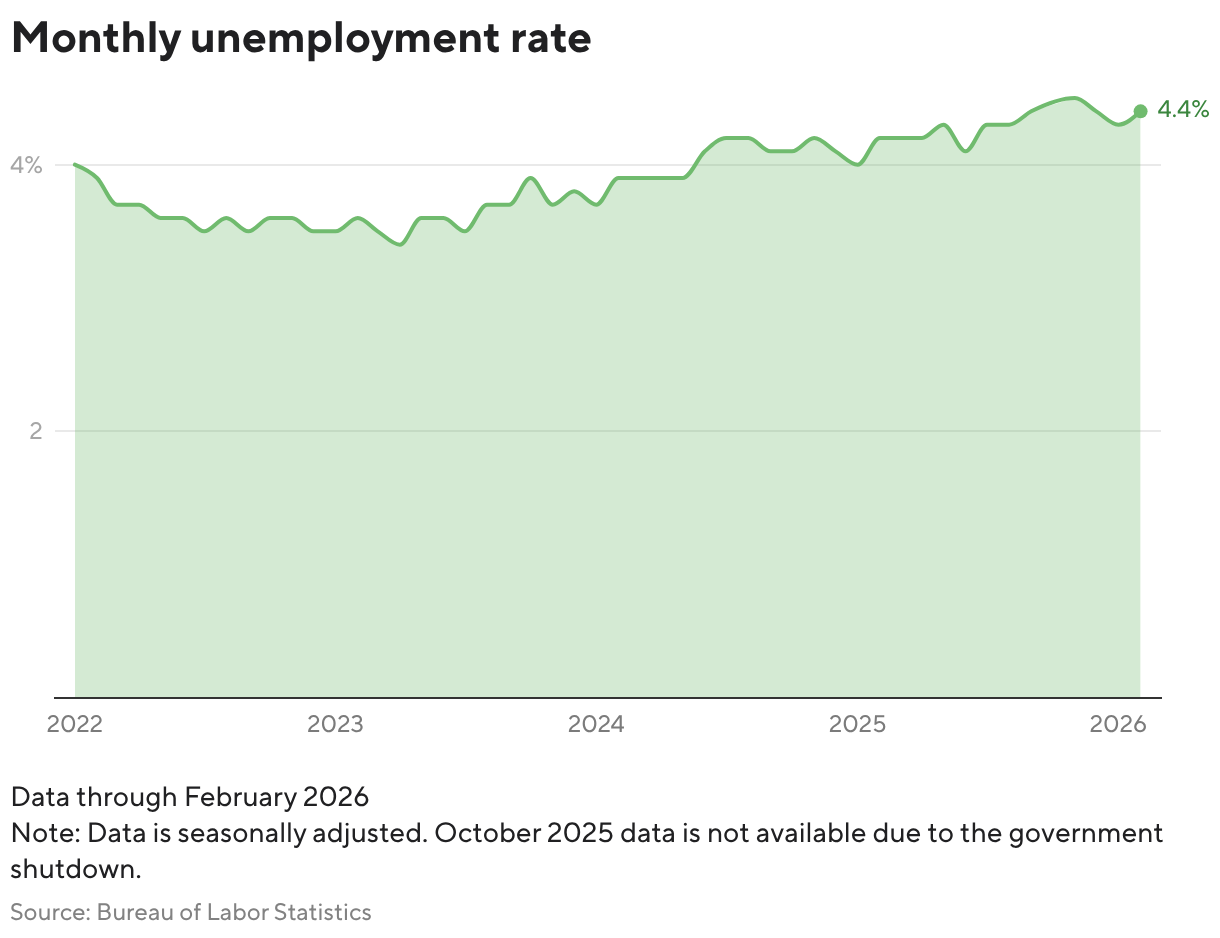
The nation’s unemployment rate ticked up to 4.4% last month from 4.3% in January.
By the numbers
Economists polled by FactSet had predicted a payroll gain of 60,000 last month.
February marks the third time in the last five months that the job market has shown job losses. U.S. stocks fell on the surprise payrolls miss, while oil prices jumped to their highest level in nearly two years amid the widening war in Iran.
A drop in hiring in the health care sector, recently a source of strong employment gains, dragged down job growth in February. That sector shed 28,000 jobs, which the Labor Department attributed to recent strike activity. A nurses’ strike in California ended late last month.
Some analysts noted that the strikes and recent winter storms may have distorted the latest employment data, overstating the weakness last month.
“Just as the January jobs report overstated any emerging strength in the labor market, the February employment data give a false impression of deteriorating labor market conditions,” Nancy Vanden Houten, lead economist at Oxford Economics, said in an email on Friday.
Payroll gains were unexpectedly strong in January, soaring well above economists’ expectations. On Friday, however, the Labor Department revised job growth for that month down by 4,000 and for December by 65,000, a sign that the labor market was weaker than previously thought.
Even if the job market is stronger than it appears, experts said Friday that the February employment data is injecting a degree of uncertainty into the U.S. economy.
“Recent labor market data had been pointing to resilience, but today’s sharply weaker reading raises the risk that a different picture could be in play,” said Seema Shah, chief global strategist at Principal Asset Management, in an email. “Markets are being tugged in opposing directions, and this jobs report adds yet another layer of uncertainty to an already noisy backdrop.”
As of late, the labor market has been marked by a stretch of weak hiring. The pace of job turnover hit a nine-year low in January, at 5.8%, a recent ADP report found, as many workers cling to their jobs. The lackluster hiring was also evident last year, when employers added a total of 181,000 jobs, the lowest since the pandemic year of 2020.
What experts are saying
The February jobs decline could complicate the Federal Reserve’s decision-making on interest rates as monetary policymakers look to bolster employment while keeping inflation at bay, experts said. Easing borrowing costs for consumers and businesses could bolster the labor market. At the same time, cutting rates could fuel inflation, which has become a central concern as the war in Iran drives up global energy prices.
Fed officials will be grappling with whether February’s data is a blip or if it reflects a longer-term trend, experts noted.
“Today’s data show that the labor market has averaged essentially zero net job creation over the past six months,” Cory Stahle, an economist for Indeed Hiring Lab, said in an email. “The key question now is whether February was a temporary setback or the start of a more concerning trend.”
The Fed’s next rate decision will be announced on March 18.
“Today’s numbers may have put the Fed between a rock and a hard place,” Ellen Zentner, chief economic strategist for Morgan Stanley Wealth Management, said in an email. “Significant weakening in the labor market would support a rate cut, but given the risk that higher-for-longer oil prices could trigger another inflation surge, the Fed may feel compelled remain on the sidelines.”
Inflation fears, driven by rising oil prices, are already rattling parts of the U.S. economy such as the housing market, where mortgage rates recently edged up to 6%.
Fuel costs are also rising. As of Friday, the national average gas price has jumped 32 cents a gallon over the last seven days, to roughly $3.31 a gallon — the highest since August of 2024, according to GasBuddy. Diesel has soared 51 cents in a week to $4.26 a gallon, the highest since November of 2023, the tracking service found.
