
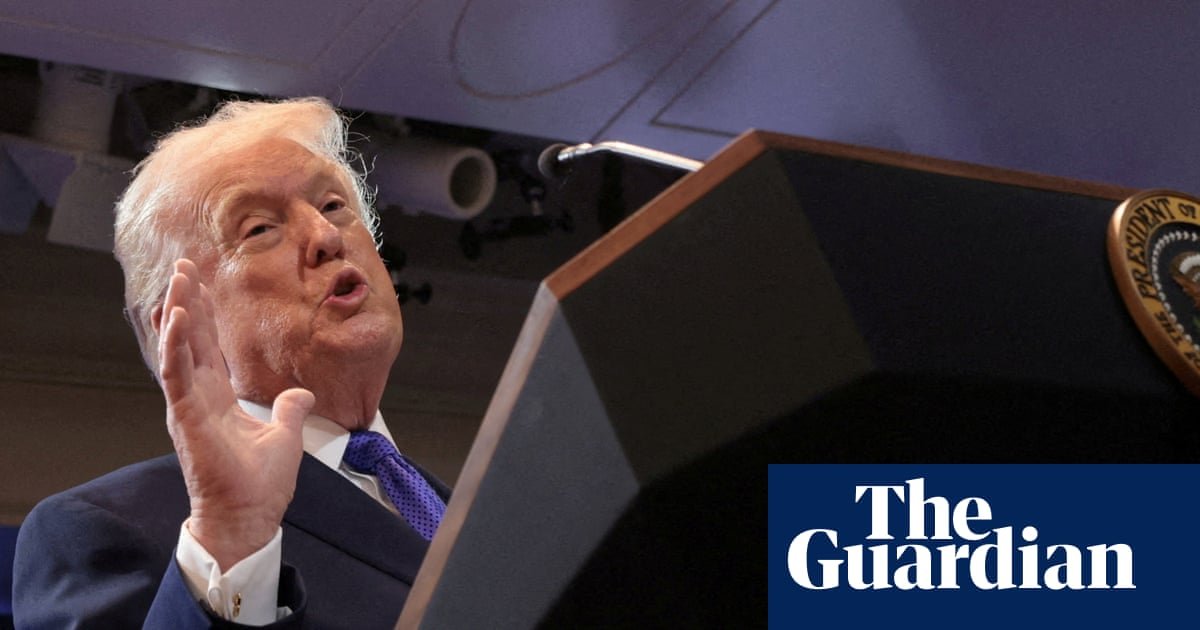
Donald Trump has claimed he has “the absolute right” to impose new tariffs after the US supreme court ruled many of the import duties he imposed last year were illegal.
The president attacked the court in a late night broadside on Sunday, accusing it of having “unnecessarily RANSACKED” the US – and failing to show him sufficient loyalty.
In February, the supreme court found that a 1977 law designed to address national emergencies did not provide the legal justification for many of the tariffs the Trump administration had put on countries around the world.
The administration has scrambled in recent weeks to piece back together its controversial trade agenda and regain economic leverage.
Trump swiftly imposed 10% tariffs on goods from much of the world under a different law, section 122 of the 1974 Trade Act. But these expire after 150 days, in July. While the president also vowed to raise this temporary duty to 15%, he has yet to do so.
US officials launched a string of trade investigations last week, which set the stage for the potential imposition of a new wave of permanent tariffs to take the place of those that were repealed.
“Our Supreme Court has made these Countries very happy but, as the Court pointed out, I have the absolute right to charge TARIFFS in another form, and have already started to do so,” Trump wrote on social media on Sunday.
The supreme court’s decision did not say the president had the absolute right to charge tariffs in another form.
“This completely inept and embarrassing Court was not what the Supreme Court of the United States was set up by our wonderful Founders to be,” Trump wrote on his Truth Social platform. “They are hurting our Country, and will continue to do so.”
He posted hours before US officials were due to convene with their Mexican counterparts on Monday, for talks over the future of their trilateral USMCA trade accord with Canada.
Trump is also due to meet his Chinese counterpart, Xi Jinping, at the end of March, after an extraordinarily turbulent year for economic relations between Washington and Beijing. In an interview with the Financial Times on Sunday, he suggested that their summit may be delayed, however, while urging a string of countries including China to send ships to the Middle East to help reopen the strait of Hormuz.
The US president has continued to use US economic power to try to push other countries around despite the supreme court ruling. He threatened to cut off all trade with Spain earlier this month after its government refused to give the US permission for two jointly operated bases in southern Spain to be used in US strikes on Iran.
