
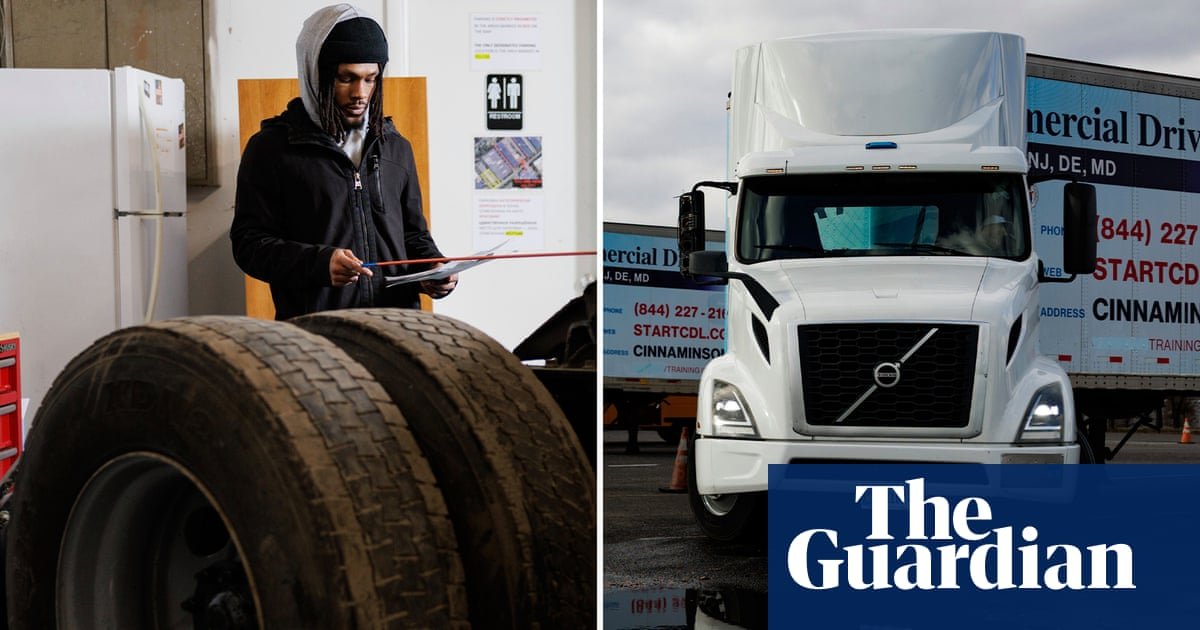
Vasyl Kushnir and Gene Moik jovially greeted some of the young men studying the parts of the hulking 18-wheel trucks parked at their driving school – but behind their smiles were the growing worries that their business is at risk of closing down nearly a decade after it opened.
Every morning, Kushnir and Moik have been running numbers, projecting that it’s becoming increasingly difficult to stay afloat when they’ve suffered a significant drop in student enrollments at their business, Start CDL, since the second Trump administration announced new restrictions for immigrant drivers.
“We had almost 100 students last January, now we only have 28, and we haven’t put prices up. Companies come to ask us or call us every day to see if we can provide them with drivers, but sometimes we have to say no, we don’t have any,” said Kushnir, a 36-year-old immigrant from Ukraine.
“In November and December of 2024 we had almost 100 students each month here in this warehouse, a year later we had between 25 and 30. We are at a point where we may shut our company down,” he said.
Before Donald Trump took office for the second time, immigrants with work authorization in the United States who saw being a truck driver as a good opportunity typically spent at least a month receiving instruction, in both classrooms and behind the wheel in established training schools, like the one Kushnir and Moik founded.
But since the transportation department tightened commercial drivers license requirements for anyone without US citizenship or permanent residency (a green card), Kushnir and Moik said the restrictions have created confusion and chaos. Their driving school has largely stopped receiving calls from refugees, asylum seekers or DreamersAKA recipients of Deferred Action for Childhood Arrivals (Daca).
Thousands are set to lose their commercial drivers licenses since, amid court challenges, the latest version of the new rules came into force last week from the transportation department.
When the Guardian visited Kushnir and Moik’s trucking school recently, in Cinnaminson, New Jersey near the border with Pennsylvania, none of the students inside the warehouse that day had joined with the status of refugee, asylum seeker, Dreamer or similar.
But a year ago, the situation looked entirely different, Kushnir said. Most of the students then were Ukrainians who had fled the Russian invasion and legally entered the US thanks to the Uniting for Ukraine program created under the Biden administration.
Last May, the transportation department also announced that drivers should meet requirements to understand English sufficiently enough to read all signs and communicate well with law enforcement.
For several years, Kushnir and Moik’s truck driving school offered English lessons to those who needed them prior to their license exam. They said they recently had to let go of their tutor because of the economic woes since the new rules came in.
An estimated 9,500 drivers have been taken off the roads in recent months, according to statements by US transportation secretary, Sean Duffy, for failing English language proficiency requirements meeting guidance set by the federal motor carrier safety administration (FMCSA)an agency within the transportation department that seeks to prevent motor-vehicle fatalities and injuries.
Kushnir and Moik talked about former students who are no longer truck drivers because they fear being pulled over and failing the English proficiency test.
“Losing nearly half of our students while keeping the same operational costs created a large gap between revenue and expenses. We had to make staff reductions and now our American dream of being entrepreneurs and helping families is going to waste,” said Moik, a 54-year-old immigrant from Belarus.
“We’re not asking for special treatment, but overnight changes hurt everyone, and we have heard of other schools that are suffering too. It’s hard to say where the industry is going now,” he added.
The transportation department has also threatened to revoke the accreditation of trucking schools across the US that are suddenly accused of falsifying or manipulating training data, neglecting to meet required curriculum standards and instructor qualifications and failing to maintain accurate records.
The department confirmed that 7,000 training providers and schools have seen their accreditations revoked so far.
While causing uproars in many immigrant communities and among advocates, the new policies have found support in some circles.
Andrew Poliakoff, executive director of the Commercial Vehicle Training Association, the largest association of US trucking schools, singled out for praise Derek Barrs, the Trump-appointed administrator of the federal motor carrier safety administration, which sits within the transportation department, for raising standards.
“Barrs’ comprehensive oversight and enforcement actions are cleaning up the entire industry and we see that creating positive downstream effects on the freight market by removing bad actors – CDL [commercial driver’s license] ‘mills’ that were contributing to the most problematic and unsafe forms of excess capacity,” he said.
Poliakoff added that none of the 100 schools that are part of his association have been decertified.
Kushnir and Moik’s trucking school is part of the New Jersey Driving School Council, an organization of 60 professional driving schools. Alissia Alfaro, one of the founders of this organization, said none of the group’s members have been decertified, but many schools are downsizing.
Alfaro, who also leads Ideal Driving School, with multiple locations in North Jersey, said that her commercial drivers licensing classes have dropped by 40% because of the tougher immigration status and language requirements.
Meanwhile, the transportation department recently called out North Carolina, accusing the state of lax standards and saying it will withhold $50m in federal funding if the state fails to revoke licenses issued illegally to foreign drivers.
“North Carolina’s failure to follow the rules isn’t just shameful – it’s dangerous,” said Duffy, adding: “I’m calling on state leadership to immediately remove these dangerous drivers from our roads and clean up their system,”
He accused the state of being just the latest in a string allegedly “putting Americans at risk by recklessly issuing non-domiciled CDLs to inadequately vetted foreign drivers”.
Duffy previously threatened to withhold funds from other states that federal audits have alleged improperly issued commercial driver’s licenses, including New YorkPennsylvania and California.
Back in Cinnaminson, not long after the end of the training session, Justin Taylor, a student, was still examining the internal and front parts of the truck. The 24-year-old from Willingboro, New Jersey, said he is in the second week of training and almost ready to take up the exam for his license.
“I’ve met people that don’t fully speak English here, but I see them learning, memorizing every single part of the truck and sometimes they even recite them better than me,” said Taylor.
“Makes me wonder, why can’t I do it? I also want something more stable and that is pretty good pay. All the precautions that we need to follow are well taught here.”
Not far from Taylor, a couple of men were speaking Spanish. One of them was Juan Carlos Castañeda, born in Toluca, a city in central Mexico, before migrating north in 2012. Castañeda said he received his green card less than a year ago. When speaking with the Guardian, the 37-year-old switched regularly between English and Spanish.
Castañeda said that ever since he arrived in the US, he has been working in landscaping and building fences. But shortly after he received his green card, family members told him to switch professions.
“My brother and my cousins told me that with all that physical endurance I have I should become a truck driver. More money and better benefits,” said Castañeda.
“I know about the restrictions, but I am not afraid, I studied English for four years. This is a more stable job and I am willing to take the risks,” he said.
Karina Krainova, however, a trucker in South Carolina, did not have a green card and had her license revoked a year early, last October, despite being law-abiding and living and working legally in the US under Uniting For Ukraine.
With that loss and growing fears over Trump’s anti-immigration agenda, which has also affected Ukrainians, she chose to leave. Despite having hoped her partner could eventually join her in the US, instead, she reunited with him back in Odesa, Ukraine, less frightened of the Russian bombs that are still falling there than the prospect of being “stopped by ICE” and even ending up in what she called “those detention centers” where record numbers remain locked up in the US.
