
I have in my hand several hundred pieces of paper. Dog-eared, scribbled with rewrites, and stained with sweat and ancient Bermondsey vinegar. But a wodge of paper that may just guarantee, finally, what passes for peace around here.
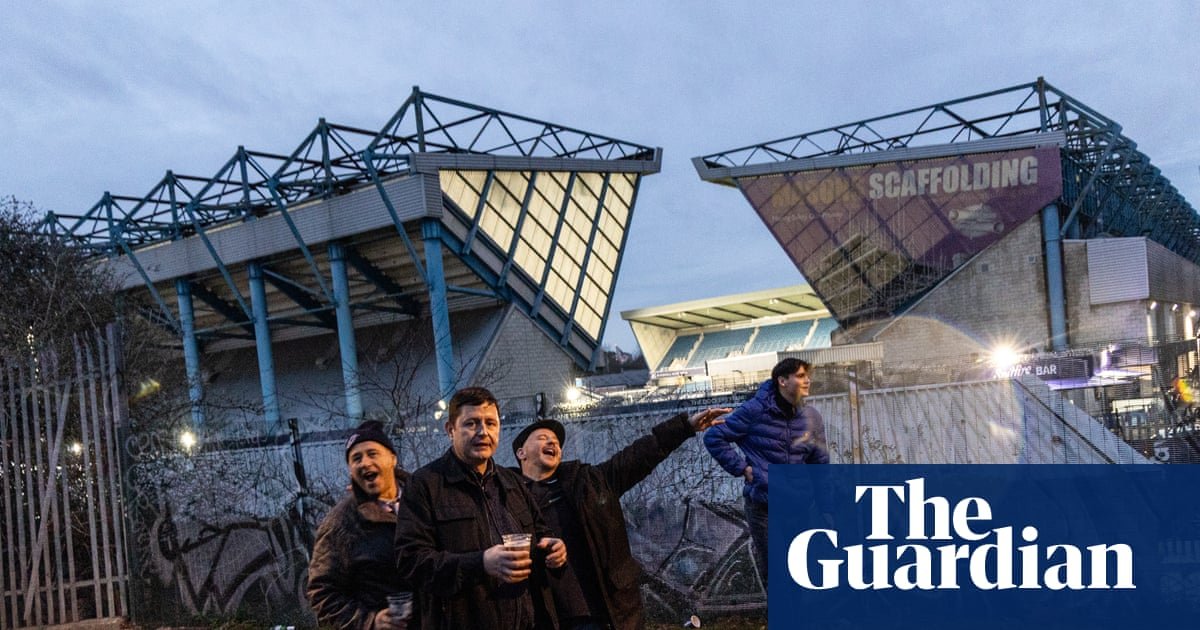
There was a moment at the Den on Saturday afternoon that carried its own strictly localised sense of history. An hour before kick-off in Millwall’s Premier League playoff-push game against Portsmouth, the key personnel gathered in a wedding-style lineup around the centre circle.
In the middle, close to where the door of the vanished missionary church once stood, were the Lions managing director, Mark Fairbrother, and the mayor of Lewisham, Dame Brenda Dacres.
Fanning out either side was a mixed cast of board members, community trustees and fan activists.
At the edge of these were the outlines of absent friends, John Berylson, Paul Jiggins, and beyond that the shadows of bit-parters who never quite came centre stage, from Steve Norris, Tony Blair, Bananaman and unconfirmed Albanian amusement arcade cartels, to the mysterious financial information gatherer known only as Swiss Tony.
Commemorative photos were snapped. And as of Friday morning Millwall and Lewisham council have signed the club’s transformative new 999-year lease on the land beneath its feet.
It is a massive day in the history of Millwall FC, and more widely in the violent cultural push-pull of London. The current parcel of clay was pillaged by Henry V, then reindustrialised as London’s Larder, bombed into dust by the Luftwaffe as Target Area G, and more recently recast as fertile soil for London’s glass and steel tower boom. It will now remain the property of inner south-east London’s only professional football club.
The lease puts an end to a 10-year cycle of acrimony. It also marks the start of something for this stubborn inner London peninsula. The Millwall site and its surrounds is one of the remaining pockets of old Bermondsey, a patchwork of ad hoc housing, shipping container warrens and pop-up shops with plastic pots of fruit outside. For decades London money has been insisting this land is made over and reharvested.
In this context a new lease with development rights is a best-case outcome from a battle that began in earnest with news that Lewisham intended to purchase compulsorily the club’s narrow but vital car park space and reallocate it to a housing developer, a plan that would have threatened the club’s existence in south London.
The preferred developer, Renewal, was owned behind a veil of secrecy in the British Virgin Islands. This is not unusual in itself. The point of ignition was the revelation one of Renewal’s founding directors was (hang on) the previous Labour mayor of Lewisham, Dave Sullivan. Renewal and Sullivan were adamant he was no longer involved and would not benefit from the potentially vast profits of the council-backed plans. But BVI anonymity did nothing to diminish this negative impression. The sense of some oddly blurred act of dispossession persisted.
So began a battle of resistance that spoke to many other threads: disenfranchisement, cultural vandalism, the pricing out of people from their own homes. This was soundtracked by endless leaks, political ambitions dashed and re-enflamed, and a Battle of the Five Armies-style coming together in the local community.
Nobody knows if the wilder rumours about who stood to gain from the land had even the slightest grain of truth. But the story went global. Parliamentary figures had their say. The Say No To the CPO hardcore (in reality: three blokes) ran the 73-year-old Willow Winston as a candidate in the general election. The CPO was finally abandoned just before a televised FA Cup tie at the Den in January 2017, capturing for posterity a day of defiant south London glee.
Nine years on this has now become that rarest of things, a good news story. The rapprochement was overseen by the relentlessly energetic Fairbrother, who returned to the club in 2022 as managing director. How did it feel to open that door again?
“It was frosty,” he says. “That’s probably a good way to describe it. But you have to embrace the future. The councillors we had the worst of battles with have moved on. We know we can’t operate without each other. It’s a common goal, especially with Brenda as mayor. She has been brilliant driving it forward. Her affiliation with the club has come through the community trust, which just shows how important it is to the work we do.”
It is a part of the Millwall paradox. There is an enduring fascination with this club, target of both deserved and undeserved scorn. There have undeniably been incidents of violence and racism down the years. It has been tempting for some parts of the media to locate all evil here. If only we could solve Millwall: maybe all these societal problems would simply melt away.
The reality is Millwall, and Lewisham, is an exceptionally hard thing to govern, a space where the battle lines meet, one that reflects and embodies the tensions of society like no other. It will also defy your expectations, a club of the white working class, but also one of the more mixed crowds you’re likely to find at football. It is also a place where good stuff actually gets done.
Lewisham’s labour council was key to the setting up of the club’s groundbreaking community trust 40 years ago. Since then the club with a reputation for nihilism has done as much as any other anywhere to engage with its mixed and shifting parish.
“The new lease will safeguard our community delivery, and that facility is fundamental to our development,” Fairbrother says. “They are brilliant, they just do it, and a lot of that time without any plaudits, just because it’s the right thing to do from a community outreach perspective.
“What I say to everyone is: ‘Come down and meet people, you’ll see that your expectations are completely off kilter.’ We are a cross-section of society in terms of our fanbase. We have got people from all different walks of life, which is not what you always see in sport.
“From a personal perspective, I’m openly gay and I’ve never once experienced anything adverse here. My husband comes down. We bring friends. I certainly wouldn’t ever feel intimidated. It’s so open. Nobody cares about people’s backgrounds. When I was asked to come back, it was a no-brainer. This place, I think for anyone who ever comes here, holds a special place in their heart.” And as of Friday, in the borough too.
There is still uncertainty about what happens next. As ever the need to preserve must be balanced against growth. The instant bonus is that the club can set about building up to a thousand new properties on underused land, providing homes and also income for itself and the council. Plans for the ground are less clear. On the table are building up, building over, filling the corners (not always the best view: also, the chug of trains going past is one of the great urban football backdrops).
“The key thing is we can never lose what makes this place special,” Fairbrother says. “We want everyone close to the pitch. We want opposition to be fearful of coming here. What we don’t want to be is just another faceless stadium. You need to be at the Den. This place is unique and that’s what we should be proud of.”
Will the club now be sold? Millwall has been a passion project for the Berylson family, not to mention something of a money pit. The lease transforms its value at a stroke. “I mean, you can never say never,” says Fairbrother. “The affiliation with the family, the love of the club is so much deeper than I’ve probably seen at any other club. You never know what the future holds, but it’s also not a transactional relationship with the football club. This is deep-seated, and obviously with James [son of John] as chairman, he’s got his vision on how he wants to do things.”
This may or may not involve promotion and a place in the top tier for the first time since 1990. The season could yet provide the perfect year-end content, a playoff date with Wrexham, Millwall’s soft-focus alternate.
“That would be fantastic,” Fairbrother says. “The EFL would love it, obviously; I’m sure Disney+ would as well. It’s total Hollywood, isn’t it, where they’ve come from? It’s also a challenge because there are those of us doing it a different way who perhaps aren’t afforded a TV show with all the sponsors and all the new interest. But if we can do it our way, then it’s a win for the normal guys.”
It is an appropriately Millwall note to end on, a little bit of low-key bristle. Although, let’s be honest, nothing very normal ever really happens around here.
