
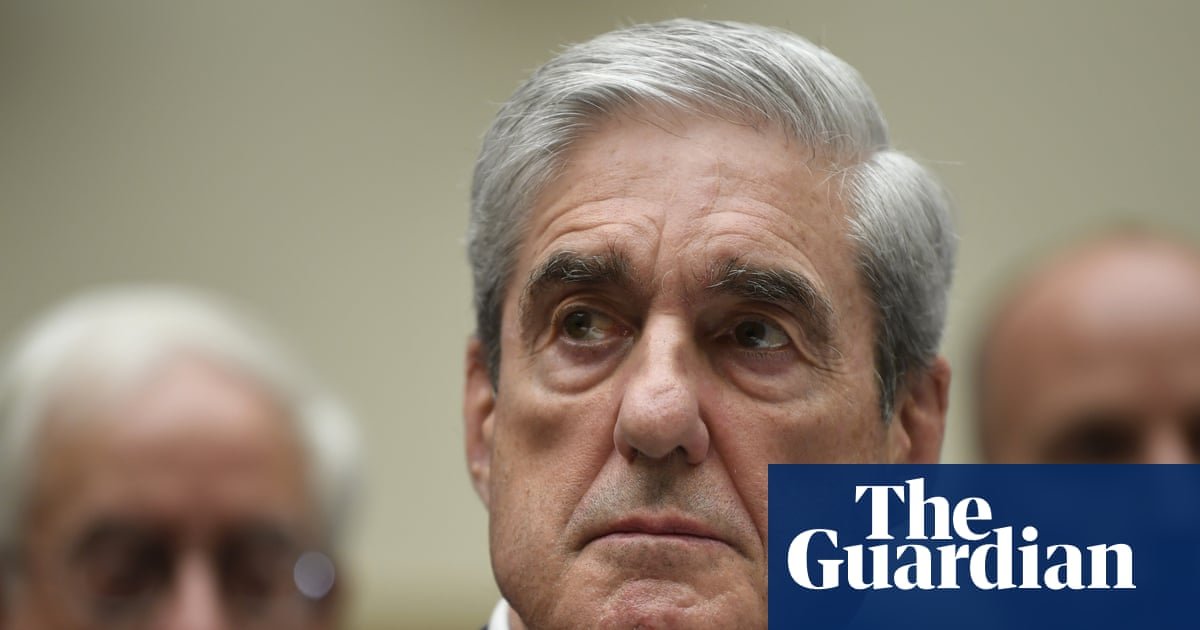
Robert Mueller, the former special counsel who investigated Russian interference in 2016 and links between Donald Trump and Moscow, has died, his family said on Saturday. He was 81.
A statement from Mueller’s family, relayed by the New York Times on Xsaid: “With deep sadness, we are sharing the news that Bob passed away last night. His family asks that their privacy be respected.”
Mueller was appointed as special counsel in 2017 by then deputy attorney general Rod Rosenstein to oversee the federal investigation into Russian interference in the 2016 election.
The two-year investigation dominated much of Trump’s first term in office and concluded in 2019 that Russia had interfered in the election with the intention to benefit Trump’s 2016 campaign.
Mueller served as FBI director from 2001 to 2013, making him the longest serving official in the position since J Edgar Hoover. Earlier in his career, he oversaw the prosecutions of Panama strongman Manuel Noriega, New York mobster John Gotti, and led the investigation into the 1988 bombing of Pan Am flight 103.
Following the 9/11 terrorist attacks, Mueller helped transform the FBI from an agency focused on national security and law enforcement into one that gathered intelligence and countering terrorism globally.
His 50 years of public service began with voluntary conscription in the US marines at the age of 21. He began a legal career in Boston in 1971 before becoming a prosecutor in the US attorney’s office in the northern district of California in 1976. In 1982, Mueller was appointed US attorney for the district of Massachusetts, and later as US attorney for the northern district of California.
But in July 2001 be was nominated to be director of the FBI by George W Bush. Two months later, and one week after he was sworn in, the Twin Towers in New York were attacked and destroyed by Islamic fundamentalists, requiring the FBI to be radically shaped to combat the growing threat of foreign terrorism.
He often stood on principle. In 2004, Mueller and deputy attorney general James Comey came within hours of resigning over the planned reauthorization of a dragnet domestic wiretapping program, which Mueller and Comey believed to be illegal. The program was not reauthorized.
Mueller’s reputation among Republicans and Democrats alike was as a hard-working, methodical and serious straight-shooter. When he came to the end of his 10-year term as FBI director, he was approved for a second 10-year term, at Barack Obama’s request, by a unanimous vote in the Senate.
“He is probably America’s straightest arrow, very by-the-book, very professional,” Garrett M Graff, whose book The Threat Matrix studied how Mueller transformed the FBI after the 9/11 attacks, previously told the Guardian.
“He is so straight, he always wears a white shirt,” Thomas B Wilner, a longtime friend, told the Washington Post. “He’s a pain in the ass in many ways because he is so straight … He’s conscious that he’s a public figure, and he doesn’t want anything to compromise his integrity. Even a blue shirt.”
But his appointment to special counsel to investigate allegations of Russian interference in the 2016 election brought Mueller into the gladiatorial arena of US domestic politics.
He obtained a guilty plea from Trump’s former national security adviser Michael Flynn for lying to investigators, and indicted or secured guilty pleas from 34 individuals and three companies, including six former Trump aides, five of whom pleaded guilty, as well as 26 Russians and three Russian companies.
Trump repeatedly called Mueller’s work a witch-hunt but Mueller remained silent, preferring that his work be more professional and effective.
In March 2019, Mueller ended his investigation and delivered his 448-page report to attorney general William Barr. There were to be further indictments, but according to a letter summarizing the investigation, there was insufficient evidence to establish that members of Trump’s campaign knowingly engaged in a criminal conspiracy with the Russian government to interfere with the election.
He laid out damaging details about Trump’s efforts to seize control of the investigation, and even shut it down. Mueller declined to prosecute Trump but the report said it did “not exonerate” Trump. Attorney general Barr and Rosenstein decided that the evidence was not sufficient to charge the president with obstruction.
Mueller pointedly noted: “If we had confidence after a thorough investigation of the facts that the president clearly did not commit obstruction of justice, we would so state. Based on the facts and the applicable legal standards, we are unable to reach that judgment.”
After Mueller’s death was announced on Saturday, Trump offered an uncharitable comment on his social media platform, Truth Social. He wrote: “Robert Mueller just died. Good, I’m glad he’s dead. He can no longer hurt innocent people! President DONALD J. TRUMP.”
In other quarters, Mueller will be remembered as a defense lawyer, prosecutor, government official and soldier. As a marine in Vietnam, he was shot through the thigh and would be recognized with a Bronze Star for valor in combat, a Purple Heart and other decorations.
“Second Lieutenant Mueller’s courage, aggressive initiative and unwavering devotion to duty at great personal risk were instrumental in the defeat of the enemy force,” the commendation for his Bronze Star read.
“Bob’s a good marine,” his deputy, Tom Pickard, told Graff for a 2008 profile. “He was very cool under fire.”
