
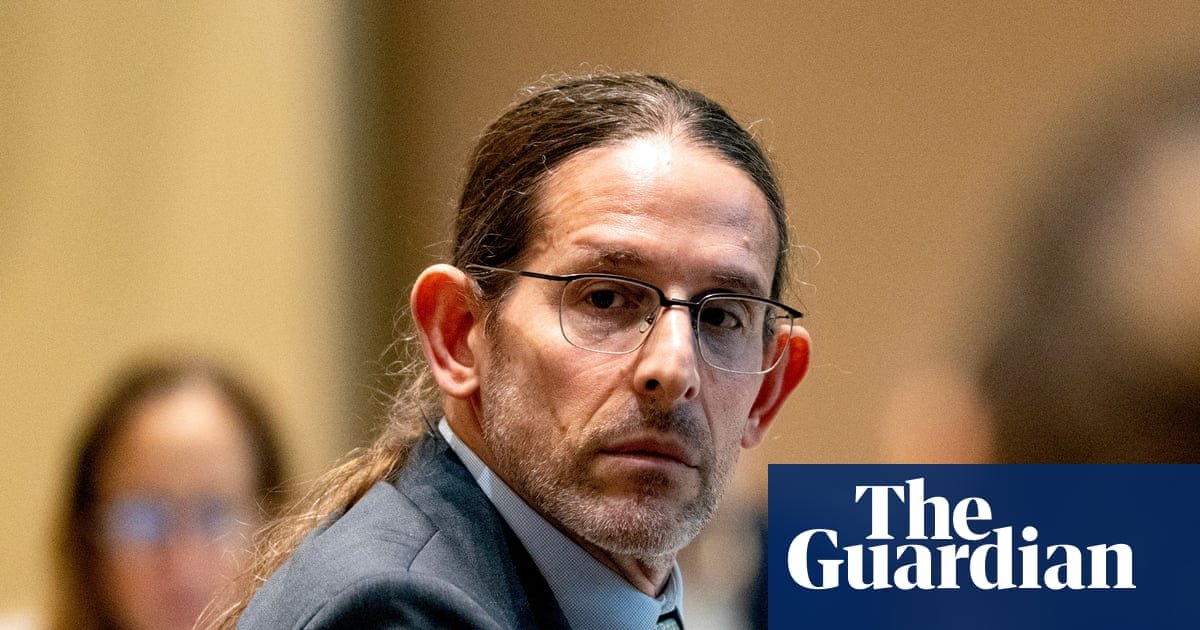
The MIT professor who has been appointed by Robert F Kennedy Jr to review the safety of Covid-19 vaccines has failed to meet basic scientific standards in his own research on the topic, according to more than a dozen scientists and public health experts.
Retsef Levi, an operations management professor, is a member of the US health department’s vaccine advisory committee (ACIP) which is meeting later this month and – many experts fear – could seek to rollback recommendations on who should receive Covid-19 vaccines.
Levi, who holds Israeli and American citizenship, has claimed that Covid-19 vaccines are the “most failing medical product in the history of medical products”, despite a body of research that has shown they are safe and effective. A modeling study published in 2022 in the prestigious medical journal The Lancet estimated that Covid-19 vaccines saved nearly 20 million lives in the first year they were available.
He holds a coveted seat on ACIP, which was once considered the “international gold standard for vaccine decision-making” but has faced criticism after Kennedy fired 17 of the group’s voting members – including doctors, immunologists and epidemiologists – and replaced them with individuals who have been criticized for undermining public trust in the safety and efficacy of many vaccines, without any basis in fact.
A Guardian review of Levi’s record found that more than a dozen experts have criticized research papers he has authored on the topic for being misleading. Some experts also said they believed Levi, who is not a physician or vaccine expert and now heads ACIP’s special immunizations work group on the Covid-19approaches the topic with a pre-determined agenda, instead of a spirit of true scientific inquiry.
In a statement to the Guardian, Levi, 55, said that criticism of his work was not valid. “My papers are factual, balanced, rigorous and accurately contextualize their findings,” he said. “My record, expertise and experience speak for themselves.”
Dr Sharon Alroy-Preis, who served as head of Israel’s public health services during the pandemic, and stepped down from that role earlier this year, told the Guardian she could recall reading a draft of a paper Levi wrote in 2021, which suggested a correlation between Israel’s vaccination rate and emergency calls received by first responders in Israel that involved cardiac arrest.
“We took it very seriously at the ministry of health. We invited him to a meeting to thoroughly look at the research,” she said. “At the meeting it was clear that he was not familiar with the way the data is collected and potential wrong interpretations. What was more troubling: he didn’t seem to care.”
She added: “Having no answers to our professional questions he continued to insist he was right and ‘on to something’. It was clear he came with an agenda.”
Levi did not comment on this specific criticism.
Nadav Davidovitch, an epidemiologist and public health physician who was on a national advisory committee in Israel during the pandemic, said Levi was one of a handful of prominent individuals from prestigious institutions who sought to share their opinions on how to tackle the pandemic even though they were not experts in vaccines, epidemiology or infectious disease.
Davidovitch, a fellow at the Hastings Center for Bioethics, and member of faculty of medicine at Bar Ilan University, said he believed Levi became “more radical” as the pandemic went on, specifically in regards to children being vaccinated, because he seemed to believe the government was doing “dangerous things”.
“What was different with him was that after a year or so he became very vocal on social media and attracted people who were even more conspiratorial than he was,” he said.
Davidovitch said he believes the Covid-19 vaccines saved millions of lives, though there could also be side effects, and said the medical establishment was not always transparent enough – not because of conspiracy theories, but because doctors were racing against time during the pandemic.
“Levi was very engaged. He is very eloquent and well connected, and he also got the ear of people like Robert Kennedy,” he said. “The issues of transparency and trust were a major lesson learned as experts seek to improve their response in future public health crises.”
Levi defended his credentials in a statement to the Guardian. “I have over two decades of experience as a professor at MIT developing advanced analytical methods to evaluate complex risk–benefit trade-offs in healthcare and public health systems, manufacturing systems of biologics, as well as pharmacovigilance and drug safety – to name a few,” he said. He added that he also had “extensive experience working with clinicians, regulators and industry experts”.
Levi’s research citing Israeli emergency calls to first responders – which was thoroughly criticized by the Israeli ministry of health in a paper – was later peer reviewed and ultimately published in 2022 by Scientific Reports, where it would become one of the most widely cited studies to suggest vaccines could be causing harm. It still garnered intense criticism online.
One paperwhich was signed by 10 scientists but not peer-reviewed, called on Scientific Reports to retract the paper, saying it was the “perfect demonstration” of a phenomenon that had developed during the Covid-19 pandemic, in which publications were rushed “potentially without rigorous peer review”.
The authors wrote: “The paper does not pass basic statistical and epidemiological review, which brings into question whether the findings do indeed ‘raise concerns regarding vaccine-induced undetected severe cardiovascular side-effects’ … or whether the reported weak correlations are simply the result of inadequate and inappropriate methodological choices.”
In response to some of the criticism, Levi told FactCheck.org in 2022 that the paper’s findings were “merely correlation and NOT providing causality”, and said more studies should be done. Scientific Reports did investigate the paper and Levi was ultimately forced to issue a correction that cited several errors. But it was never retracted.
Lonni Besançon, an assistant professor in data visualization at Linköping University in Sweden who has been called a “research integrity sleuth”, said the paper failed to distinguish between the effects of Covid-19 itself and effects of the vaccine.
“Despite this, it surely had an impact of [promoting] vaccine hesitancy,” he said. “It is the 41st most shared paper of all time … which is shameful.”
In 2023, Levi tweeted that there was “mounting and indisputable” evidence that mRNA vaccines – the technology used in the Pfizer and Moderna Covid-19 vaccines – “cause serious harm, including death”. Besançon said the claim was unsubstantiated and harmful to science and public health. Indeed many believe the use of mRNA technology represents a new frontier in vaccine science.
At least one other paper Levi published about Covid-19 – which has not been peer reviewed and found that recipients of the Pfizer vaccine had a roughly 40% higher all-cause mortality than Moderna over 12 months – was heavily criticized by public health experts who were asked to read it by the Guardian. The paper was co-authored by Joseph Ladapo, the surgeon general of Florida who has been called an “unexpected source of vaccine misinformation” and once compared vaccine mandates to slavery. Ladapo has hit back at critics, including at the Food and Drug Administration (FDA), and said his attempts to get more “honesty and transparency” from the government has been met with “a word salad of pandering and gaslighting”.
“The pattern across Levi’s work is using study designs that can generate associations but cannot establish causation, then having those findings amplified as evidence of vaccine harm, sometimes even when he acknowledges the limitations himself,” said Jess Steier, executive director of the Center for Unbiased Science & Health. “Someone who repeatedly chooses study designs that can’t answer causal questions, and whose work gets weaponized to support conclusions he admits it can’t support, is not who you want driving vaccine policy.”
Elizabeth Jacobs, professor emerita at the University of Arizona and a founding member of Defend Public Health, said the Pfizer paper was “messy” and “sloppy” and difficult to evaluate because certain data was missing. She said the work did not take into account pre-existing health conditions, which she called “a major red flag that the study isn’t scientifically rigorous”.
“Dr Levi has made a number of easily-disproved statements about his baseless belief that mRNA Covid-19 vaccines are harmful, despite having little or no education, training or experience in public health,” Jacobs said. “If Mr Kennedy were serious about objective evaluations of the data, Dr Levi would not be included in any assessment of Covid-19 vaccine safety, let alone leading it. His biases are clear, insurmountable and disqualifying.”
Levi disputes the claim that he lacks relevant expertise.
The Guardian asked Levi to address all of these critiques of his work. In response, Levi said in a statement: “The mentioned criticism on my research has been addressed through formal peer-review processes, with all retraction requests, including the one by the Israeli Ministry of Health, denied by Scientific Reports.”
A spokesperson for HHS said “attacks” on Levi were “clearly politically motivated and ignore his substantial credentials”.
“He is more than qualified to serve on ACIP. Secretary Kennedy appointed members who are willing to ask hard questions and follow the evidence, which is exactly what restores public trust, not rubber-stamping recommendations,” the spokesperson added.
The published agenda for ACIP’s 18-19 March meeting indicates the committee will focus on Covid-19 vaccine injuries, long Covid, and potential changes to vaccine recommendation methodologies.
Dr Jake Scott, an infectious diseases specialist and clinical associate professor at Stanford University School of Medicine who is a nationally-recognized vaccine expert, said he fears ACIP will use data that has not been peer-reviewed or publicly released – like an unsubstantiated allegation by a former FDA official that at least 10 children died from Covid vaccination – to justify restrictions on vaccine recommendations, even in cases when real-world data does not merit the limits.
“What concerns me is not that someone is reviewing the data, but that the person who is reviewing it has said mRNA vaccines should be removed from the market,” he said. “The question becomes, is this a genuine scientific inquiry or a review with a pre-determined decision?”
Dr Scott said he was concerned not just as a vaccine research expert, but as a doctor who was on the front lines of the pandemic. He said he had lost more than 100 patients – people in nursing homes and others who were vulnerable – and then saw the “dramatic change” that occurred once vaccines were introduced. After that, he witnessed a sharp drop-off in Covid-19 associated deaths.
“In 2021 the vast majority – nearly all – of my patients who I lost to Covid had chosen to be unvaccinated, and that was tragic in its own way. Many were younger. I lost parents who had relatively young kids, who would not have died had they been vaccinated.”
Dr Scott added: “There is so much misinformation about Covid vaccines in general, so many extreme fringe theories that continue to fuel doubt and mistrust in vaccines, in public health, and in doctors. It is heartbreaking and mind blowing and hard to put into words how high the stakes are.”
