
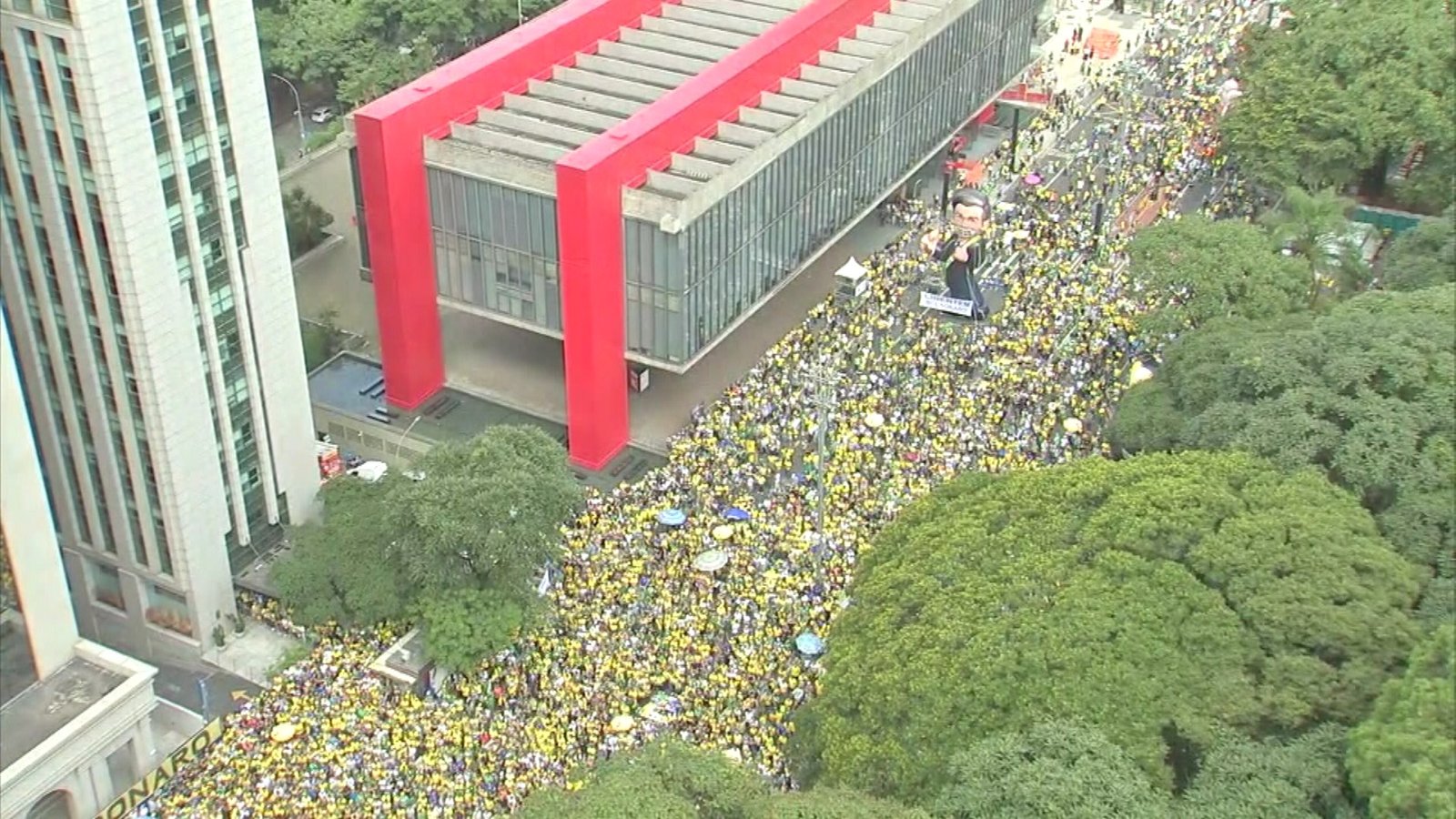
Protesters linked to right-wing movements gathered this Sunday (1st) on Avenida Paulista, in the central region of São Paulo, in an event criticizing President Luiz Inácio Lula da Silva and ministers of the Federal Supreme Court (STF). The protest was called by federal deputy Nicolas Ferreira (PL-MG) and is taking place simultaneously in at least 20 Brazilian capitals.
In the capital of São Paulo, the concentration began around 2 pm, near MASP. An electric trio was set up at the site, where political leaders spoke throughout the afternoon. At the beginning of the act, the National Anthem was played.
Among the main agendas are requests for “Lula Out”, criticism of ministers Alexandre de Moraes and Dias Toffoli, in addition to defending amnesty for those convicted of the acts of January 8, 2023 and the transfer of former president Jair Bolsonaro to house arrest.
State deputy Tomé Abduch (Republicans) was one of the first to speak in São Paulo. The organizers expected an increase in attendance throughout the afternoon, especially with the arrival of Nicolas Ferreira, the main name behind the call.
The act is also seen as a political thermometer within the right-wing camp, amid the articulations for the next presidential elections. The participation of senator Flávio Bolsonaro (PL-RJ) is expected, identified by allies as a possible name for the group to dispute the Planalto. On Friday (29), he was in São Paulo alongside governor Tarcísio de Freitas (Republicans), in a meeting at Palácio dos Bandeirantes, which was interpreted as a sign of political alignment.
The mobilization, however, exposed differences between Bolsonaro leaders. Part of the group argued that the focus of the protest should be exclusively the amnesty for those arrested on January 8th and the legal situation of Jair Bolsonaro, while another wing prioritized criticism of the STF and requests for impeachment of Court ministers.
In Brasília, the event was organized by deputy Bia Kicis (PL-DF), with the presence of parliamentarians such as senators Eduardo Girão (Novo-CE), Rogério Marinho (PL-RN) and Izalci Lucas (PL-DF). There are also records of demonstrations in cities such as Porto Alegre, Goiânia, João Pessoa and Manaus.
According to organizers, the events were previously communicated to the authorities and have a security system. Until early afternoon, there were no records of serious incidents.
The demonstrations take place at a time of intensification of political articulations on the right, with internal disputes over leadership and electoral strategy. Adherence to the acts must be observed by allies as an indication of the group’s ability to mobilize on the streets.
