
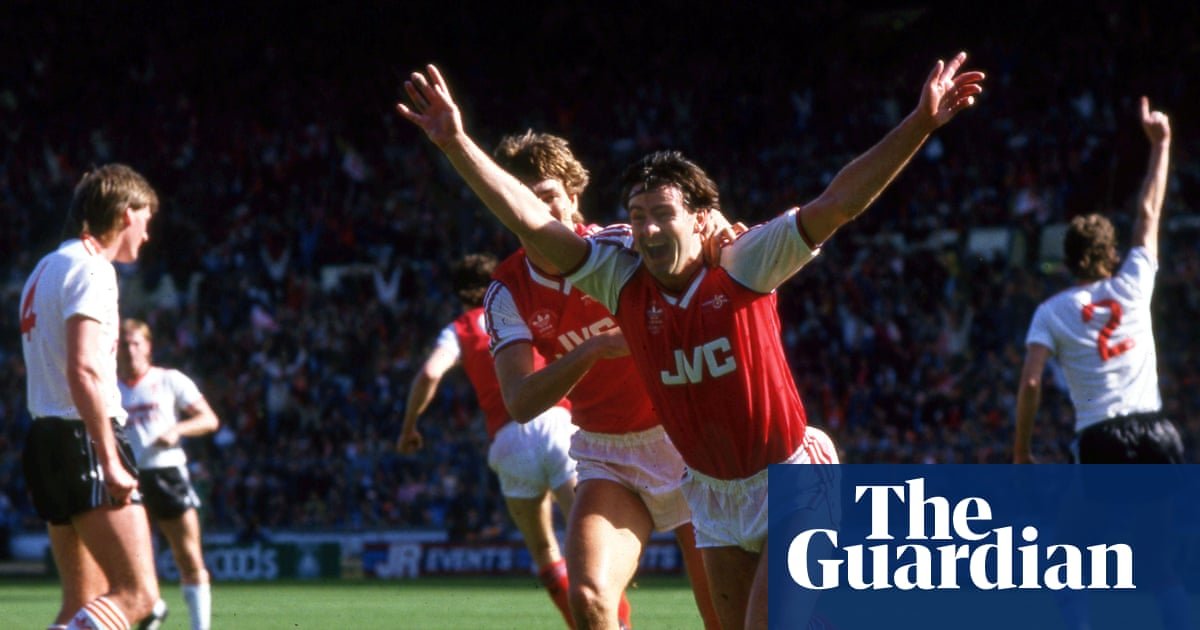
“He’s the Bonnie Prince this afternoon.” The words of Barry Davies at the conclusion of the 1987 League Cup final were typically well chosen. For on that glorious, sunny Sunday afternoon at Wembley, Charlie Nicholas delivered on the biggest stage and ended Arsenal’s eight-year wait for a trophy.
In truth, Nicholas’s time at Arsenal had not lived up to the excitement and hype that surrounded his move from Celtic in 1983. There were occasional glimpses of magic – happily for Arsenal fans he often saved his best for Tottenham – but his performances were as inconsistent as the team were during the Terry Neill and Don Howe reigns.
George Graham took over in the summer of 1986 and there were constant murmurings that Nicholas’s days at the club were numbered. A player who hardly fitted Graham’s energetic and industrious style, Nicholas did indeed depart for Aberdeen in January 1988. But he gave Arsenal fans an ideal parting gift before he left.
The prospect of Arsenal reaching a Wembley final for the first time in seven years seemed like a distant dream midway through the second leg of their semi-final against Tottenham. Trailing 1-0 on the day and 2-0 on aggregate, even the Spurs stadium announcer thought Arsenal were down and out, as he shared information about how Tottenham fans could get tickets for Wembley.
The Arsenal players heard the announcement in their dressing room and it provoked a reaction: they scored twice in the second half to force a replay. They came from behind again three days later to clinch a memorable 2-1 victory at White Hart Lane. Graham’s young guns never knew when they were beaten.
They would have their hands full in the final, though. Liverpool were understandably favourites due to their vast experience of Wembley finals. “They have visited the place so often in recent years that the stadium has practically become their second home,” wrote the Guardian reporter David Lacey in his preview. Gary Gillespie was the only member of the Liverpool starting XI who had not played there before and this was their eighth domestic cup final in 10 years.
Arsenal’s league form had tailed off since the start of the year but there were reasons for optimism when the teams met on 5 April 1987. Liverpool were faltering in their title race with Everton, losing the previous two league matches before the final. And with Mark Lawrenson, Jim Beglin and Steve Nicol ruled out for the rest of the season, key parts in Liverpool’s machine were missing.
It was an archetypal Wembley final: live coverage on the BBC, a 3pm kick-off, Jimmy Hill presenting with Bobby Charlton and Trevor Brooking as pundits, the twin towers, the marching band, and that long walk from the tunnel to the halfway line. Marvellous.
Liverpool started quickly and took control, with Ian Rush dragging an effort wide and Craig Johnston forcing a fine save from John Lukic. Jan Mølby then blazed over from the edge of the box after a mistake from Arsenal captain, Kenny Sansom. Davies noted that Sansom was nervous, a worrying thought for Arsenal fans given the left-back was one of their most experienced players.
Sansom said his start was far from ideal in his 1986-87 season review book, Going Great Guns. “We have been told that the first 20 minutes are going to be vital because if Liverpool get hold of you then, they never let go. And they have started well, we can’t get a kick and we are under pressure. This is not going as planned. Then they score and I feel sick from my stomach. It is Rushy, it has to be Rushy.”
Rush’s goal in the 23rd minute was beautifully created, a move beginning in the hands of Bruce Grobbelaar and ending with a clinical finish. Mølby’s superb pass to Steve McMahon cut Arsenal open and there was only going to be one outcome when the midfielder cut the ball back to Rush. “It’s such a familiar sight,” said Davies.
“Arsenal will be desperately trying to get out of their mind that infernal statistic,” added Davies, referencing a fact that everyone watching at home knew: Liverpool had not lost any of the 144 matches in which Rush had scored. But their comebacks in the semi-final had left a mark on Arsenal’s players. “The strange thing was that, even though I had been caught by a sucker punch, I still had this feeling that we were going to win the game,” Tony Adams wrote in Addicted. Rather than collapse after Rush had opened the scoring, Arsenal woke up and took the game to Liverpool.
Paul Davis nearly equalised, hitting a post from distancebefore Nicholas found the net in the 30th minute. After a scramble in the Liverpool box, Nicholas hit a post again and then swept the ball home. “It’s Charlie. Charlie Nicholas has done it,” said Davies excitedly. Adams grabbed the goalscorer in a headlock as they ran off in celebration. “The moment Charlie got his first I knew we would win the match,” wrote Sansom in his season review. With Davis and Steve Williams gaining control in midfield, Arsenal were growing in confidence.
The second half was a nip-and-tuck affair. Moelby and McMahon went close, Viv Anderson dived hilariously in the area to try to win a penalty – “reminiscent of Duncan Goodhew,” said co-commentator Charlton – and there was a moment of confusion between Grobbelaar and Ronnie Whelan that caused panic. But with less than 10 minutes remaining, extra time looked a real possibility.
But then came the match-winning moment, inspired by a £50,000 signing from Colchester. The substitute Perry Groves had pace to burn and, when he skipped past Gillespie on Arsenal’s left in the 83rd minute, Liverpool were stretched. Groves cut the ball back to Nicholas, who opened his body and tried to shoot into the far corner. But his effort deflected off Whelan and limped apologetically fits Grobbleaar.
Nicholas and Groves hugged behind the net, Graham punched the air in delight, and even Bob Wilson could be spotted rising to his feet before he remembered his BBC impartiality. Liverpool had no response. A little over seven minutes later, Arsenal had won the League Cup for the first time.
One-nil down, two-one up – a good name for a fanzine – once again, as chants of “Arsenal are back” and “Charlie, Charlie” came from the Arsenal end. Rush’s record was over – a week later he would score again at Norwich and end up on the losing team – and Arsenal had beaten Liverpool in a Wembley final for the third time, after their 1950 and 1971 FA Cup wins.
“Arsenal’s younger players came of age,” wrote Lacey in his match report, although most newspaper coverage focused on Nicholas and his desire to sign a new contract. Graham would not be drawn into discussions regarding his future, instead revelling in bringing a trophy to Arsenal in their centenary season.
Nicholas said he hoped Wembley would be “the start of something big”. It turned out that way for the club, but not for the man himself. With Alan Smith recently signed from Leicester, the writing was on the wall. Graham, boosted by the unexpected success in his first season, went on to build a team capable of toppling Liverpool.
“This can be the start of a run of success similar to Liverpool’s over the last two decades,” said Graham after the final. Arsenal did not quite go on to dominate England and Europe, but beating Liverpool and ending their trophy drought laid the foundations for the glory that followed.
This article is by Steven Pye for That 1980s Sports Blog
