
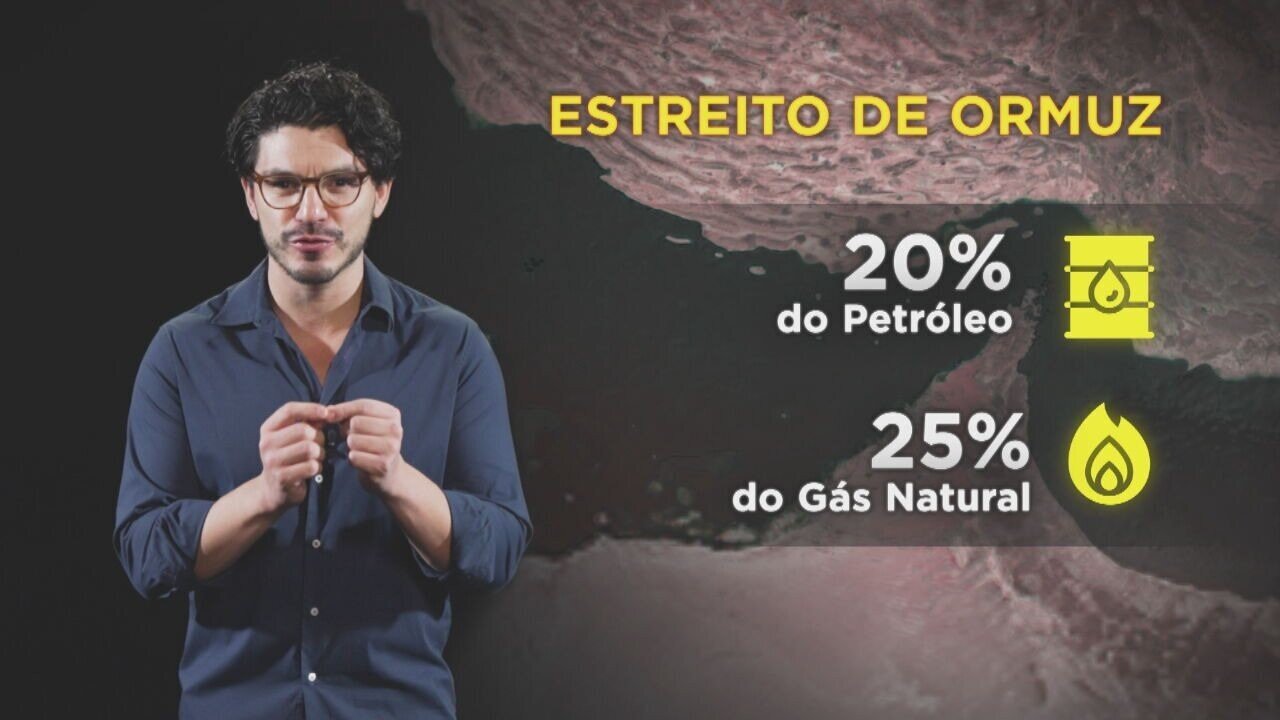
Strait of Hormuz has become the focus of attention in the war in Iran Iran’s offensive in the Strait of Hormuz, one of the most strategic maritime routes in the world, is already having repercussions on the global economy. The blockage of the passage of the Strait, on the Iranian coast, has significantly reduced the flow of oil that crosses the route and, consequently, put pressure on commodity prices, leading authorities in several countries to adopt measures to contain the impacts. Experts explain that the Iranian action is part of an international pressure strategy. Find out more in the video above and in the text below. Importance of the Strait of Hormuz and Iran’s takeover of control Through the Strait of Hormuz passes 20% of all oil produced on the planet and up to 25% of natural gas — most of it destined for China, India, South Korea and Japan. Under normal conditions, between US$ 300 million and US$ 360 million in oil crosses the narrow passage that is just 33 km wide every day. Today, control of the Strait of Hormuz is in the hands of the mines and drones of Iran’s revolutionary guard. Last week, the Iranian government confirmed the closure of the strait and threatened to set fire to any ship that tried to cross it. The interruption has occurred since the United States and Israel began a campaign of air strikes against Iran on February 28, which increased military tension in the region. Before the conflict escalated, movement in the Strait was intense. Now, with the risk of naval mines and attacks, the scenario has completely changed, with a sudden reduction in ship traffic in the region, as shown in an illustration displayed by Fantástico (see the image below). See the change in movement in the Strait of Hormuz after the conflict in the Middle East Reproduction/TV Globo Iran’s strategy and the real risk of a global crisis According to analysts, the Iranian strategy is precisely aimed at the fear of a global crisis. The country has already threatened to close the Strait on other occasions, such as in 2019, when it was accused of attacking oil tankers in the region. For the Iranian government, both at that time and today, the strategy is to make the world worried about a possible global economic crisis. “The closure of the Strait of Hormuz is a strategic option for Iran, in the sense of trying to contain the war and, therefore, end the pressure against its own territory”, points out Ronaldo Carmona, professor of Geopolitics/Escola Superior de Guerra. Experts warn of the economic impact of the measure: “Saudi Arabia is currently the main oil exporter in the world, and Saudi oil basically passes through the Strait of Hormuz. Oil today is still the main source of energy in the world. As I remove some source of energy from the matrix, it reduces supply and automatically increases the price and generates inflation”, explains Adriano Pires, director of the Brazilian Infrastructure Center. Mines at sea: understand Iran’s weapons threaten global crisis Reproduction/TV Globo Iran’s naval mines: the pillars of the offensive The threat of Iran’s use of sea mines has become one of the central points of the naval war taking place amid the conflict in the Middle East. These naval weapons are operated by two military structures in the country: the traditional Iranian Navy and the force considered most feared, the Revolutionary Guard Navy, specialized in asymmetric operations at sea. “This is classic from the point of view of naval warfare, the use of mines as a movement to block ports and canals. And these mines are increasingly becoming sophisticated”, explains Ronaldo Carmona, professor of Geopolitics/Escola Superior de Guerra. Experts explain that there are three main types of sea mines: contact mines, which detonate when touched; influence mines, activated by sensors; remote mines, controlled remotely by the Revolutionary Guard. According to experts, these artifacts can be launched quickly and remain submerged without any visible sign to anyone sailing, which makes navigation dangerous: “The ship has no way of detecting the existence of mines. It would be very risky navigation”, says Eduardo Tannuri, professor of Mechatronic Engineering/USP. Iran’s use of naval mines harks back to historical episodes. During the Gulf War in 1991, around two thousand mines were spread in the Persian Gulf by Saddam Hussein’s regime, directly impacting the energy supply of other countries — including Brazil. “The risk was hitting a mine, there actually was an explosion and a fire. The war started to take a little longer than expected. The country, Brazil, started to go into a rationing crisis, closing at night, hospitals needing energy, where there is a thermoelectric plant. So it became a mission, right? So you have to take the risk, it has to be taken because of the country’s needs”, recalls José Menezes Filho, former oil tanker commander. Mines at sea: understand Iran’s weapons threaten global crisis Reproduction/TV Globo READ ALSO: ‘A path of 1h30 took 24h’: war spreads beyond Iran and Brazilians report tense escape in Lebanon USA reacts and conflict escalates In the current sea battle, the President of the United States, Donald Trump, said that one of his targets is to annihilate the Iranian Navy. The American president stated that the US shot down 42 Iranian vessels. Also this week, an American submarine sank an Iranian frigate near Sri Lanka, in an action unprecedented since World War II. At least 87 bodies were found, and 32 people were rescued. Trump said last Sunday that the United States could escort the tankers, but so far the Strait of Hormuz remains partially closed. According to the UN, 20,000 crew members are on board ships in the Persian Gulf, awaiting the full opening of the Strait. Oil crisis: understand why Iran’s offensive at sea threatens the global market Reproduction/TV Globo Listen to the Fantástico podcasts ISSO É FANTÁSTIC The Isso É Fantástico podcast is available on g1 and the main podcast apps, bringing great reports, investigations and fascinating stories on podcast with the Fantástico journalism seal: depth, context and information. Follow, like or subscribe to Isso É Fantástico on your favorite podcast player. Every Sunday there’s a new episode. PLEASURE, RENATA The podcast ‘Prazer, Renata’ is available on g1 and the main podcast apps. Follow, subscribe and enjoy ‘Prazer, Renata’ on your favorite platform. BICHOS NA ESCUTA The podcast ‘Bichos Na Escuta’ is available on g1 and the main podcast apps.
Source link
Oil crisis: understand why Iran’s offensive at sea threatens the global market
12
