
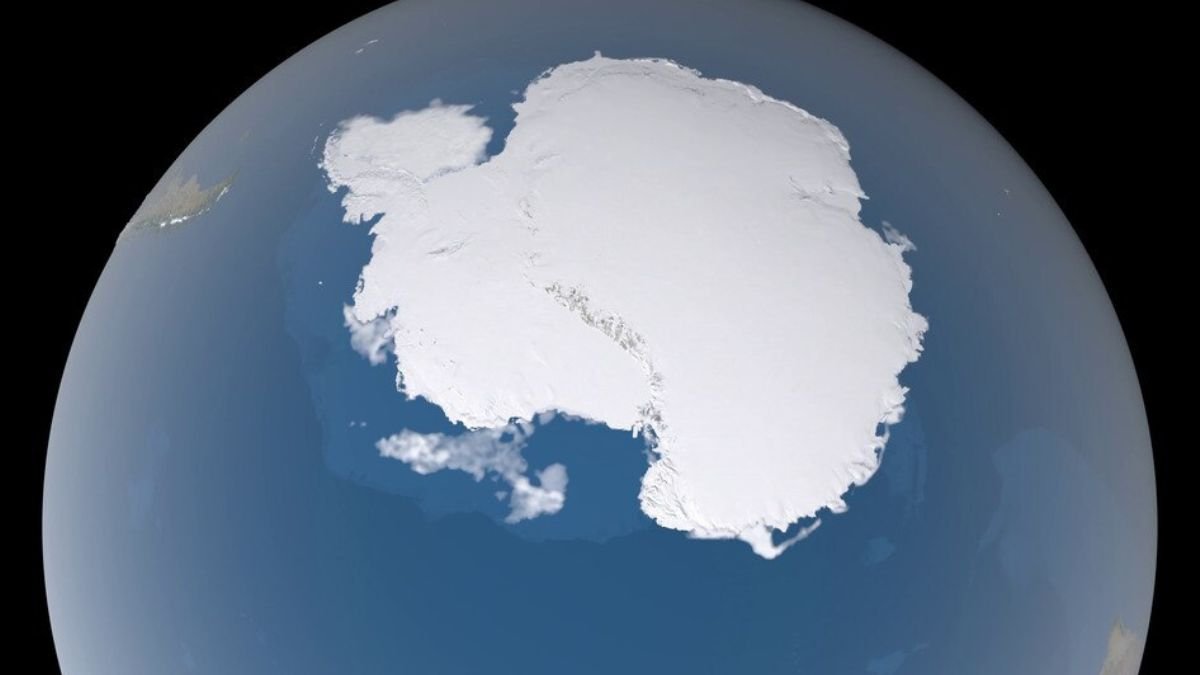
For decades, Antarctica was seen as a huge white block on the map. An ice-covered, isolated and seemingly uniform continent. But the new subglacial map of Antarctica shows that beneath this frozen layer, which can exceed four kilometers in thickness, there is a complex relief, with mountains, deep valleys and extensive subglacial canyons.
What was once just an assumption, now begins to take on more precise contours from the recent research published by Science magazinealso led by glaciologist Robert Bingham, from the University of Edinburgh, Scotland. And this changes the way scientists understand the planet’s past and future.
What is the new subglacial map of Antarctica?
The new map in question is the result of decades of data collection combined into a more detailed model of the terrain hidden beneath the ice.
It reveals the geology of Antarctica even more accurately, showing entire mountain ranges, plateaus, deep depressions and structures that help explain how ice moves today.
It’s not just geographic curiosity. The submerged relief in Antarctica directly influences the behavior of glaciers and, consequently, the level of the oceans.
In an interview with Reuters, the glaciologist highlights the importance of mapping. “Having the most accurate map of the shape of Antarctica’s glacial bed is crucial, because bed shape is an important factor in controlling the friction that acts against ice flow, which we in turn need to include in numerical models used to project how quickly Antarctic ice will flow toward the ocean, melt, and contribute to global sea level rise,” he says.
How did scientists map the region?
Advancement under ice sheets was only possible thanks to the use of remote sensing technologies and, mainly, the so-called Antarctic radar.
The technique works relatively simply: planes and satellites emit radio waves that pass through the ice and reflect when they hit the rock below. By analyzing the signal return time, researchers are able to calculate the thickness of the ice and map the shape of the terrain.
This data was gathered by international polar science teams, who compiled measurements taken over decades of scientific exploration. However, there is still a lot to discover.
“You can get an idea of what’s under the duvet, but it’s not the full story,” says Duncan Young, a glaciologist at the University of Texas at Austin, in an interview with Science.
What does the map reveal about the continent’s history?
The geology of Antarctica also holds clues about the evolution of the continents. The identified structures help to reconstruct ancient tectonic movements, when Antarctica was part of the supercontinent Gondwana.
Buried mountain ranges indicate geological processes that occurred millions of years before ice dominated the landscape. Thus, the new map not only describes the present, but contributes to understanding the planet’s deep past.
Mountains under the ice and canyons deeper than imagined
The map shows that there are entire buried mountain ranges in Antarctica, some comparable in scale to large known mountain systems.
They were also identified subglacial canyons that help direct the flow of ice. In some regions, the terrain forms true natural corridors that accelerate the movement of glacial masses towards the sea.
These discoveries refine what was already known. Previously, the models were more generic. Now, scientists can observe details that make a difference in climate calculations.
Why is relief under the ice so important?
Understanding the subglacial map of Antarctica is essential for predicting how the ice will react to rising temperatures. The solid state of water does not move randomly. It follows the relief.
If the land below is tilted toward the ocean, for example, melting could accelerate. In areas where there are deep depressions, seawater can penetrate beneath the glaciers, further destabilizing the ice sheet.
Therefore, climate change and subglacial relief are directly connected. Climate models that ignore detailed topography risk underestimating or overestimating the impact on sea level.
What are the implications of the new mapping of Antarctica for the future
The detailing of Antarctica’s submerged relief also guides future glacial scientific exploration missions. After all, with more accurate data, researchers can better choose where to drill through the ice, install sensors or study subglacial lakes. Furthermore, oceanographers can assess how the rocky bottom influences the circulation of cold currents around the continent.
“We can now also better identify where Antarctica needs more detailed field surveys and where it doesn’t,” adds Bingham.
Additionally, the new subglacial map helps reduce the margin of scientific uncertainty on the icy continent by showing that beneath the surface lies a complex territory, shaped by geological forces and now influenced by climate change. This places Antarctica as one of the key points for understanding the future of the planet.
