
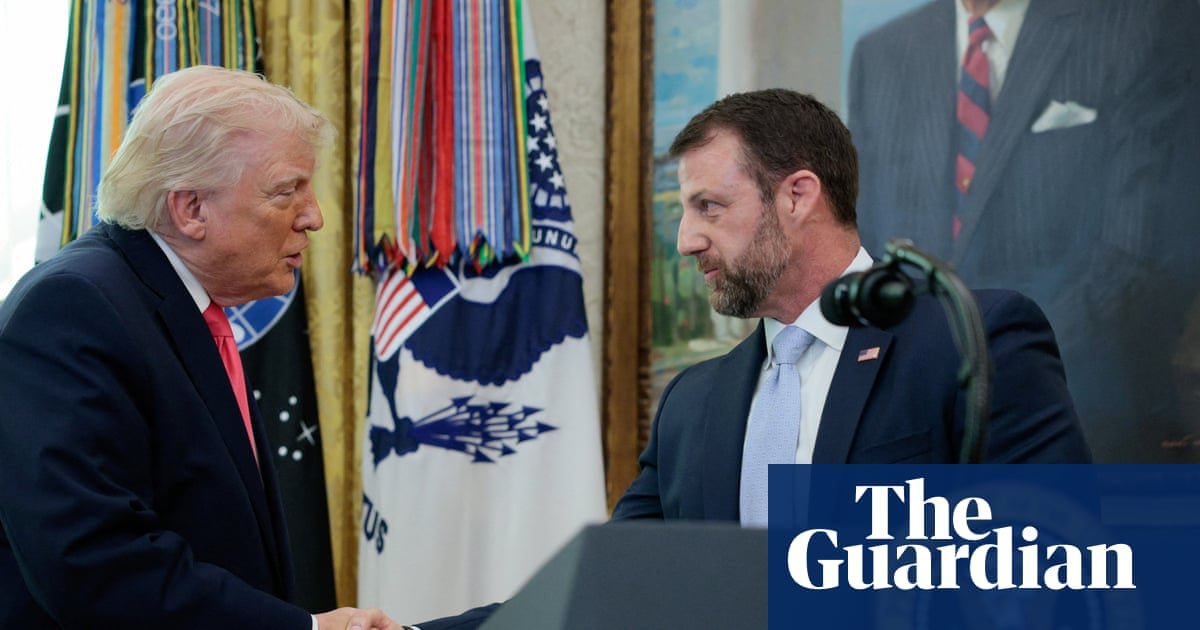
Donald Trump on Tuesday swore in Markwayne Mullin as secretary of the Department of Homeland Security (DHS), while Senate Republicans unveiled a compromise that would restart funding to most of the agency but appears to exclude reforms to immigration enforcement Democrats have demanded.
The two parties have been at an impasse over DHS funding since mid-February, after Democrats insisted any legislation include new guardrails on immigration enforcement after federal agents killed two US citizens in Minneapolis.
The funding lapse has resulted in some airports seeing lines stretch for hours at Transportation Security Administration checkpoints, prompting Trump to deploy agents from Immigration and Customs Enforcement (ICE) on Monday in what he said was an effort to ease congestion.
In brief remarks after being sworn in by the attorney general, Pam Bondi, in an Oval Office ceremony Trump attended, Mullin, a former Republican senator from Oklahoma, recounted meeting with DHS employees who had been working without pay for weeks “because of political politics”.
“I told them, as you’re fighting 365 days, understand I’ll be fighting 365 days beside you,” Mullin said. “No one’s going to outwork me, and I’m not going to let any of them outwork me. The president has entrusted me with this, and failure is not an option.”
At the Capitol, the Republican Senate majority leader, John Thune, said he had sent Democrats “a proposal with legislative text that would allow us to get DHS back and open up again. And it is essentially what the Democrats have been asking for.”
Thune said the compromise would partially fund ICE as well as Customs and Border Protection (CBP), another agency involved in the immigration crackdown, but would not include many of the reforms Democrats demanded in response to the deaths of two US citizens at the hands of federal agents in Minneapolis.
“It became very clear to us that they really weren’t interested in reforms,” Thune said. “If they want to have a conversation about some of the reform ideas that they had put in front of us, then that would be contingent upon actually providing funding for ICE.”
The proposal materialized after a White House meeting late on Monday between Republican senators and Trump, who had insisted that no deal with the Democrats be made until the party supports the Save America act, which would impose a host of new ID mandates on voters registering and casting ballots.
But the president now appears to have backed down from that demand, and told reporters at the White House on Tuesday he would probably support the deal in the Senate.
“I’m going to look at it and we’re going to take a good hard look at it,” he said, then added: “I guess they’re getting fairly close but I think any deal they make, I’m pretty much not happy with it.”
It remains to be seen if the proposal is acceptable to Democrats. The Senate minority leader, Chuck Schumer, said earlier on Tuesday that he was waiting to read the GOP’s offer, while calling the airport security lines “untenable”.
Later in the day, Patty Murray, the top Democrat on the appropriations committee, which crafts spending bills, reiterated the party’s demand that any legislation funding ICE or CBP “must take some key steps to rein them in”.
The party has named among their demands a requirement that immigration agents obtain judicial warrants before entering private property, wear identification, cease wearing masks and adhere to a stronger use of force policy.
“The current Republican offer in front of us does not do that. We have made some progress, and the White House has already agreed to some steps. Bottom line: reforms must make it into law,” Murray said.
She called for the passage of standalone legislation to fund DHS operations separate from immigration enforcement, a prospect that Republicans have rejected.
The shutdown of the DHS has not halted ICE’s operations because Republicans allocated the agency tens of billions of dollars in funding in the One Big Beautiful Bill Act passed last year.
In Oklahoma, the Republican governor, Kevin Stitt, appointed the energy executive Alan Armstrong to take over from Mullin in the Senate. State law bars Armstrong from running for a full term, and voters will elect a new senator to a full term in November.
