
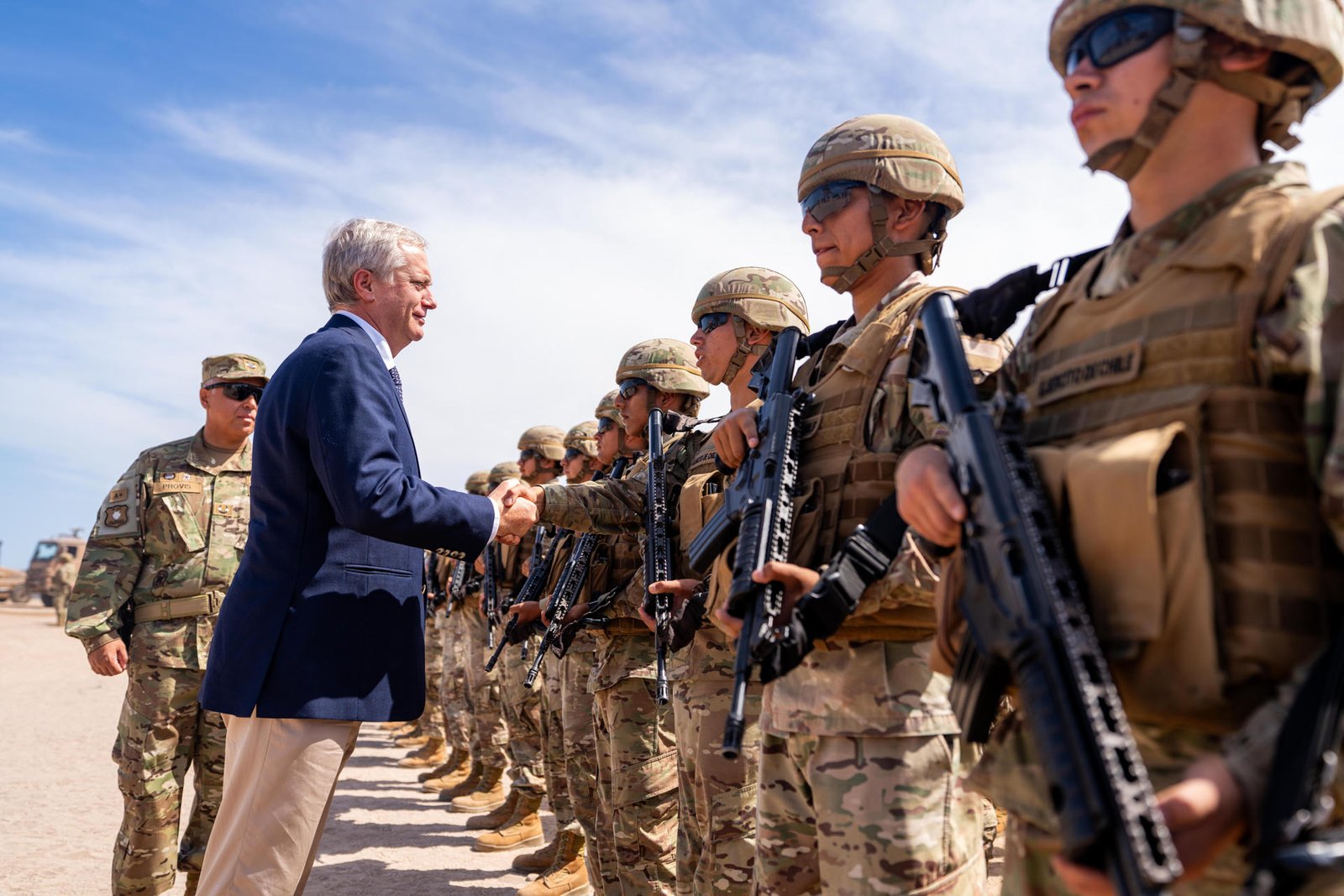
Conservative José Antonio Kast, who assumed the presidency of Chile on the 11th, began his term at an accelerated pace, putting into motion two initiatives that he had promised during the campaign: a wall on the country’s northern border to contain illegal immigration, and a package of economic changes that address his goal of a liberal shock to the Andean nation.
On the 16th, Kast was in Arica, on the border with Peru, for the launch of the Border Shield Plan. The project’s most visible point is a system of 5 meter high security walls and fencesin addition to 3-meter-deep trenches in areas of high migratory flow with the aim of preventing vehicle access and the passage of caravans.
It is not known for sure what the exact length of the wall will be, but the Minister of the Interior, Claudio Alvarado, estimated the “porous” limits on the approximately 1,000 km of Chile’s northern border, with Peru and Bolivia, at 500 km.
Such works will be accompanied by constant patrols by the Armed Forces and the Carabineros (Chile’s national police) in the region, surveillance towers and thermal radars to allow immediate detection of suspicious movements and autonomous drones with facial recognition, infrared and thermal cameras that will operate around the clock.
“The Border Shield is largely based on technology, in order to free up human resources, which are the most scarce,” said retired Army general and current senator Cristián Vial, creator of the plan, in an interview with the newspaper El País.
Kast presents Chile reconstruction project
An enthusiast of the liberal economic policy of the regime of dictator Augusto Pinochet (1973-1990), for whom his brother Michael was a minister and president of the Central Bank, Kast also seeks economic reforms in the country.
This month, his Finance Minister, Jorge Quiroz, presented to the Chilean Congress a set of measures called the National Reconstruction Project.
The proposal includes reducing bureaucracy and licenses, with the aim of unlocking investments, and reduction of the tax rate for medium and large companies from 27% to 23%in line with the averages of the Organization for Economic Cooperation and Development (OECD), of which Chile is a member.
“The objective is that private projects can be resumed even before the full implementation of tax cuts, based on the recovery of confidence and respect for the legal framework”, informed the Ministry of Finance.
The package also provides for a macroeconomic subsidy“without bureaucracy or access barriers”, according to the ministry’s statement, to support employers in paying social security contributions for formal workers.
O The project also includes exemption from Value Added Tax (VAT) about residential properties for 12 months to facilitate access to housing and taxes on the first home for elderly people.
New president wants to cut spending on maintaining social benefits
In addition to these measures, Kast has an ambitious plan to spending cuts that would total US$6 billion per year, without eliminating social benefits.
During the campaign, in a debate on Channel 13, the conservative said that “US$3 billion will come from adjustments in the State and US$3 billion from legislative adjustments”.
In the Executive, Kast detailed that the economy will come from three main axes: fighting corruption, increasing the efficiency of public management and fiscal austerity.
“If we analyze the issue of fraud, we will find almost US$1 billion; if we analyze efficiency, we will find at least another US$1 billion; and if we analyze austerity, we will find another US$1 billion”, he argued.
A report this month from the risk rating agency Fitch highlighted that Chile, governed until the beginning of the month by the leftist Gabriel Boric, presented a structural deficit of 3.6% of GDP at the end of 2025, exceeding the country’s structural balance target for the second year in a row. The fiscal deficit increased to 2.8% of GDP.
“Chilean President José Antonio Kast’s plans to quickly rein in public finances will be complicated by a larger-than-expected budget deficit and soaring oil prices,” Fitch said.
