
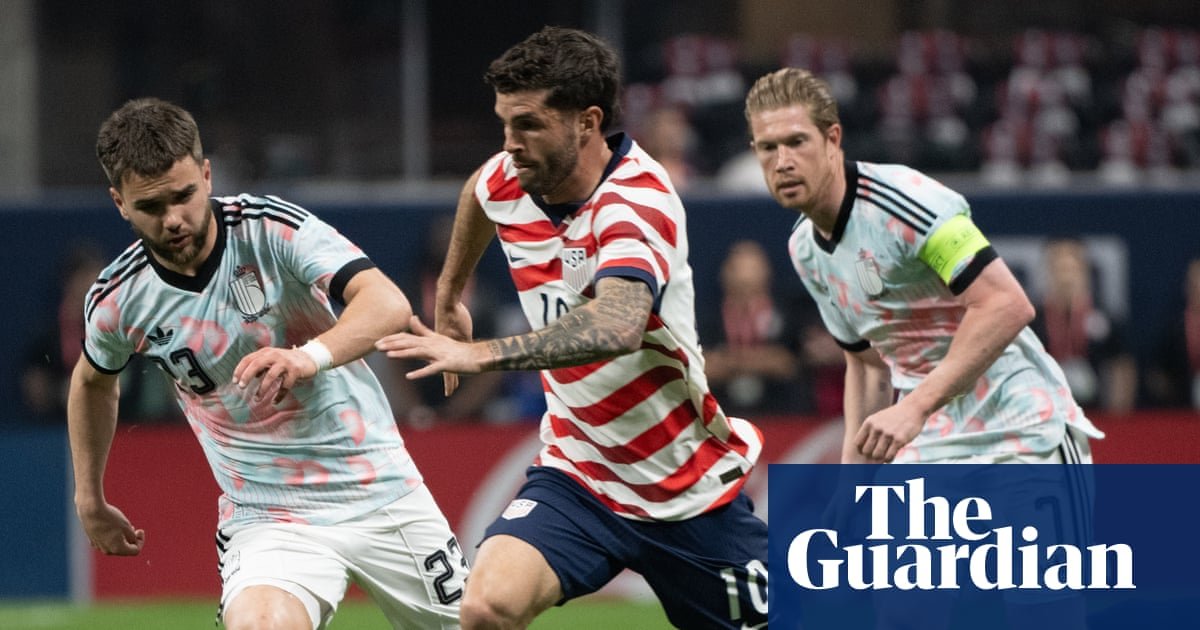
Saturday’s friendly between the US men’s national team and Belgium at Mercedes-Benz Stadium was played indoors, in a climate-controlled environment, on natural grass, even.
Inside the cavernous, 70,000-seat venue, the air was a perfect 72 degrees, as it always is. The stadium’s massive, 8,400-ton HVAC system is designed to cut Atlanta’s stifling summer humidity. On Saturday, they probably could’ve turned the thermostat off entirely: outside, it was a picture-perfect, comfortable spring day.
It made it all the more bizarre, then, when the match referee blew his whistle and directed both teams towards their benches for a mandatory hydration break. While not a completely alien concept in international soccer – these types of breaks are frequently employed when conditions are deemed dangerous to players – they will be mandatory in this summer’s World Cup, regardless of weather conditions or venue.
To better replicate World Cup conditions for both sides, the mandatory breaks were put in place for the US and Belgium on Saturday. Many of the 66,867 in attendance were confused by the unexpected stoppage, and boos rained down when the stadium public address announcer clued them in on what was happening.
On the field, though, it offered a first glimpse into the tactical wrinkles that might emerge from these newfound stoppages. Both head coaches clearly used the break to make adjustments and offer their thoughts to players. On the US sideline, head coach Mauricio Pochettino impassionately addressed his players gathered in a circle around him, not unlike a basketball coach might do during a timeout. Rudi Garcia, his Belgian counterpart, did much the same.
Yet there was no hiding Pochettino’s irritation at the breaks during his post-game remarks.
“To be honest I don’t like [them],” said Pochettino. “I don’t like it because I think you cut the rhythm of the game. I understand when you play in open stadiums, maybe yes, we need to care about the health of the players. But in this type of stadium when it’s 21, 22, 23 degrees [celcius]I think it’s the perfect time and weather to play. But that’s the new rule that we need to accept.”
Garcia’s take could not have been more different. Neither team had scored by the time the first break arrived, but Belgium had fairly clearly wrested control of the game away from the US. Garcia seemed to imply that he did not need to make many adjustments during each of the two breaks.
“I like them,” said Garcia, “because this is an opportunity for us coaches to speak with the team, to speak about strategy and plan … We had a plan tonight tactically, defensively. So we play as we know with our 4-3-3 and it was a good decision. It was very good and interesting to speak with the team during these breaks.”
As for the US players, none of them seems to make much of the breaks at all. US keeper Matt Turner suggested that players – especially those who are subjected to summer heat in leagues like Major League Soccer – are already acclimated to the breaks. Timothy Weah praised the breaks, citing player safety concerns. Weston McKennie took it a step further.
“I had a super dry mouth, honestly,” said McKennie, trailing into laughter. “I was kind of OK with it. I don’t think it’ll affect, so much, anything. Maybe teams will be happy about it because a lot of these teams in Europe won’t be used to playing in heat and you want to keep it level through the whole competition [indoors or out.]”
Christian Pulisic said the hydration breaks didn’t affect anything – but offered another complaint.
“The jerseys were more difficult to deal with.”
About that kit matchup…
The US took the field on Saturday sporting their vibrant, red-and-white-striped World Cup kits, meant to emulate the American flag in motion. Paired with blue shorts and white socks, they looked sharp and undeniably American. They’re also hardly a dark-colored kit. Belgium wore their away strip, a definitively lighter colored getup meant to represent Begium’s “rich artistic heritage.” according to Adidas.
The end result: Confusion for everybody, from fans watching in the stands and on TV, to the players on the field.
“Yes, it was [difficult,]” continued Pulisic. “That’s not an excuse at all, because both teams had to deal with it, but that just can’t happen. Was it hard for you guys? Turning on the field I looked up [and sometimes couldn’t tell them apart.] I didn’t know until we took off the prematch shirts and then I saw it. Everyone was a bit shocked.”
A US Soccer spokesperson clarified the selection process, which began earlier in the week. The US informed the Belgian federation they’d be wearing their stripes, and requested that the Belgians wear their alternate kits. Photos of the matchup were sent to the match commissioner, who approved. The matchup was also approved on gameday by the referees. Only after players began to complain did it become an issue. Neither team had alternate uniforms available, with Belgium having already shipped theirs to Chicago for their next friendly at Soldier Field against Mexico.
“It’s tough,” said Weah. “Some of us have pretty good vision but some of us don’t. Mixing up the jerseys, it’s kind of something where you’re looking up fast and you have to find your teammate as quickly as possible. Not being able to do that at your best was tough tonight.”
McKennie, like every other US player, was quick to clarify that the kit mixup had nothing to do with the end result. He, too, though, said he struggled with it.
“It definitely was a little difficult,” said the Juventus midfielder. “Whenever you do a quick glance to tell which was which it was almost like a 50/50 thing, so you definitely had to take a little more time on the ball before you made a decision or play one-touch to a player.”
