
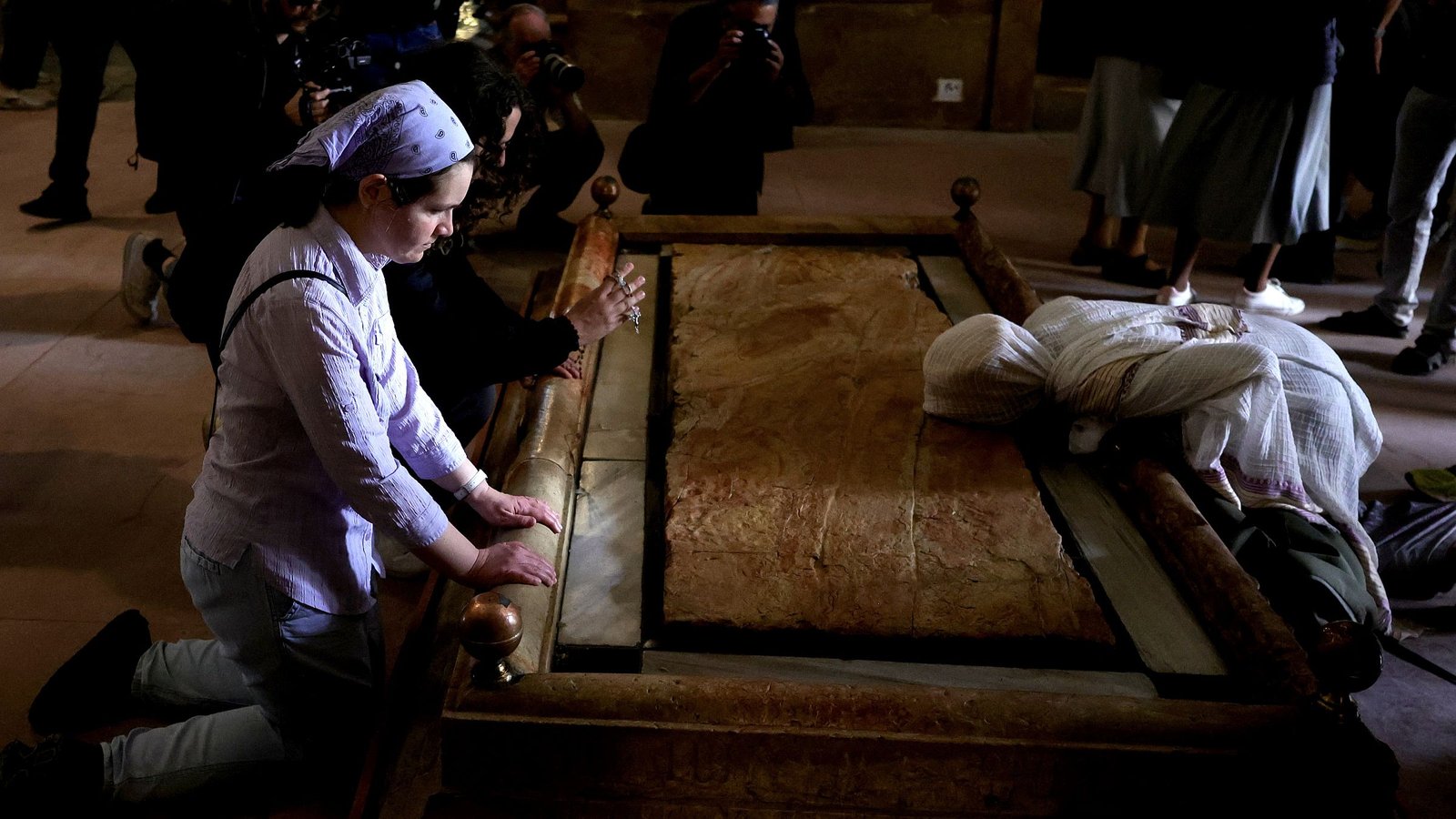
This Sunday (29), the Israeli police prevented Cardinal Pierbattista Pizzaballa and the Custodian of the Holy Land, Francesco Ielpo, from entering the Basilica of the Holy Sepulcher, in Jerusalem, where they were celebrating Palm Sunday Mass – one of the most important dates in the Christian calendar, which marks the beginning of Holy Week.
According to a joint statement from the Latin Patriarchate of Jerusalem and the Custody of the Holy Land, the two religious were stopped by the police as they went to the site “in private and without any characteristics of a procession or ceremonial act”. Unable to continue, they had to return, and the celebration was not held in the sanctuary. Days earlier, the Latin Patriarchate had already canceled the traditional Palm Sunday public procession from the Mount of Olives and prohibited the participation of faithful in public meetings.
The Church classified Israel’s measure as “irrational and seriously disproportionate” and stated that it was an unprecedented episode. According to the statement, it is “the first time in centuries” that Catholic leaders are prevented from celebrating Palm Sunday Mass at the Holy Sepulcher, considered one of the holiest sites in Christianity.
The document also states that the decision represents a “serious departure” from the principles of religious freedom and the so-called “status quo” that regulates access to holy sites in Jerusalem. According to the Patriarchate, the measure ignores the symbolic importance of the date for “billions of people around the world”.
The celebration marks the beginning of Holy Week and remembers, according to Christian tradition, the entry of Jesus Christ into Jerusalem days before the crucifixion.
International repercussion
The episode generated international repercussion. The Brazilian government classified the action as “extremely serious” and stated that the measure violates the principle of freedom of worship and the historical status of sacred sites. In a note, Itamaraty also mentioned recent restrictions imposed by Israel on access for Christian and Muslim believers in East Jerusalem.
European leaders also criticized the decision. The president of the Spanish government, Pedro Sánchez, called the case an “unjustified attack on religious freedom”. The Prime Minister of Italy, Giorgia Meloni, classified the veto as an “affront” to freedom of worship, while the President of France, Emmanuel Macron, warned of the “worrying multiplication” of violations in sacred sites.
The US ambassador to Israel, Mike Huckabee, also criticized the measure, calling it an “unfortunate excess”. According to him, the group of religious people was small and was within the established security limits.
Israel alleges security concerns
Faced with criticism, Prime Minister Benjamin Netanyahu’s government stated that the decision was motivated by security reasons. According to the office, there is a risk of attacks with Iranian ballistic missiles in the region, including in areas close to the Holy Sepulcher.
The Israeli government declared that “there was no malicious intent”, but rather concern for the safety of religious people, and reported that it is working on a plan to allow celebrations in the coming days of Holy Week.
Restrictions on access to the Old City of Jerusalem have been intensified since the start of the current conflict in February. According to Israeli authorities, the region does not have adequate infrastructure, such as bomb shelters, which would increase the risks in the event of attacks.
SEE ALSO:
- Iran claims to have launched a new wave of attacks against the US and Israel in the Middle East
