
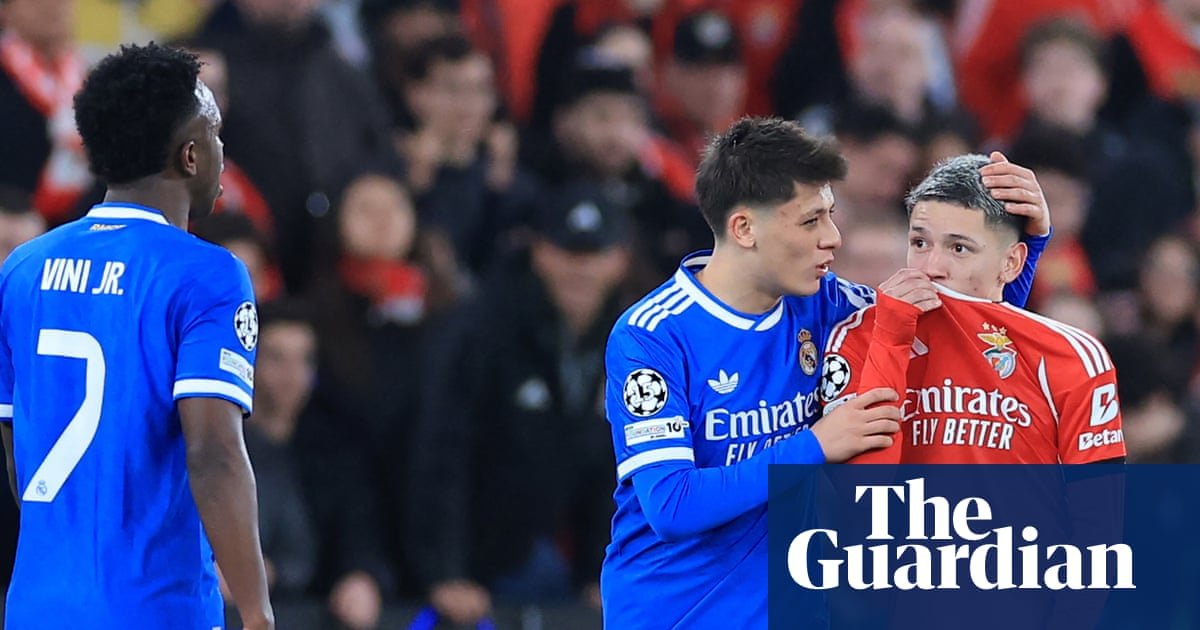
The Fifa president, Gianni Infantino, has suggested players who cover their mouths while addressing opponents could be sent off as part of the governing body’s battle against racism.
The practice, which has long been deployed to prevent cameras picking up conversations between teammates and opposition, has been put in focus after Vinícius Júnior’s allegations of discriminatory abuse by Gianluca Prestianni. The Benfica player denies doing so but was suspended for his side’s Champions League playoff second leg against Vinícius’s Real Madrid pending the outcome of a formal investigation.
After the game, Vinícius posted in Portuguese on Instagram: “Racists are, above all, cowards. They need to put their shirts in their mouths to demonstrate how weak they are.”
The issue was discussed at Saturday’s meeting of the International Football Association Board (Ifab), with Infantino clear that a more interventionist approach is now necessary to punish those who hide their mouths to avoid detection. He said on Sky News: “If a player covers his mouth and says something, and this has a racist consequence, then he has to be sent off, obviously.
“There must be a presumption that he has said something he shouldn’t have said, otherwise he wouldn’t have had to cover his mouth. I simply do not understand – if you don’t have something to hide, you don’t hide your mouth when you say something. That’s it, as simple as that.
“And these are actions that we can take and we have to take in order to be serious about our fight against racism.”
Measures could be agreed and implemented in time for use at this summer’s World Cup, with the Fifa Congress in Vancouver next month the next important staging post.
Infantino, meanwhile, wants to encourage guilty parties to take public responsibility. “Maybe we should also think about not just punishing, but also somehow allowing, changing our culture, allowing players or whoever does something to apologise,” he said.
“You can do things that you don’t want to do in a moment of anger [and] apologise and then the sanction has to be different, to move one step further and maybe we should think about something like that as well.”
