
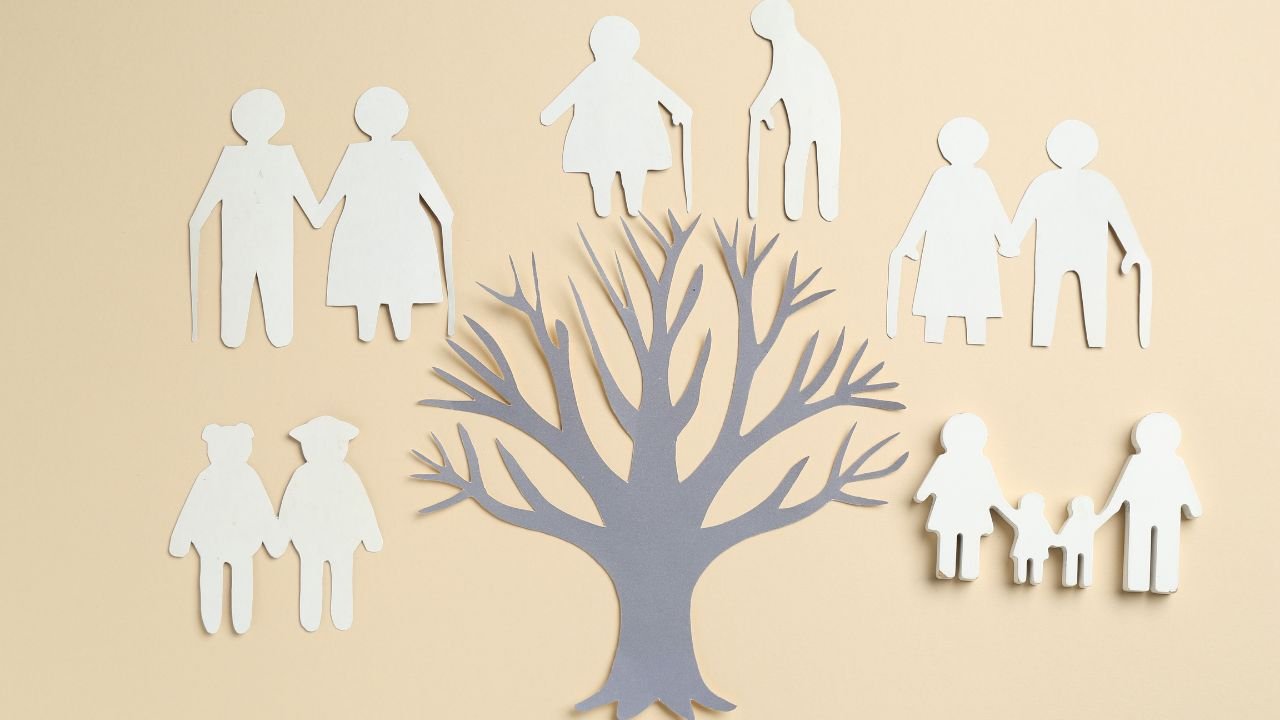
When a child is born, they already come to a family history that existed before them. We all become part of a chain of generations formed by experiences, memories, values and events lived by parents, grandparents and other ancestors. In this way, a large part of our emotional, psychic and social world is built from what we inherited from these previous generations.
French psychologist Anne Ancelin Schützenberger, who studied psychic transmission between generations, described this family connection in a well-known reflection
“For each of us, life is a romance. I and all of us live prisoners of an invisible spider’s web, of which we are also one of the masters of the work.”
This image helps us think about how family stories can remain present over time. From this arise important questions. To what extent can we escape these familiar repetitions? Are we really free to live our own lives or do we often end up returning to paths already taken by our parents and grandparents?
Several lines of psychology seek to understand this transmission between generations. Carl Gustav Jung, for example, observed that psychic life is also influenced by family complexes and by elements that are part of a shared human experience.
More recent research in epigenetics has expanded this discussion by investigating how environmental, emotional and social factors can influence the expression of genes and leave marks that reach subsequent generations.
When family traumas resurface
Clinical psychology often shows that symptoms and anguish are not always explained by individual history alone. In many cases, they are also linked to events experienced by previous generations.
Situations such as wars, violent losses, forced displacement or sudden changes in life tend to leave intense marks on families. These experiences do not always find space to be narrated. Silence often appears as an attempt to protect children or as a way of moving forward after difficult events.
When these experiences are not worked through, they can continue to be present in the family history in indirect ways. Unexpressed grief, secrets and traumatic events can reappear in other generations in the form of emotional suffering or even physical symptoms.
An often cited example involves families marked by the Second World War. People who went through concentration camps or experienced extreme situations often kept these memories to themselves as a form of psychic survival. In some cases, children and grandchildren begin to present manifestations that seem linked to these experiences that were never fully narrated.
Recurrent nightmares, persistent anguish or physical illnesses may thus appear as expressions of events that remained unelaborated within the family history.
Understanding inheritance to move forward
Throughout our lives, we all inherit from our ancestors a language, a culture and a set of experiences that participate in the formation of identity. This heritage helps explain who we are and where we come from.
The writer Hermann Hesse reflected on this human condition in a well-known passage from his “Letter to a Young Artist”
“The thing that counts most is the fact that each of us is the custodian of an inheritance and is the bearer of a mission.”
Recognizing this heritage does not mean remaining stuck with it. Psychotherapeutic work can help bring to light family stories that have been stored for a long time and allow them to be understood from another perspective.
By getting in touch with these experiences, many people are able to work through old conflicts, reduce the weight of certain repetitions and make room for more conscious choices. Knowing your own family history can, therefore, be an important step towards understanding the present and building new paths.
Dr. Dorli Kamkhagi – CRP 15511
Psychology
Head Nacional Brazil Health
