
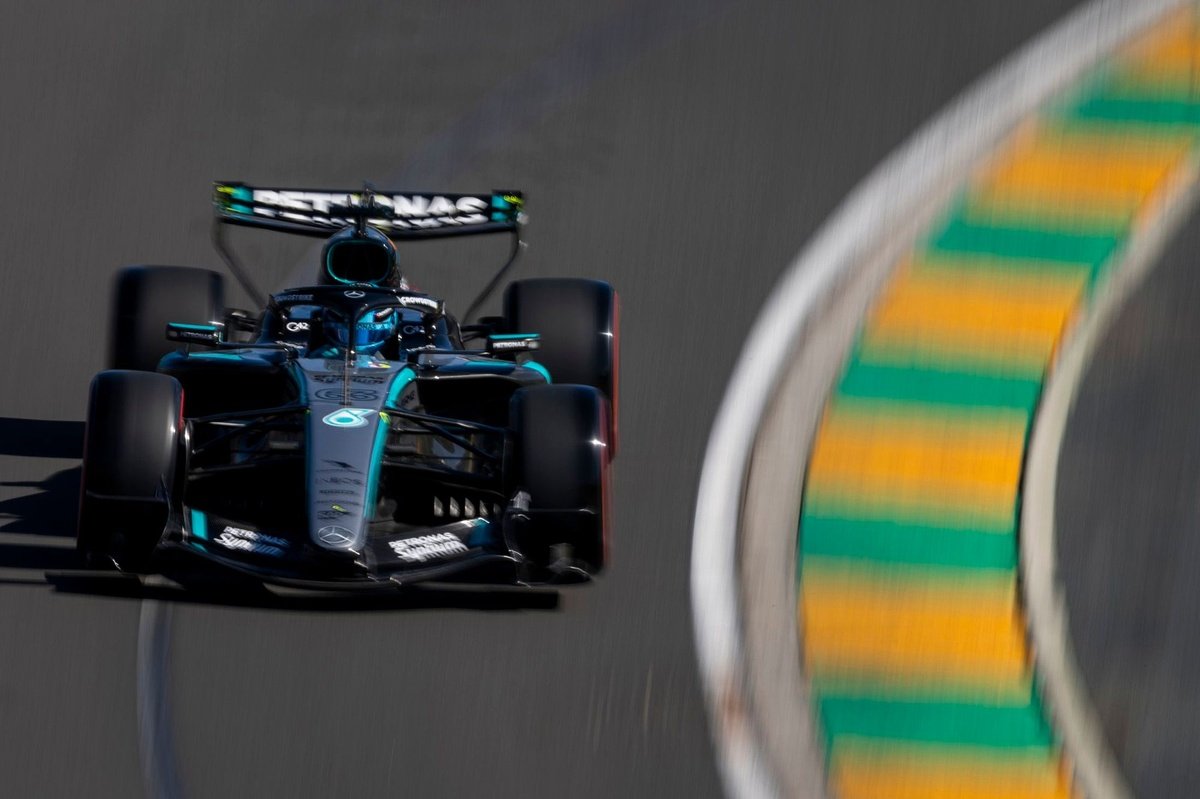
“I think yesterday, I said [the gap to Mercedes was] half a second, now it’s eight tenths, so it’s bigger than what I expected for sure,” said Charles Leclerc with a rueful sigh after placing his Ferrari fourth for the Australian Grand Prix.
“It was a very significant gap yesterday already, so… I was very, very impressed this morning with the FP3, the power that they’ve shown was just crazy in the last lap of George.
“I looked at the data for the first time and I had to re-upload it because I thought there was a problem on the things I was seeing, but apparently not, so it’s very, very impressive.”
Indeed, FP3 had provided an eerie premonition of what was to come in qualifying: as the cars emerged from the pitlane with four minutes left on the clock, following Kimi Antonelli’s messy appointment with the wall at Turn 2, the Ferraris of Lewis Hamilton and Leclerc sat atop the timesheets. Then, over the course of one sizzling flyer, George Russell finally showed the pace Mercedes had been artfully concealing during pre-season testing, posting a 1m19.053s – 0.616s up on Hamilton, who rounded out the session in second place.
The new technical formula’s focus on energy management has made it much more challenging to decipher a car’s absolute pace, and by extension rendered the process of ‘sandbagging’ easier to conceal. No longer is an optimum lap a function of braking at the latest possible point and then cornering at the absolute limit of grip, particularly in the faster corners.
Drivers now roll into bends with the rear axle harvesting power, perhaps braking later than before but with less pedal pressure for the most part because the ERS is doing so much more heavy lifting. Keeping the battery topped up is the priority, especially at an energy poor circuit such as Albert Park, where all that juice is required for the many straights.
George Russell, Mercedes
Photo by: Mark Sutton / Formula 1 via Getty Images
Since the data Autosport can access lacks details on the state of charge, comparing individual laps comes with caveats. Deployment and harvesting strategies vary between teams and power unit suppliers, even between teams using the same power units. The relative pace of Mercedes and its customers shows that, while PU performance is important in the new formula, so too is aerodynamic efficiency: a draggy car is an energy-poor car.
It is, as McLaren team principal Andrea Stella said after qualifying, “A new language and a new way of thinking.”
It’s likely the cooler ambient temperatures in qualifying, held at 4pm local time, played in Mercedes’ favour as others found fewer gains. Initially, it was Antonelli who held the upper hand in Q3 in his rapidly rebuilt W17, shrugging off a mistake at Turn 1 on his first flying lap to go top with a 1m18.811s.
Russell’s riposte was a 1m19.084s – slower than his Q2 laps – before he put in the mighty 1m18.518s that secured pole position. Just two tenths then separated third-placed Isack Hadjar’s Red Bull from Hamilton in seventh, but it’s the gap between the fastest Mercedes and the next-fastest car that most bears examination: 0.785s.
Russell doesn’t use top gear through sector one
Comparing such data as we have gives a fascinating insight into the different strategies being employed at any given time. The need to preserve energy means drivers are no longer flat out from the final corner on the lap preceding their push lap.
While Hadjar hooks eighth gear shortly after crossing the line to start his lap, Russell stays in seventh and lifts-and coasts before hitting the brakes into Turn 1; Hadjar is later off the throttle an earlier on the brakes. Having been 7km/h faster on the straight, Hadjar is briefly a tenth up shortly before the apex of the corner as their speeds converge and overlap as Russell carries more pace through the short chute to Turn 2.
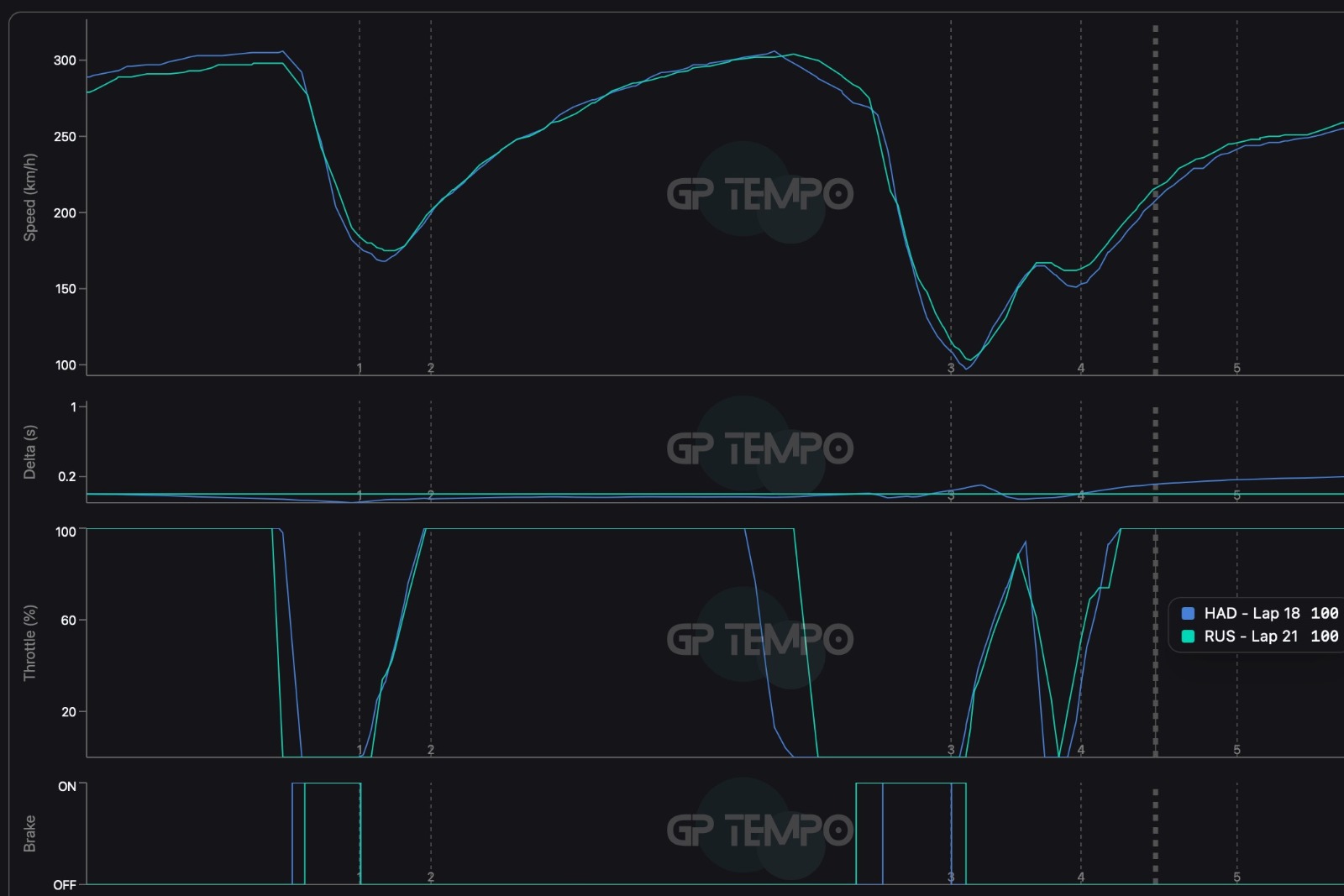
They pick up the throttle at broadly the same point at the exit but once again, while Hadjar goes up through the gears from fourth to eighth, Russell goes no higher than seventh. Both drivers do a pronounced lift-and-coast into Turn 3 but this time it’s Russell who is later off the throttle and earlier on the brake. Despite being longer on the brakes, though, he retains a small speed advantage – 10-15km/h – until just after the apex.
Russell is then able to take Turn 4 with a much briefer feather on the throttle, enabling him to be 10km/h quicker in the acceleration phase out of the corner, which opens the gap to two tenths on the run to Turn 6.
Combined harvesting in sector two
At Turn 6 both drivers come off the throttle at the same time, but Russell is earlier and longer on the brake. Despite this – and Hadjar being earlier off the brakes and on the throttle, Russell carries 15km/h more into the apex of Turn 6 and their speeds don’t converge until the approach to the more open Turn 7. By now Russell is 0.331s up.
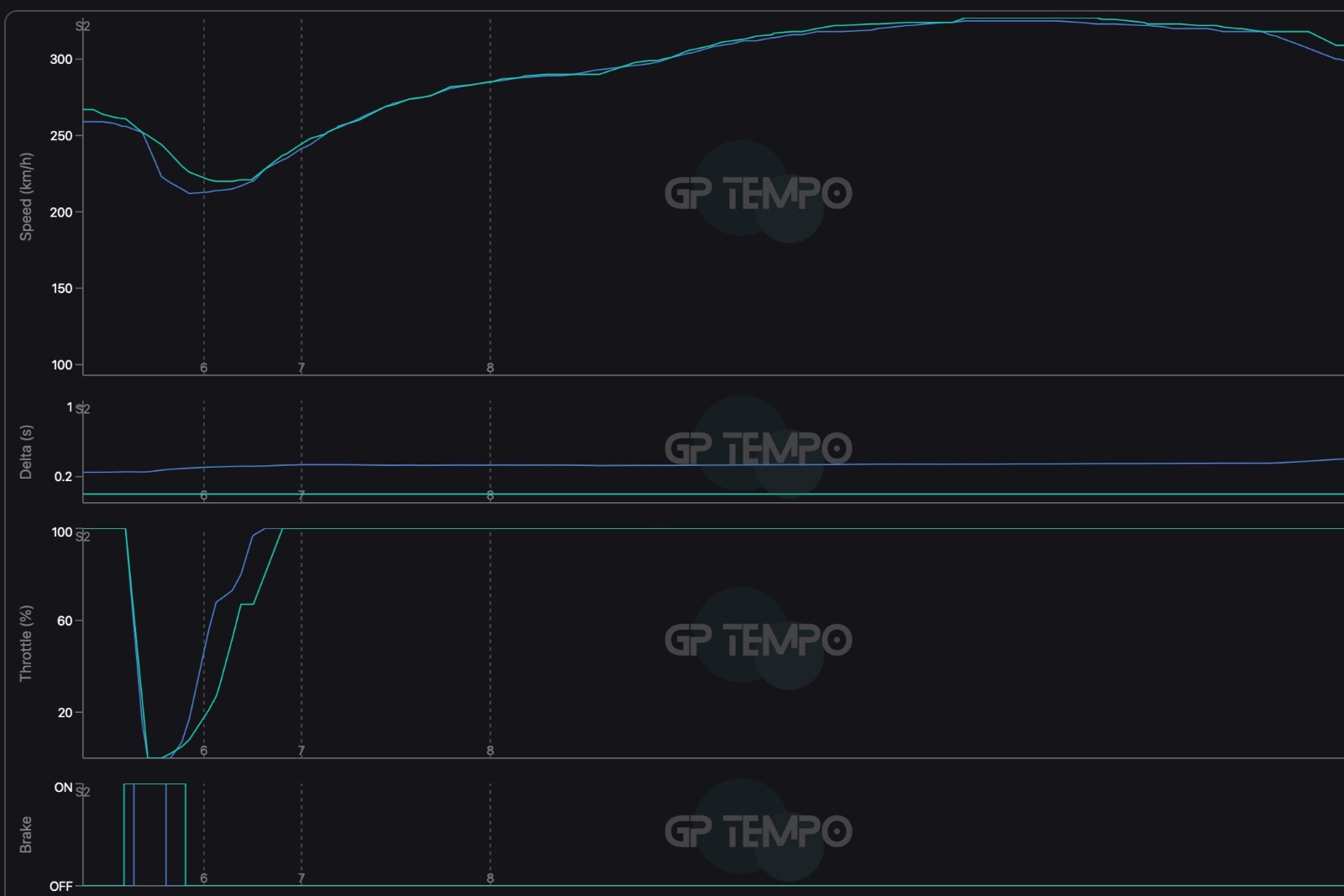
Russell is long past the apex of Turn 8 before he engages top gear for the first time in the lap, though a disparity of 300rpm between the two cars suggests the Mercedes is running a slightly taller eighth gear. What happens on the run to Turn 9 is particularly interesting: Hadjar’s speed and revs ramp down progressively towards the end of this gently curving straight while Russell’s drops later and more abruptly, enabling him to maintain a respectable top speed for longer.
What this strongly suggests is that Russell has been able to harvest more energy through sector one while still being quicker through the crucial Turns 4 and 6.
Different approaches through Turn 9
One of the most intriguing aspects of this weekend has been the variety of approaches into Turn 9 and that’s perfectly illustrated by Russell and Hadjar. The Mercedes super clips, indicated by Russell downshifting to seventh while remaining flat on the throttle; he then lifts off and rolls through the corner, letting the recovery system handle the braking effort. Hadjar releases the throttle at the same time but also taps the brakes, only then downshifting to sixth after the apex and hitting the accelerator earlier than Russell.
Overall, though, the Mercedes has carried 15km/h more speed through the corner and is extending the gap to 0.7s and beyond. That Hadjar then upshifts to eighth while Russell goes no higher than seventh, while still being around 5km/h faster, is again indicative of the Mercedes having more electrical power to deploy on the straight between Turns 10 and 11.
At the sharp right-hander of Turn 11 both drivers release the throttle at the same point, though Hadjar is slightly later to come off it fully, while Russell brakes for longer and waits until after the apex to get back fully on the power.
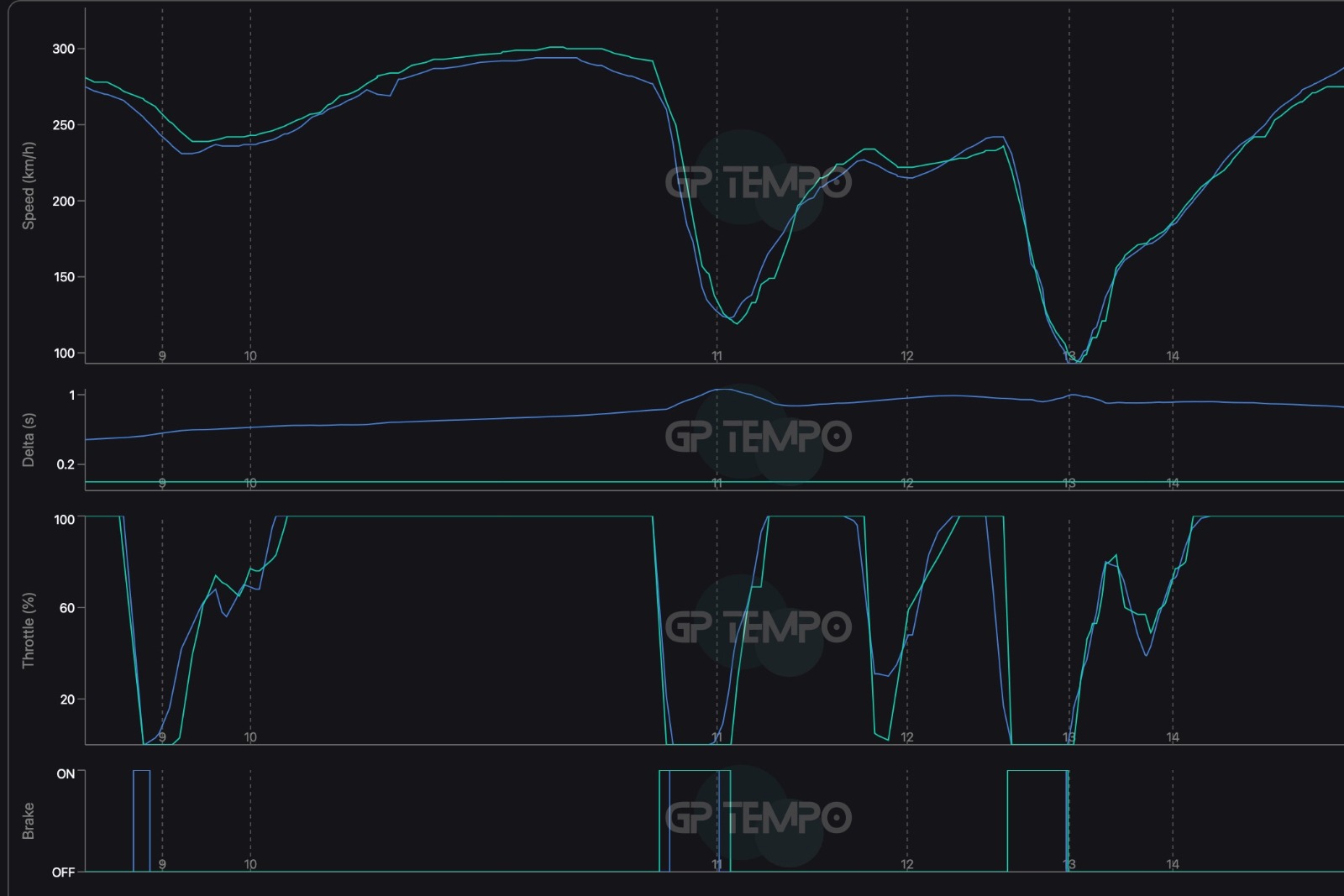
The Mercedes had been a second ahead of the Red Bull at this point, but Hadjar’s earlier throttle application enables him to claw back a little bit of laptime before Russell matches him for speed, the steep climb in the trace suggesting a judicious punch of electrical power.
On the approach to Turn 12, Russell scrubs off the necessary speed by lifting off fully, while Hadjar feathers the throttle at 30% – but, again, the Mercedes remains in the region of 6km/h faster through this area, taking the gap to almost a full second again.
Hadjar is briefly 9km/h quicker between Turns 12 and 13, courtesy of electrical deployment, but by this point the lap is long since lost. The Red Bull punches slightly harder out of Turns 13 and 14 and is 10km/h faster on the run to the line, reducing the deficit to 0.785s as again Hadjar pulls top gear while Russell peaks at seventh.
“It wasn’t easy conditions out there today, it was quite windy, quite gusty, but I’m enjoying that,” he said later.
“It feels more like a go-kart compared to last year. It [the ground-effect car] felt like a bouncing bus, to be honest. It wasn’t as fun to drive.
“So, I think there are lots of mixed views on the new regs as a whole, but I do think the car regulations for everyone are definitely a step forward compared to what we’ve had for the past, what, eight years now.”
That outlook on the new regulations stands in stark contrast to those expressed by several of Russell’s rivals, but it’s easy to be positive when you’re sitting on an advantage of eight tenths to the next-fastest car. What’s clear for the moment is that Mercedes has the most mature understanding of how to get the most out of its power unit, combined with a car which is quick enough through corners to minimise the potential downsides associated with the need to harvest energy.
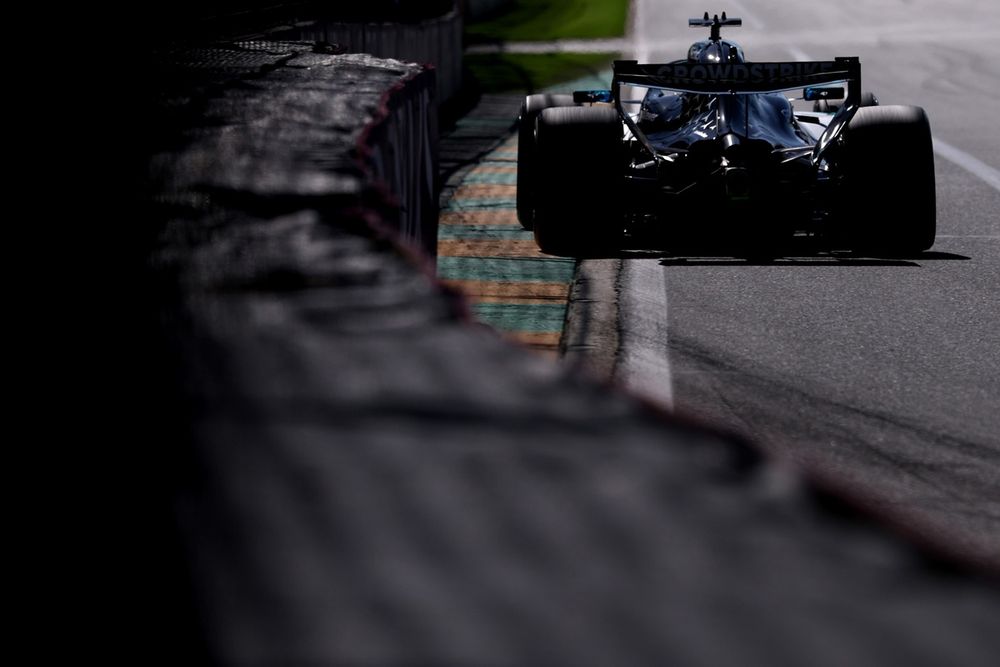
George Russell, Mercedes
Photo by: Lars Baron / Getty Images
Among those observing Mercedes most closely are its customers.
“As you can imagine, this was one of the key points in our post-qualifying debrief,” said McLaren team principal Stella.
“Trying to understand how can you exploit these power units to the best of their potential, because, as we can see, this moves quite a lot of lap time.
“In itself, let me say, it’s partly good news, because it means that there’s a lot of lap time available, if you kind of give the right input from a driving point of view, and you do the right exploitation from a control systems point of view and programming. So there’s a lot of lap time available.
“We discussed what might have been different with what we have seen on Russell’s lap. I think we have a good understanding.
“Somehow it took a qualifying, it took to be all in the same condition, on track, same power unit, to actually have enough of a reference to understand what is possible…”
We want to hear from you!
Let us know what you would like to see from us in the future.
– The Autosport.com Team
